 AP Chemistry Tutoring
2.1 Types of chemical bonds
AP Chemistry Unit 2: Compound Structure and Properties · 4 simulations · 17 practice questions
Updated · Aligned to the AP Chemistry Course and Exam Description
Chemical bonds are classified by how valence electrons are shared or transferred. Atoms with similar electronegativity share electrons in nonpolar covalent bonds; a moderate electronegativity difference gives polar covalent bonds with partial charges and ; a metal and a nonmetal with a large difference form ionic bonds; and metal atoms bond through a sea of delocalized electrons (metallic bonding).
What a bond is
A bond makes atoms act as one unit.
Two H atoms and one O atom in a box aren't water. Bonded together, they are: liquid at room temperature, freezes at 0 °C, dissolves salt.
Reactions break and make bonds.
Freezing water is not a reaction: stays . Hydrogen burning in oxygen is: H–H and O=O bonds break, O–H bonds form.
Three kinds of bond. The elements tell you which.
An electron is transferred. Big electronegativity difference.
NaCl, MgOElectrons are shared, equally (nonpolar) or unequally (polar).
, ,Cations in a sea of shared, free-moving electrons.
Cu, Fe, brassRises across a period, falls down a group. F is the highest.
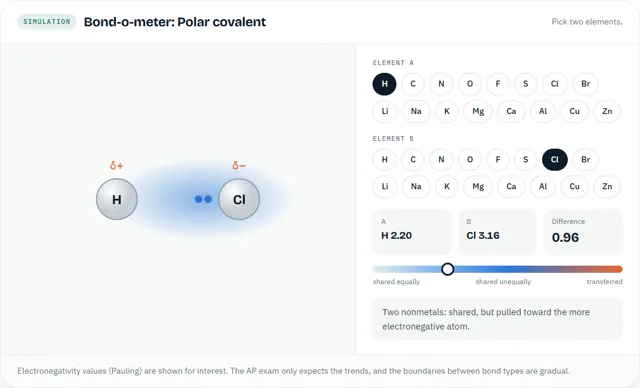
no numbers to memorizeBond-o-meter:
?A binary compound has ionic bonding. Which is most likely true: both elements are metals, the atomic masses are small, electrons are shared equally, or the electronegativity difference is large?Think, then tap to check
The electronegativity difference is large. Ionic bonds form between a metal and a nonmetal; equal sharing is nonpolar covalent, and two metals are metallic.
Ionic bonds & solids
Transfer, then attraction.
Na gives its one valence electron to Cl. Now and have opposite charges, and opposite charges attract. That attraction is the ionic bond.
The crystal lattice explains every property.
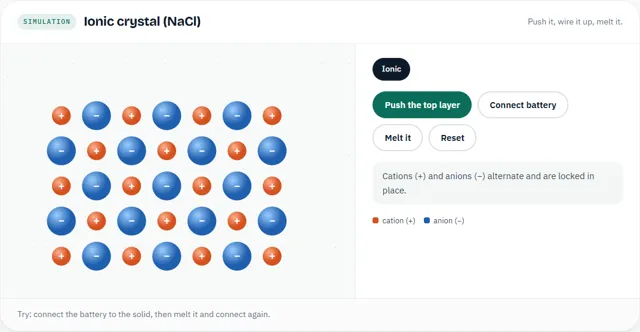
Cations and anions alternate in a fixed, ordered lattice. Each ion is held by all its neighbours.
Every ion is bonded to its neighbours, so the lattice resists being squeezed.
Like charges line up, repel, and the crystal cracks.
Lots of energy is needed to pull the ions apart.
Solid: no free charges. Liquid or aqueous: ions move.
Ionic crystal
How strong? Coulomb's law.
Bigger charges attract more. Smaller ions sit closer, and closer attracts much more.
Stronger attraction → higher melting point, more rigid.
Which lattice holds tighter?
Bar length = from ionic radii. Click a row.
Why does MgO melt at 2852 °C but NaCl at only 801 °C?
- Charges: is . is .
- Size: is smaller than (more protons, same shell). is smaller than (one fewer shell). So is smaller in MgO.
- Bigger and smaller : the attraction in MgO is several times stronger.
- Stronger ionic bonds need more energy to break → higher melting point.
?Does molten NaCl conduct electricity? Why?Think, then tap to check
Yes. Melting frees the and ions to move, and moving ions carry charge. In the solid they're locked in the lattice, so it doesn't conduct.
Covalent bonds
Sharing, equally or not.
In Cl–Cl the twins pull equally: nonpolar. In , oxygen pulls much harder, so the shared electrons spend more time near O: polar.
The O end gets a partial negative charge (), the H ends partial positive ().
Potential energy & bond length
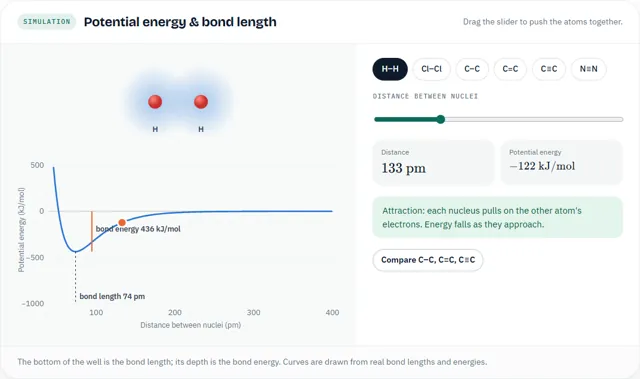
More shared electrons: shorter and stronger.
A single bond shares 2 electrons, a double 4, a triple 6. More overlap pulls the nuclei closer and holds them tighter.
| C–C single · 2 | 154 pm | 347 kJ/mol |
| C=C double · 4 | 134 pm | 614 kJ/mol |
| C≡C triple · 6 | 120 pm | 839 kJ/mol |
Length ↓ and strength ↑ as bond order rises.
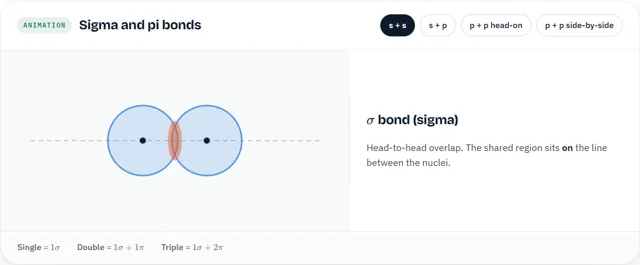
Sigma and pi bonds
?How many and bonds are in HCN (H–C≡N)?Think, then tap to check
H–C is single (). C≡N is triple (). Total: and .
Study notes
Key concepts
What a chemical bond is. A chemical bond is a strong attraction that holds atoms or ions together. Every bond is electrostatic at heart: positive nuclei attract negative electrons. Forming a bond releases energy because the bonded arrangement has lower potential energy than the separated atoms. Breaking a bond always requires energy. A very common misconception is that "breaking bonds releases energy". It never does.
Three bond types.
| Bond type | Usually forms between | What happens to the valence electrons | Typical example |
|---|---|---|---|
| Ionic | a metal and a nonmetal | transferred from metal to nonmetal, giving cations and anions that attract each other | NaCl, MgO |
| Covalent | two nonmetals | shared between two nuclei in a localized bond | H₂O, CH₄, Cl₂ |
| Metallic | metal atoms with each other | delocalized over the whole solid; not owned by any one atom | Cu, Fe, Al |
Electronegativity (EN). Electronegativity is the ability of an atom in a bond to attract the shared electrons toward itself (SAP-3.A.1). The Pauling scale runs from about 0.7 (Cs, Fr) to 3.98 (F).
-
EN increases from left to right across a period. Moving right, the number of protons increases but the added electrons go into the same shell, so shielding barely changes. The effective nuclear charge felt by the valence electrons increases and the atom gets smaller, so by Coulomb's law the nucleus attracts bonding electrons more strongly.
-
EN decreases down a group. Each new period adds a shell, so the valence electrons are farther from the nucleus and better shielded by inner electrons. The attraction to bonding electrons is weaker.
-
The noble gases are usually left without EN values because they rarely form bonds.
Useful Pauling values to know approximately:
| Element | H | C | N | O | F | Cl | Br | I | S | P | Na | Mg | Al |
|---|---|---|---|---|---|---|---|---|---|---|---|---|---|
| EN | 2.20 | 2.55 | 3.04 | 3.44 | 3.98 | 3.16 | 2.96 | 2.66 | 2.58 | 2.19 | 0.93 | 1.31 | 1.61 |
Nonpolar covalent bonds (SAP-3.A.2). When two atoms with equal or very similar EN share electrons, the sharing is essentially equal. Bonds between identical atoms (H–H, Cl–Cl, C–C) are nonpolar. The C–H bond is treated as effectively nonpolar even though C (2.55) is slightly more electronegative than H (2.20), a difference of only 0.35. This is why hydrocarbons such as CH₄ and C₈H₁₈ are described as nonpolar.
Polar covalent bonds (SAP-3.A.3). When the two atoms have different EN, the shared electrons spend more time near the more electronegative atom.
-
The more electronegative atom gets a partial negative charge (δ⁻); the other atom gets a partial positive charge (δ⁺). In H–Cl, Cl is δ⁻ and H is δ⁺.
-
For single bonds, a larger EN difference gives a larger bond dipole. H–F (ΔEN = 1.78) is more polar than H–Cl (0.96), which is more polar than H–Br (0.76) and H–I (0.46).
-
A bond dipole is drawn as an arrow pointing toward the δ⁻ end, with a small cross on the δ⁺ end.
Ionic character is a continuum (SAP-3.A.3c). There is no sharp line between "polar covalent" and "ionic". Every polar bond has some ionic character, and even NaCl has a little covalent character. Many class notes use the rule of thumb below. Use it only as a first guess.
| ΔEN (rule of thumb) | Usual label |
|---|---|
| less than about 0.4 | nonpolar covalent |
| about 0.4 to 1.7 | polar covalent |
| more than about 1.7 | mostly ionic |
EN difference is not the only test (SAP-3.A.4). The CED says that, in general, metal + nonmetal bonds are ionic and nonmetal + nonmetal bonds are covalent, and that the best way to classify bonding is to look at the properties of the compound. Two examples show why the ΔEN rule fails:
-
HF has ΔEN = 1.78, above 1.7, but HF is a molecular substance. It is a gas at room temperature (boiling point about 20 °C) and pure liquid HF is a very poor electrical conductor. Its bonding is polar covalent.
-
AlCl₃ is metal + nonmetal with ΔEN = 1.55. Its low sublimation temperature (about 180 °C) shows it behaves more like a molecular substance than a typical ionic solid.
So in an AP answer, justify a bond type with evidence: what kinds of elements are present and how the substance behaves (melting point, conductivity as a solid, liquid and in solution, hardness, brittleness).
| Property | Ionic solid | Molecular (covalent) substance | Metal |
|---|---|---|---|
| Melting point | high | low to moderate | low to very high |
| Conducts as solid? | no (ions fixed) | no | yes |
| Conducts when molten? | yes (ions mobile) | no | yes |
| Conducts in water? | yes if it dissolves | usually no (acids are an exception) | does not dissolve |
| Mechanical | hard, brittle | soft | malleable, ductile |
Metallic bonding (SAP-3.A.5). In a metallic solid the valence electrons are delocalized: they are not associated with any one atom and can move through the whole sample. This "sea of electrons" explains electrical and thermal conductivity in the solid. It is covered in more depth in Topic 2.4.
Compounds with both kinds of bond. A compound containing a polyatomic ion, such as Na₂SO₄ or NH₄Cl, has ionic bonding between the ions and covalent bonding inside the polyatomic ion (S–O bonds inside SO₄²⁻; N–H bonds inside NH₄⁺).
Common misconceptions.
-
"Ionic compounds are made of molecules." They are not. NaCl(s) is an extended lattice; the formula gives the ion ratio only.
-
"A polar bond means a polar molecule." Not always. CO₂ has two polar C=O bonds but is nonpolar because of its linear shape (Topic 2.7).
-
"Fluorine is the most electronegative so F–F is polar." No. Identical atoms always give a nonpolar bond.
Worked examples
Worked example 2.1-A. Ranking bond polarity. Rank these bonds from least polar to most polar and identify the δ⁻ atom in each: C–H, O–H, C–O, N–H, C–F.
Step 1. Find ΔEN for each bond with the table above.
| Bond | ΔEN | δ⁻ atom |
|---|---|---|
| C–H | 2.55 − 2.20 = 0.35 | C |
| N–H | 3.04 − 2.20 = 0.84 | N |
| C–O | 3.44 − 2.55 = 0.89 | O |
| O–H | 3.44 − 2.20 = 1.24 | O |
| C–F | 3.98 − 2.55 = 1.43 | F |
Step 2. Rank: C–H < N–H < C–O < O–H < C–F.
On the exam you are not given EN values, so you should be able to reach the same order from periodic trends: F > O > N > C > H, and atoms that are farther apart in EN form more polar bonds.
Worked example 2.1-B. Classifying bonding from properties. Three white solids, X, Y and Z, are tested.
| Solid | Melting point | Conducts as solid | Conducts when molten | Conducts in water |
|---|---|---|---|---|
| X | 801 °C | no | yes | yes |
| Y | 186 °C | no | no | no |
| Z | about 1700 °C | no | no | insoluble |
X has a high melting point and conducts only when its ions are free to move (molten or dissolved), so it is ionic. Y melts at a low temperature and never conducts, so it is a molecular (covalent) substance with weak forces between molecules. Z has a very high melting point and never conducts; it is a covalent network solid (like SiO₂), in which every atom is held by covalent bonds (covered fully in Unit 3).
Unit 2 study guide: exam-style free-response set, worksheet and answers.
Worked example
- Electronegativity increases across period 2 (more protons pulling on the same shell): C < N < O, and all three are more electronegative than H.
- The largest electronegativity difference with H is for O, so is the most polar.
- The more electronegative atom, O, carries .
- Answer: is the most polar; oxygen is .
Free-response practice
Write your answer first, then open the solution and mark yourself against it.
FRQ 2.1-1. Answer the following about the bonds in HCl, NaCl and Cl₂.
(a) Identify the bond in each substance as nonpolar covalent, polar covalent or ionic.
(b) In HCl, which atom carries a partial negative charge? Explain in terms of atomic structure.
(c) A student says, "Cl₂ must be polar because chlorine is very electronegative." Explain the error.
(d) NaCl(s) does not conduct electricity, but NaCl(l) does. Explain at the particle level.
Show the solution
(a) Cl₂: nonpolar covalent (identical atoms). HCl: polar covalent (two nonmetals of different EN). NaCl: ionic (metal + nonmetal, and NaCl is a high-melting solid that conducts when molten). 1 point for all three.
(b) Cl is δ⁻. Cl has a greater nuclear charge than H, and although its valence electrons are in the third shell, the high effective nuclear charge (17 protons, shielded by only 10 core electrons) attracts the shared pair more strongly than the single proton of H does. 1 point.
(c) Polarity requires a difference in EN. Both atoms in Cl₂ have the same EN, so the shared electrons are pulled equally and there is no dipole. 1 point.
(d) In NaCl(s) the ions are locked in fixed positions in the lattice and cannot move to carry charge. In NaCl(l) the lattice has broken down and Na⁺ and Cl⁻ ions are free to move toward the electrodes, so charge flows. 1 point.
FRQ 2.1-2. A sample of an unknown solid has the following properties: it is shiny, bends without breaking, melts at 1085 °C and conducts electricity both as a solid and as a liquid.
(a) Identify the type of bonding in the solid.
(b) Explain why it conducts as a solid, using a particle-level model.
(c) Explain why an ionic solid with a similar melting point would not conduct as a solid.
Show the solution
(a) Metallic bonding (the data match copper). 1 point.
(b) The solid is a lattice of metal cations surrounded by delocalized valence electrons. The delocalized electrons are free to move through the lattice when a voltage is applied, so the solid carries current. 1 point.
(c) In an ionic solid the charges are carried by ions that are held in fixed lattice positions, and the electrons are localized on the ions. No charged particles can move, so the solid does not conduct. 1 point.
Common mistake
Students treat ionic and covalent as strict categories based only on metal versus nonmetal. Polarity depends on the electronegativity difference, so bonds range continuously from nonpolar to highly polar to ionic.
Frequently asked questions
?What is the difference between a polar and a nonpolar covalent bond?
In a nonpolar bond electrons are shared equally because the atoms have the same or nearly the same electronegativity; in a polar bond they are shared unequally, creating partial charges.
?Do I need to memorize electronegativity values for AP Chemistry?
No. You should know the trend (increasing up a group and across a period, fluorine highest) and use it to compare bonds.
Practice questions on 2.1
- Q1Which claim about a binary compound in which the bonding is ionic is most likely to be valid?
- Q2A binary compound is made of two elements with the same electronegativity. Its bonding is most likely
- Q3A molecule contains a carbon–carbon double bond and a carbon–carbon single bond. Which statement compares them correctly?
- Q4Hydrogen fluoride and hydrogen iodide both contain a single bond between H and a halogen. Which statement correctly compares the two bonds?
- Q5Two nonmetal atoms with identical electronegativities bond to each other. What type of bond forms?
- Q6Which list ranks the bonds in order of increasing polarity?
- Q7Which statement best explains why metallic bonding differs from ionic and covalent bonding?
- Q8The H–F bond has an electronegativity difference of about 1.8, yet hydrogen fluoride is classified as a molecular compound. Which evidence best supports the classification?
- Q9Which compound contains both ionic and covalent bonds?
- Q10Which bond is more polar, H–Cl or H–Br, and why?
- Q11Two nonmetal atoms with a small but nonzero electronegativity difference bond together. What type of bond forms?
- Q12What type of bond links amino acids together in the primary structure of a protein?
- Q13What distinguishes metallic bonding from ionic and covalent bonding?
- Q14Rank these bonds from most to least polar: O–H, N–H, C–H.
- Q15Which substance has the weakest intermolecular forces?
- Q16Why is the H–F bond often described as having significant ionic character?
- Q17Boiling points increase from pentane to octane. Why?
Stuck on a unit? Let us fix it this week.
Book a 30-minute one-to-one session for $20. Bring a test, a homework set or the topic that is not clicking.
Book a session