 AP Chemistry Tutoring
Every proton counts
pH from strong and weak acids, what salts do in water, how a titration curve bends, and why a buffer barely flinches.

The whole of Unit 8 in one video
Every topic in this unit explained step by step, with the simulations on this page, worked examples and quick checks. Watch it first, then work through the lessons and practice questions below.
pH, strong and weak
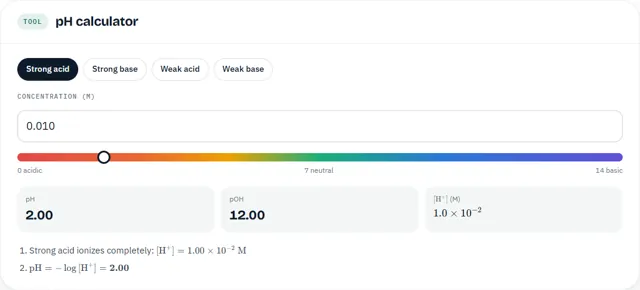
Water always holds a little and : at 25 °C. Take of both sides and you get the rule you'll use constantly:
On the AP exam you may write in place of .
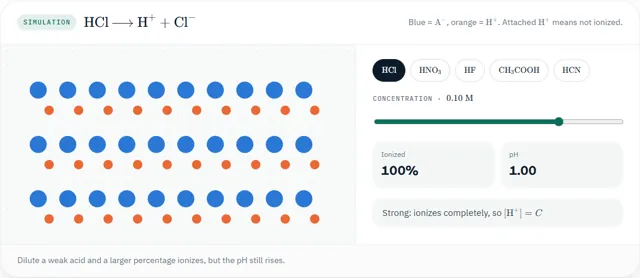
Ionize completely. Mnemonic: "SoCal HELL NO".
Dissociate completely into .
, , , , any … Small .
Take from water. Small .
pH calculator
Reactions & salts
Mixing acids and bases.
If either one is strong, the reaction goes to completion: find the limiting reactant with a table of moles, then see what's left over.
| Strong + strong | · neutral at equivalence |
| Strong acid + weak base | makes · acidic |
| Weak acid + strong base | makes · basic |
| Weak + weak | depends on vs |
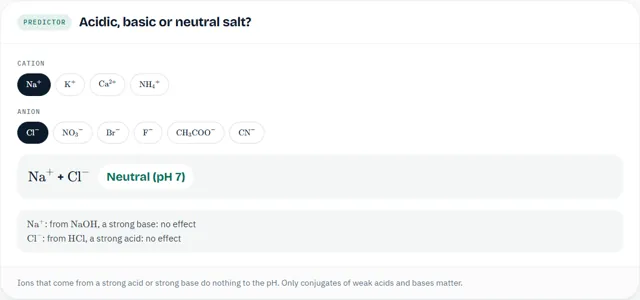
Acidic, basic or neutral salt?
500 mL of 1.0 M KOH is mixed with 300 mL of 2.0 M HBr. What is the pH?
- : . : .
- They react 1 : 1 to completion. is limiting: 0.10 mol is left.
- Total volume 0.800 L: .
? and are each dissolved in water. Which gives a slightly acidic solution, and why?Think, then tap to check
: . (from strong ) does nothing. is actually slightly basic: is the conjugate base of the weak acid .
Titration curves
Read straight off the curve.
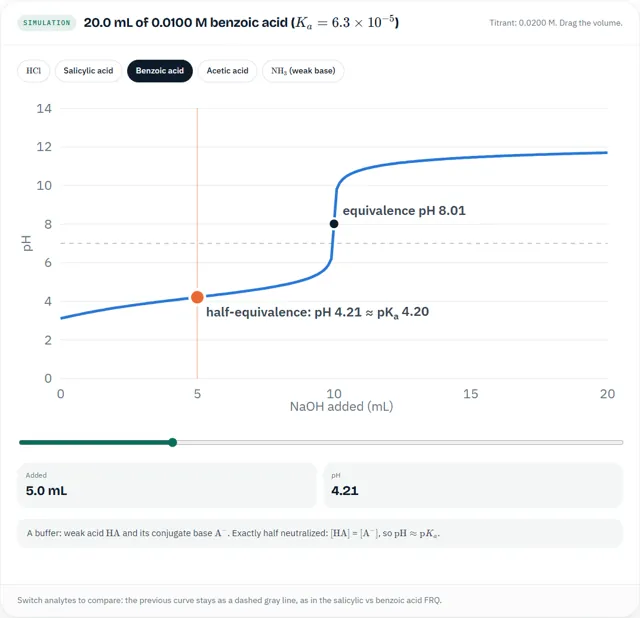
Halfway to equivalence, half the acid has become its conjugate base: , so .
At equivalence a weak acid has become all , so the pH is above 7. A strong acid gives exactly 7.
| Start | only |
| Before equivalence | + : a buffer |
| Half-equivalence | → |
| Equivalence | only → pH > 7 |
| After | excess |
20.0 mL of 0.0100 M
?A weak acid's half-equivalence point is at pH 3.0. At pH 4.0 during the titration, is there more or more ?Think, then tap to check
More . pH 4 is past the half-equivalence point (): , so .
?Benzoic acid has . What is its , and where would its half-equivalence point be?Think, then tap to check
. Same volumes as salicylic acid, so half-equivalence is at the same volume (5.0 mL here), but at pH ≈ 4.2.
Buffers
A weak acid and its conjugate base, together.
Add and the eats it. Add and the eats it. So the pH barely moves. Strong acid + strong base never makes a buffer.
Henderson–Hasselbalch. Both are in the same solution, so you can use moles instead of molarity.
100 mL acetate buffer vs water
500 mL of 0.20 M + 400 mL of 0.40 M ( of ). pH?
- : 0.100 mol. : 0.160 mol. goes to completion.
- limiting: left with 0.060 mol and 0.100 mol : a buffer.
- .
?X: 0.1 M + 0.1 M (equal volumes). Y: solution + 0.1 M (equal volumes). Z: equal moles of and . Rank by pH, lowest first.Think, then tap to check
Y < Z < X. Y: , pH 1.3. Z: buffer at . X: neutralized, pH 7.
Structure, pH and pKa
→ dominates. Indicators change color near their .
: extra O pulls electron density off O–H.
Tiny F holds H tightly, so is not released easily.
Stronger acid, weaker conjugate base.
Topics in this unit
- 8.1Introduction to acids and bases
- 8.2pH and pOH of strong acids and bases
- 8.3Weak acid and base equilibria
- 8.4Acid-base reactions and buffers
- 8.5Acid-base titrations
- 8.6Molecular structure of acids and bases
- 8.7pH and pKa
- 8.8Properties of buffers
- 8.9Henderson-Hasselbalch equation
- 8.10Buffer capacity
Everything on one screen
· 25 °Cstrong: complete ionizationweak: when half-equivalence: titration curvesReady to test yourself?
170 exam-style questions on Unit 8, each with a worked explanation.
Stuck on a unit? Let us fix it this week.
Book a 30-minute one-to-one session for $20. Bring a test, a homework set or the topic that is not clicking.