 AP Chemistry Tutoring
2.2 Intramolecular force and potential energy
AP Chemistry Unit 2: Compound Structure and Properties · 2 simulations · 19 practice questions
Updated · Aligned to the AP Chemistry Course and Exam Description
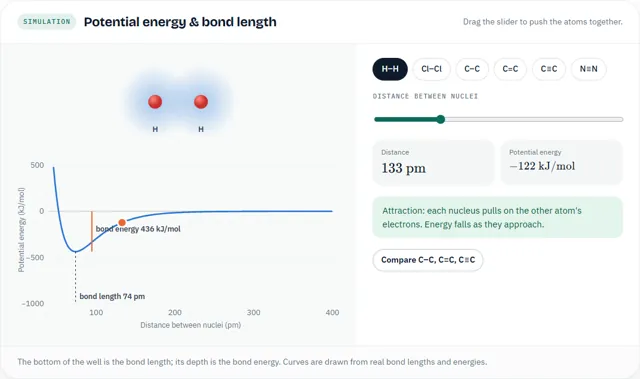
A potential energy curve plots the energy of two atoms against the distance between their nuclei. Energy falls as attraction increases, reaches a minimum at the bond length, and rises sharply when nuclei get too close and repel. The depth of the well is the bond energy, the energy required to break the bond; Coulomb's law explains these trends for ionic bonds.
Covalent bonds
Sharing, equally or not.
In Cl–Cl the twins pull equally: nonpolar. In , oxygen pulls much harder, so the shared electrons spend more time near O: polar.
The O end gets a partial negative charge (), the H ends partial positive ().
Potential energy & bond length
More shared electrons: shorter and stronger.
A single bond shares 2 electrons, a double 4, a triple 6. More overlap pulls the nuclei closer and holds them tighter.
| C–C single · 2 | 154 pm | 347 kJ/mol |
| C=C double · 4 | 134 pm | 614 kJ/mol |
| C≡C triple · 6 | 120 pm | 839 kJ/mol |
Length ↓ and strength ↑ as bond order rises.
Sigma and pi bonds
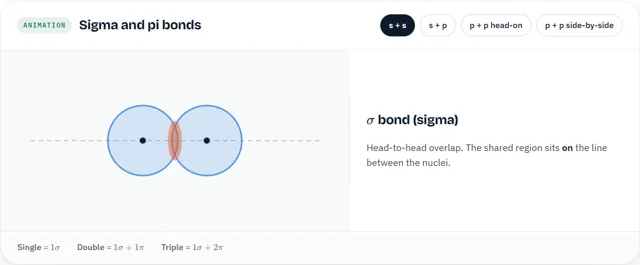
?How many and bonds are in HCN (H–C≡N)?Think, then tap to check
H–C is single (). C≡N is triple (). Total: and .
Study notes
Key concepts
Why atoms bond: the potential-energy curve (SAP-3.B.1). Picture two hydrogen atoms starting very far apart. At infinite separation they do not interact, and the potential energy (PE) of the pair is defined as zero. As they approach:
-
Each nucleus starts to attract the other atom's electron. Attraction lowers the PE, so the curve drops below zero.
-
Repulsions also grow: electron–electron and, most importantly at short range, nucleus–nucleus repulsion.
-
At one particular distance the attractions and repulsions balance and the PE is at its lowest. This distance is the equilibrium bond length.
-
If the atoms are pushed closer than this, the nucleus–nucleus repulsion dominates and the PE rises steeply, eventually becoming positive.
The depth of the well (from the minimum up to zero) is the bond energy: the energy needed to separate the bonded atoms completely. The same energy is released when the bond forms.
A PE curve is drawn with internuclear distance on the x-axis and potential energy on the y-axis. Its shape is a steep wall on the left, a single minimum, and a gradual rise toward zero on the right. Model data for H₂ (rounded) are shown below.
| Internuclear distance (pm) | 30 | 40 | 50 | 60 | 74 | 100 | 150 | 200 | 300 | very large |
|---|---|---|---|---|---|---|---|---|---|---|
| PE (kJ/mol) | +356 | −56 | −283 | −394 | −436 | −368 | −177 | −72 | −11 | 0 |
Reading this table: the bond length of H₂ is 74 pm (the position of the minimum) and the bond energy is 436 kJ/mol (the depth of the minimum). At 30 pm the PE is positive because the nuclei repel strongly.
How to read and compare PE curves.
| Feature of the curve | Meaning |
|---|---|
| x-value of the minimum | bond length |
| depth of the minimum below zero | bond energy (bond strength) |
| PE = 0 at large distance | atoms separated, no interaction |
| steep rise at small distance | nucleus–nucleus repulsion |
| deeper and further left minimum | shorter, stronger bond |
A typical exam task is to sketch a second curve on the same axes. For example, Cl₂ (bond length 199 pm, bond energy 242 kJ/mol) has its minimum to the right of and shallower than H₂ (74 pm, 436 kJ/mol). A curve for N₂ (110 pm, 941 kJ/mol) has a minimum much deeper than either.
What sets bond length and bond energy in a covalent bond (SAP-3.B.2).
-
Atomic size (size of the atom's core). Larger atoms have their valence electrons farther from the nucleus, so the bonded nuclei sit farther apart. Bond length increases down a group, and bond energy usually decreases. For example, H–F 92 pm, H–Cl 127 pm, H–Br 141 pm, H–I 161 pm, and the bond energies fall from 567 to 431 to 366 to 299 kJ/mol.
-
Bond order. A double bond shares two pairs of electrons and a triple bond three pairs. More shared electron density between the nuclei pulls them closer and holds them more tightly. Higher bond order means a shorter and stronger bond.
| Bond | Bond order | Typical length (pm) | Typical bond energy (kJ/mol) |
|---|---|---|---|
| C–C | 1 | 154 | 347 |
| C=C | 2 | 134 | 614 |
| C≡C | 3 | 120 | 839 |
| C–O | 1 | 143 | 358 |
| C=O | 2 | 123 | 745 to 799 |
| C≡O | 3 | 113 | 1072 |
| N–N | 1 | 145 | 160 |
| N=N | 2 | 125 | 418 |
| N≡N | 3 | 110 | 941 |
Notice that a double bond is not twice as strong as a single bond. The second (pi) bond adds less energy than the first (sigma) bond; see Topic 2.7.
Ionic interactions and Coulomb's law (SAP-3.B.3). The attraction between a cation and an anion follows Coulomb's law. You will not calculate absolute values on the AP exam, but you must use the proportionality to compare compounds.
-
Charge: the interaction is proportional to the product of the ion charges. Mg²⁺O²⁻ (product of charges 2 × 2 = 4) attracts much more strongly than Na⁺F⁻ (1 × 1 = 1).
-
Distance: the interaction gets stronger as the distance between ion centres decreases, that is, as the ions get smaller. NaF (small F⁻) attracts more strongly than NaI (large I⁻).
-
Check charge first, then size. A change in charge usually outweighs a change in radius.
Stronger ion–ion attractions give a larger lattice energy (the energy needed to separate one mole of an ionic solid into gaseous ions) and usually a higher melting point.
| Compound | Ion charges | Sum of ionic radii (pm) | q₁q₂/r (relative) | Melting point (°C) |
|---|---|---|---|---|
| NaI | +1, −1 | 322 | 3.1 | 661 |
| NaBr | +1, −1 | 298 | 3.4 | 747 |
| NaCl | +1, −1 | 283 | 3.5 | 801 |
| NaF | +1, −1 | 235 | 4.3 | 993 |
| CaO | +2, −2 | 240 | 16.7 | 2613 |
| MgO | +2, −2 | 212 | 18.9 | 2852 |
(q₁q₂/r values are multiplied by 1000 for readability.)
Common misconceptions.
-
"PE is proportional to 1/r²." The Coulomb force is proportional to 1/r², but the Coulomb potential energy is proportional to 1/r.
-
"The lowest point on the curve is where the atoms stop moving." No. It is the position of lowest potential energy; the atoms still vibrate about it.
-
"Energy is stored in bonds and released when they break." Breaking a bond always costs energy. Energy is released when bonds form.
Key equations
Coulomb's law for the potential energy of two charges q₁ and q₂ separated by distance r (k is a constant):
Coulomb force (for comparison only):
For ionic compounds, use the proportionality:
Worked examples
Worked example 2.2-A. Reading a PE table. For Cl₂ the following model data were obtained.
| Distance (pm) | 150 | 170 | 199 | 250 | 300 | 400 | very large |
|---|---|---|---|---|---|---|---|
| PE (kJ/mol) | +428 | −92 | −242 | −143 | −60 | −9 | 0 |
(a) Bond length = distance at the minimum = 199 pm.
(b) Bond energy = depth of the minimum = 242 kJ/mol. To break one mole of Cl–Cl bonds requires +242 kJ.
(c) At 150 pm the PE is +428 kJ/mol because the two nuclei (each with many core electrons) are forced so close that repulsion outweighs attraction.
(d) Prediction for Br₂: Br atoms are larger (one more shell), so the minimum moves to a longer distance (actual 228 pm) and becomes shallower (actual 193 kJ/mol).
Worked example 2.2-B. Ranking melting points with Coulomb's law. Rank KCl, CaO and NaCl by expected melting point.
Step 1. Charges. CaO has 2+ and 2−; the others have 1+ and 1−. CaO is highest.
Step 2. Size, for equal charges. K⁺ is larger than Na⁺ (an extra shell), so the K⁺–Cl⁻ distance is larger and the attraction weaker. KCl < NaCl.
Ranking: KCl (770 °C) < NaCl (801 °C) < CaO (2613 °C).
Unit 2 study guide: exam-style free-response set, worksheet and answers.
Worked example
- The bond length is the internuclear distance at the minimum: 74 pm.
- Breaking the bond means raising the energy from the minimum to zero (separated atoms): .
- Answer: Bond length 74 pm; 436 kJ is required to break 1 mol of H-H bonds.
Free-response practice
Write your answer first, then open the solution and mark yourself against it.
FRQ 2.2-1. The potential energy of two nitrogen atoms is measured as a function of internuclear distance.
| Distance (pm) | 80 | 95 | 110 | 130 | 160 | 220 | 400 |
|---|---|---|---|---|---|---|---|
| PE (kJ/mol) | +620 | −560 | −941 | −780 | −430 | −110 | −2 |
(a) Determine the bond length and the bond energy of N₂ from the data.
(b) Explain why the potential energy at 80 pm is positive.
(c) The bond energy of F₂ is 159 kJ/mol and its bond length is 142 pm. Describe how the curve for F₂ would differ from the curve for N₂ (position and depth of the minimum).
(d) Explain the difference in bond energy using the Lewis diagrams of N₂ and F₂.
Show the solution
(a) Bond length about 110 pm (the minimum). Bond energy 941 kJ/mol (depth of the minimum). 1 point.
(b) At 80 pm the nuclei are much closer than the equilibrium distance, and the repulsion between the two positive nuclei (and between core electrons) is larger than the attraction of each nucleus for the other's electrons. 1 point.
(c) The F₂ minimum is farther to the right (142 pm) and much shallower (−159 kJ/mol). 1 point.
(d) N₂ has a triple bond (bond order 3: one sigma and two pi), with one lone pair on each N. F₂ has a single bond (bond order 1), with three lone pairs on each F. More shared pairs mean more electron density between the nuclei, a shorter bond and a larger bond energy. 1 point.
FRQ 2.2-2. The table shows data for three ionic compounds.
| Compound | Cation radius (pm) | Anion radius (pm) |
|---|---|---|
| LiF | 76 | 133 |
| KF | 138 | 133 |
| CaF₂ | 100 | 133 |
(a) Which of LiF and KF has the stronger Coulombic attraction between its ions? Justify using Coulomb's law.
(b) A student predicts that CaF₂ has a higher melting point than KF. Is the prediction consistent with Coulomb's law? Justify.
(c) Calculate the ratio of the relative Coulombic attraction (|q₊q₋|/(r₊ + r₋)) for one Ca²⁺–F⁻ pair to that for one K⁺–F⁻ pair.
Show the solution
(a) LiF. Both have 1+ and 1− ions, but Li⁺ (76 pm) is smaller than K⁺ (138 pm), so the distance between ion centres is smaller (209 pm vs 271 pm) and the attraction is stronger. 1 point.
(b) Yes. Ca²⁺ has twice the charge of K⁺ and is also smaller, so the attraction between Ca²⁺ and F⁻ is stronger. Stronger attractions require more energy to overcome, giving a higher melting point (CaF₂ melts at 1418 °C; KF at 858 °C). 1 point.
(c) Ca²⁺–F⁻: 2 × 1 / (100 + 133) = 2/233 = 0.00858. K⁺–F⁻: 1 × 1 / (138 + 133) = 1/271 = 0.00369. Ratio = 0.00858 / 0.00369 = 2.33. 1 point.
Common mistake
Students think the atoms are most stable when the nuclei touch. At very short distances nucleus-nucleus and electron-electron repulsion dominate, so the lowest energy occurs at an intermediate distance, the bond length.
Frequently asked questions
?Why does a potential energy curve go up at short distances?
When the nuclei get very close, the repulsion between the positively charged nuclei (and between the electron clouds) outweighs the attraction, so potential energy rises steeply.
?Is a shorter bond always stronger?
For bonds between the same two atoms, yes: higher bond order means shorter and stronger. Comparing different pairs of atoms requires more care.
Practice questions on 2.2
- Q1On a graph of potential energy against the distance between two hydrogen atoms, the H–H bond length is the distance at which
- Q2The table gives bond energies for three different bonds between two carbon atoms. Which assignment is correct? Bond: X, Y, Z Bond energy (kJ/mol): 347, 614, 839
- Q3MgO melts at about 2850 °C, whereas NaF melts at about 990 °C. Which statement best explains the difference?
- Q4Which statement about covalent bonds between the same two elements is correct?
- Q5On a graph of potential energy versus internuclear distance for two hydrogen atoms, at what separation is the potential energy equal to zero?
- Q6Two atoms approach each other. Between the bond length and much shorter distances, the potential energy rises steeply. Which best explains this?
- Q7Which hydrogen halide has the weakest bond?
- Q8Which of the following solids is expected to have the highest melting point?
- Q9Potential-energy curves are drawn for H–Cl and H–I. Compared with the H–Cl curve, the H–I curve has its minimum
- Q10Nitrogen–nitrogen bond energies are 160, 418 and 941 kJ/mol. Which assignment is correct?
- Q11CaO melts at 2613 °C, while KCl melts at 770 °C. What is the main reason?
- Q12Which generally holds for bonds between the same two elements?
- Q13Which compound is soluble in water and has the highest melting point?
- Q14At what separation is the potential energy between two atoms taken as zero?
- Q15Sample X melts at 44 °C, is waxy and never conducts electricity. Sample Y melts at 712 °C, forms brittle crystals and conducts only when molten or dissolved. Sample Z melts at 1085 °C, is shiny and conducts as a solid. How are they classified?
- Q16When two bonded H atoms are pushed closer together than their bond length, the potential energy rises sharply. Why?
- Q17Which species has the shortest, strongest N–N bond?
- Q18Which bond is easiest to break?
- Q19Which compound has the highest melting point?
Terms used in this topic
Stuck on a unit? Let us fix it this week.
Book a 30-minute one-to-one session for $20. Bring a test, a homework set or the topic that is not clicking.
Book a session