AP Chemistry · Unit 6 Thermochemistry

Where the heat goes

Every reaction moves energy. Track it in and out of the system, measure it with a calorimeter, and calculate it three different ways.

4chapters
6simulations & tools
7–9%of the exam
ΔH < 0
Video · 25 min

The whole of Unit 6 in one video

Every topic in this unit explained step by step, with the simulations on this page, worked examples and quick checks. Watch it first, then work through the lessons and practice questions below.

01
Topics 6.1 · 6.2

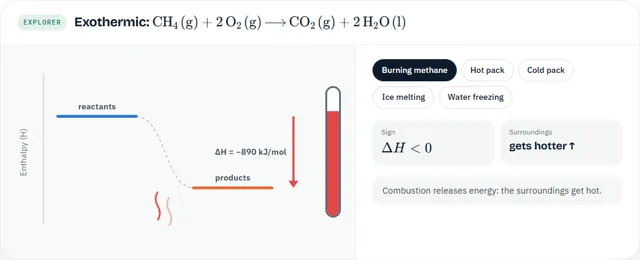
Endothermic & exothermic

Exo: energy exits.

Like people moving out of California: the system loses energy, the surroundings gain it and get hotter. Products end lower than reactants: ΔH<0\Delta H < 0. Burning is the classic example.

Endo: energy enters.

Like money arriving in your bank account: it came from someone else. The system takes energy from the surroundings, which get colder. Products end higher: ΔH>0\Delta H > 0.

ΔH=Hproducts−Hreactants\Delta H = H_{\text{products}} - H_{\text{reactants}}
Explorer

:

Preview of this simulation
Sign up free to use this simulation A free account opens every simulation on the site and saves your practice scores. Email or Google, about 30 seconds.
Remember

Breaking bonds always takes energy (endothermic). Forming bonds always releases it (exothermic). A reaction is exothermic overall when forming the new bonds releases more than breaking the old ones took.

02
Topics 6.3 · 6.4

Heat transfer & calorimetry

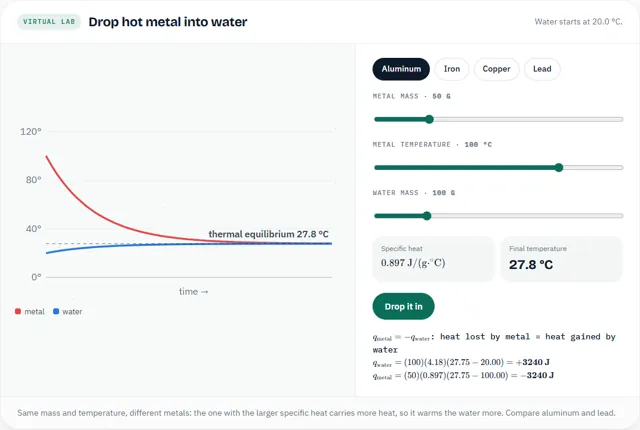
Heat flows from hot to cold, until equal.

When two objects reach the same temperature they're at thermal equilibrium: energy still moves both ways, but equally, so nothing changes. Heat lost by one = heat gained by the other.

q=mcΔTq = mc\Delta T

cc = specific heat: J needed to warm 1 g by 1 °C. Water: 4.18 J/(g⋅∘C)4.18\ \mathrm{J/(g{\cdot}{}^\circ C)}.

thermometerstirrerinsulatedcups
Virtual lab

Drop hot metal into water

Water starts at 20.0 °C.
Preview of this simulation
Sign up free to use this simulation A free account opens every simulation on the site and saves your practice scores. Email or Google, about 30 seconds.
Exam tip

In a calorimeter, qrxn=−qsolnq_{\text{rxn}} = -q_{\text{soln}}. Use the mass of the whole solution in q=mcΔTq = mc\Delta T, then divide by moles of the limiting reactant for ΔH\Delta H in kJ/mol.

03
Topic 6.5

Phase changes

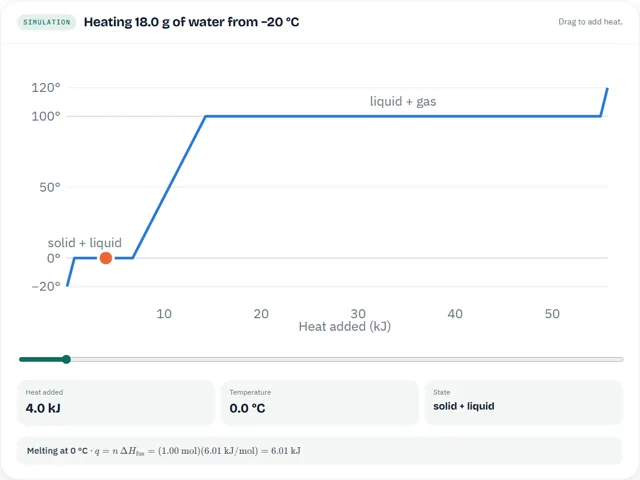
Flat lines on a heating curve.

While ice melts or water boils, the temperature doesn't change. All the energy goes into overcoming intermolecular forces, not into speeding the molecules up.

Boiling takes far more energy than melting: every attraction must be broken, not just loosened.

Temperature changingq=mcΔTq = mc\Delta T
Melting / freezingq=n ΔHfusq = n\,\Delta H_{\text{fus}}
Boiling / condensingq=n ΔHvapq = n\,\Delta H_{\text{vap}}
Simulation

Heating 18.0 g of water from −20 °C

Drag to add heat.
Preview of this simulation
Sign up free to use this simulation A free account opens every simulation on the site and saves your practice scores. Email or Google, about 30 seconds.
04
Topics 6.6 – 6.9

Enthalpy of reaction

Three ways to calculate ΔH.

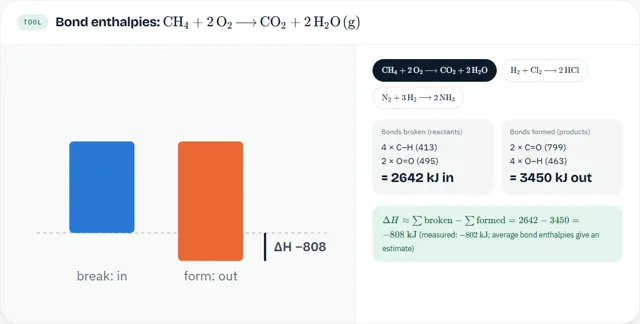
Bond enthalpiesbroken − formed

Reactant bonds in, product bonds out.

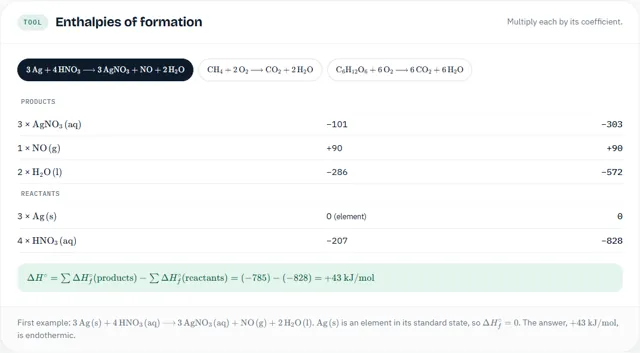
Formationproducts − reactants

Elements in their standard state are 0.

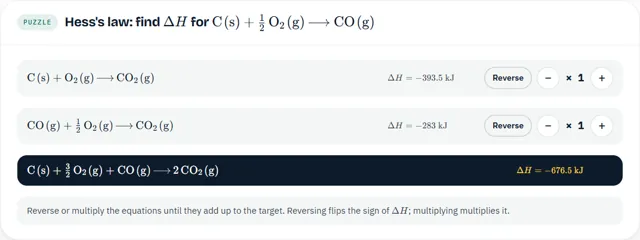
Hess's lawadd the equations

Reverse: flip the sign. Multiply: multiply ΔH\Delta H.

Tool

Bond enthalpies:

Preview of this simulation
Sign up free to use this simulation A free account opens every simulation on the site and saves your practice scores. Email or Google, about 30 seconds.
Tool

Enthalpies of formation

Multiply each by its coefficient.
Preview of this simulation
Sign up free to use this simulation A free account opens every simulation on the site and saves your practice scores. Email or Google, about 30 seconds.
Puzzle

Hess's law: find ΔH\Delta H for C(s)+12 OX2(g)→CO(g)\ce{C(s) + 1/2 O2(g) -> CO(g)}

Preview of this simulation
Sign up free to use this simulation A free account opens every simulation on the site and saves your practice scores. Email or Google, about 30 seconds.
?A catalyst (MnOX2\ce{MnO2}) speeds up 2 HX2OX2→2 HX2O+OX2\ce{2H2O2 -> 2H2O + O2}. What happens to EaE_a and to ΔH\Delta H?Think, then tap to check

EaE_a is lower (a lower hump on the energy diagram). ΔH\Delta H is unchanged: the reactants and products sit at the same energies.

?Why is ΔHf∘\Delta H^\circ_f of OX2(g)\ce{O2(g)}, Ag(s)\ce{Ag(s)} or He(g)\ce{He(g)} zero?Think, then tap to check

They're elements already in their standard state. Forming them from themselves involves no change.

★
Review

Everything on one screen

ΔH=Hproducts−Hreactants\Delta H = H_{\text{products}} - H_{\text{reactants}}negative = exothermic
q=mcΔTq = mc\Delta Theat with a temperature change
qrxn=−qsolnq_{\text{rxn}} = -q_{\text{soln}}calorimetry
q=n ΔHfus or n ΔHvapq = n\,\Delta H_{\text{fus}}\ \text{or}\ n\,\Delta H_{\text{vap}}phase changes
ΔH≈∑broken−∑formed\Delta H \approx \sum \text{broken} - \sum \text{formed}bond enthalpies
ΔH∘=∑ΔHf∘(prod)−∑ΔHf∘(react)\Delta H^\circ = \sum \Delta H^\circ_f(\text{prod}) - \sum \Delta H^\circ_f(\text{react})formation
Costs pointsUsing only the mass of the solute, not the whole solution, in \(q = mc\Delta T\).
Costs pointsLosing the negative sign when converting the heat gained by the water into \(\Delta H\) for the reaction.
Costs pointsForgetting to multiply by the coefficients when using enthalpies of formation.

Ready to test yourself?

128 exam-style questions on Unit 6, each with a worked explanation.

Stuck on a unit? Let us fix it this week.

Book a 30-minute one-to-one session for $20. Bring a test, a homework set or the topic that is not clicking.

Chat on WhatsApp