 AP Chemistry Tutoring
Substances & Mixtures
Why water boils at 100 °C and methane at −162 °C. How gases push, how solutions mix, and how light measures concentration.

The whole of Unit 3 in one video
Every topic in this unit explained step by step, with the simulations on this page, worked examples and quick checks. Watch it first, then work through the lessons and practice questions below.
Intermolecular forces
Intermolecular: between molecules.
Bonds hold atoms together inside a molecule. Intermolecular forces (IMFs) are the weaker attractions between molecules.
They explain melting and boiling points, why oil is thicker than water, why oil won't mix with water, and why salt dissolves.
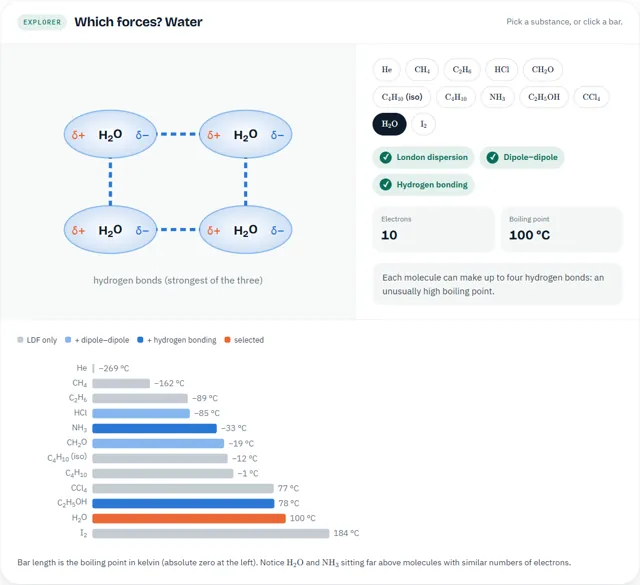
Every molecule. The only force for nonpolar molecules and noble gases.
Polar molecules: permanent and ends attract.
H bonded to N, O or F, attracted to N, O or F on another molecule.
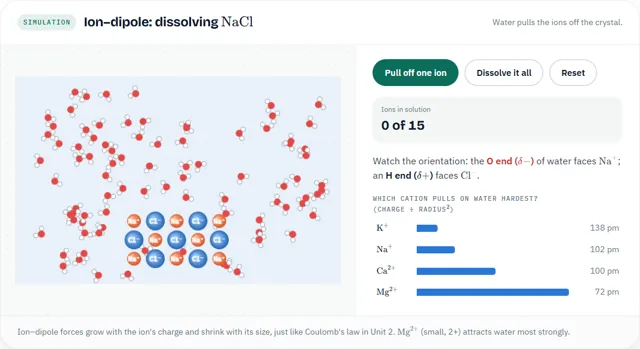
An ion and a polar molecule, like and water.
London dispersion: dipoles that flicker.
Electrons move. For an instant they bunch at one end, making a temporary dipole. That pushes the electrons in the next molecule away, inducing a dipole there. Opposite ends attract.
Bigger electron clouds, stronger LDFs.
Polarizability is how easily the cloud distorts. More electrons means a more lopsided split is possible, like a wealth gap: $10,000 can be divided far more unevenly than $1,000.
(74 ) beats (10 ). Butane beats ethane .
Shape matters too: contact area.
Butane and isobutane are both . Straight butane molecules lie alongside each other like sheets of paper; round isobutane touches like balls. More contact, stronger LDFs: butane boils higher.
Dipole–dipole: permanent ends.
In or the dipole is always there, so molecules line up to . Polar molecules have dipole–dipole forces and LDFs. LDFs are always present.
Hydrogen bonding: a strong special case.
H must be bonded to N, O or F. Those atoms strip electrons from H, leaving it strongly . Water and ammonia hydrogen bond.
Trap: has H and O, but its H atoms are on carbon. A bond is nearly nonpolar, so molecules don't hydrogen bond with each other.
Which forces?
Ion–dipole: dissolving
?Two ethanol molecules: is the strongest attraction between two hydrogens, or between the hydrogen of one and the O of the other?Think, then tap to check
. That H is bonded to O, so it's strongly and forms a hydrogen bond. hydrogens are nearly nonpolar and only give LDFs.
?Solid doesn't conduct; molten does. Is that because of free electrons or free ions?Think, then tap to check
Free ions. Molten has and ions that can move. There are no free electrons in either state.
Types of solids
Covalent networks: no molecules at all.
Every atom is covalently bonded to its neighbours, on and on, in three dimensions. To melt it you must break covalent bonds, and lots of them. Hence very high melting points and great hardness.
Only nonmetals do this, mainly C and Si: diamond, graphite, (quartz), .
Same element, different structures: allotropes of carbon.
Each C bonded to 4 C. Hardest natural material, no free electrons: an insulator.
Each C bonded to 3 C in flat sheets. Layers slide (pencils), and the leftover electrons move within a layer: conducts.
A football-shaped cage.
Rolled-up or single sheets of graphite.
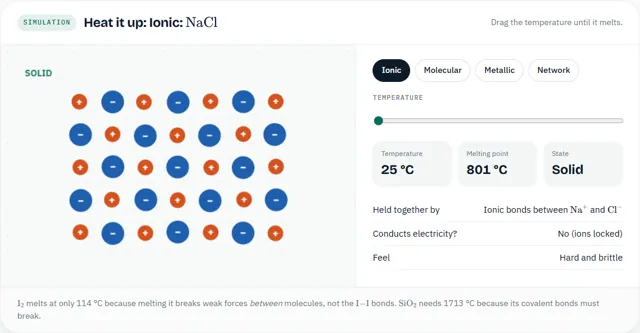
Heat it up:
Crystalline or amorphous.
Crystalline solids have a regular, repeating 3D arrangement (salt, snowflakes). Amorphous solids are jumbled, with no long-range order (rubber, glass, cotton candy).
?One allotrope of phosphorus is made of separate molecules; the other is a network of P atoms all bonded together. Which melts higher?Think, then tap to check
The network. Melting it means breaking covalent bonds, which are much stronger than the dispersion forces between molecules. (P is a nonmetal, so no metallic bonding.)
?Why is diamond so much harder than graphite?Think, then tap to check
In diamond every C has four covalent bonds in 3D. Graphite is layers held together only by weak dispersion forces, so the layers slide. Both contain only covalent bonds, not ionic.
Solids, liquids, gases
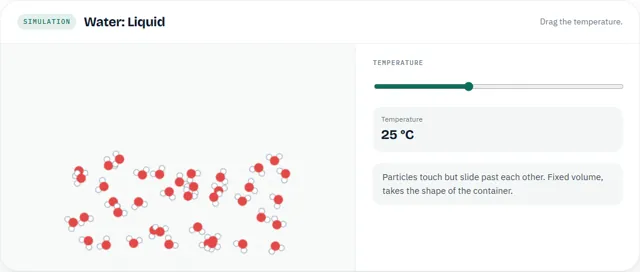
Water:
Stronger IMFs: higher boiling point, lower vapor pressure.
To boil, molecules must escape their neighbours. Strong IMFs hold them back: few escape at any temperature, so the vapor pressure is low and the boiling point is high.
Boiling breaks IMFs, never the covalent bonds inside the molecules.
| Solid | fixed shape · fixed volume · vibrate in place |
| Liquid | takes container's shape · fixed volume · slide past |
| Gas | no fixed shape or volume · far apart, fast |
Gases
The ideal gas.
Imagine gas particles that take up no space and never attract or repel each other. Real gases come close at ordinary conditions, and all of them obey one equation.
. .
What is pressure?
Particles colliding with the walls. More particles in the same space means more collisions per second, so more pressure. Heating does two things: particles hit more often and harder.
Gas in a cylinder
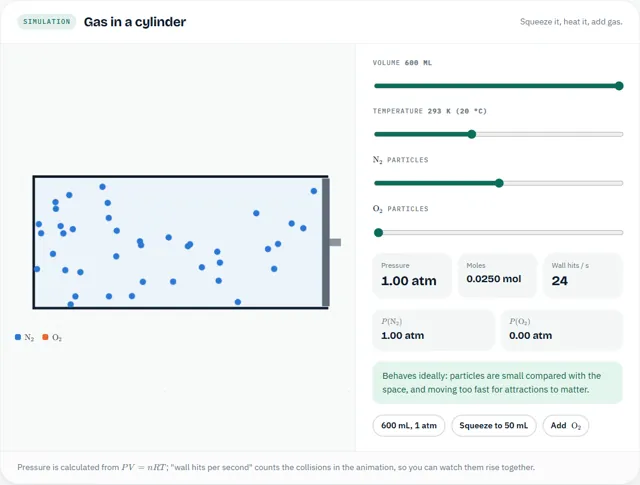
A car engine squeezes 600 mL of air at 1.0 atm down to 50 mL, at constant temperature. New pressure?
- Same gas (), same , so is constant: .
- : one-twelfth the volume, twelve times the pressure. Try it above.
in a rigid 7.0 L cylinder is at 2.1 atm and 10 °C. It is heated to 40 °C. New pressure?
- Rigid: is fixed, and is fixed. So : .
- Convert to kelvin: , .
- . (Using °C would wrongly give 8.4 atm.)
Mixtures: add the partial pressures.
Each gas in a mixture pushes as if it were alone. Its share is set by its mole fraction.
?Two rigid 5 L containers at the same temperature: at 0.8 atm and at 1.0 atm. All the is moved into the container. Total pressure?Think, then tap to check
Real gases misbehave when squeezed or cold.
High pressure: particles are crowded, so their own volume matters. Low temperature: they move slowly, so attractions pull on them. Big particles deviate more.
Kinetic molecular theory.
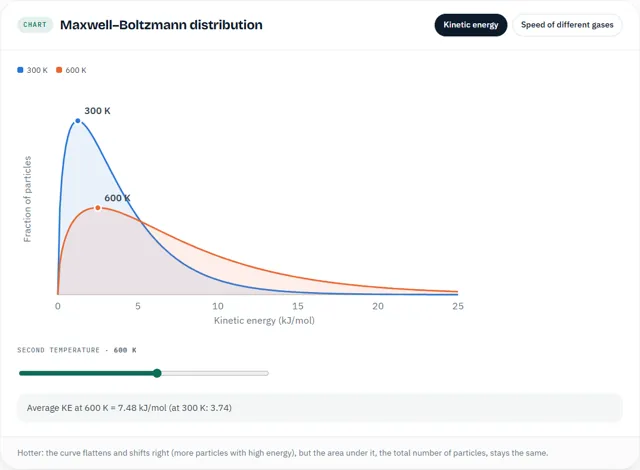
Gas particles are in continuous, random motion: different speeds, different directions. Temperature measures their average kinetic energy, .
Maxwell–Boltzmann distribution
Solutions
A solution is a homogeneous mixture.
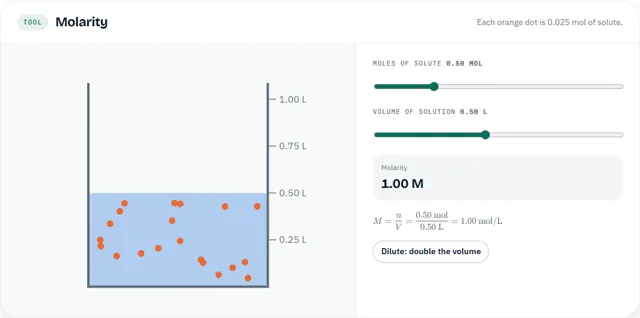
The solute is spread evenly through the solvent. Concentration in AP Chemistry is usually molarity: moles of solute per liter of solution.
Like dissolves like.
Substances mix when their IMFs are similar. Oil (LDFs) won't mix with water (hydrogen bonds). dissolves because ion–dipole forces with water beat the lattice.
Counting ions: 1 M gives 1 M and 2 M .
Molarity
Paper chromatography
Light & spectroscopy
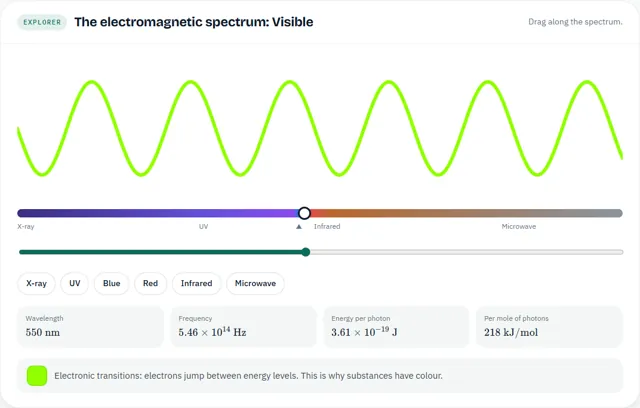
Shorter wavelength, more energy.
Light is a wave and a stream of photons. Each photon's energy depends on its frequency.
·
The photoelectric effect.
Light knocks electrons out of a metal only if each photon has enough energy. Brighter light of too low a frequency does nothing; above the threshold, extra energy becomes the electron's kinetic energy. (PES in Unit 1 uses exactly this.)
The electromagnetic spectrum:
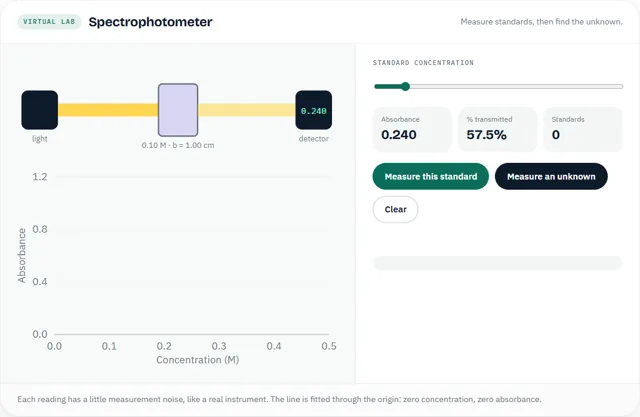
Beer–Lambert: more absorber, more absorbance.
Shine light through a solution. Absorbance rises in a straight line with concentration. Measure standards, draw the line, read off the unknown.
: how strongly the substance absorbs (molar absorptivity) · : path length (cm) · : concentration (M)
- , so .
Spectrophotometer
Topics in this unit
- 3.1Intermolecular forces
- 3.2Properties of solids
- 3.3Solids, liquids and gases
- 3.4Ideal gas law
- 3.5Kinetic molecular theory
- 3.6Deviation from ideal gas law
- 3.7Solutions and mixtures
- 3.8Representations of solutions
- 3.9Separation of solutions and mixtures (chromatography)
- 3.10Solubility
- 3.11Spectroscopy and the electromagnetic spectrum
- 3.12Photoelectric effect
- 3.13Beer-Lambert law
Everything on one screen
LDF < dipole–dipole < H-bond < ion–dipoleIMF strength · molarity and dilution · photonsReady to test yourself?
212 exam-style questions on Unit 3, each with a worked explanation.
Stuck on a unit? Let us fix it this week.
Book a 30-minute one-to-one session for $20. Bring a test, a homework set or the topic that is not clicking.