 AP Chemistry Tutoring
Chemical Reactions
Bonds break, new bonds form. Learn to spot a reaction, write what really reacts, and do the math that every later unit relies on.

The whole of Unit 4 in one video
Every topic in this unit explained step by step, with the simulations on this page, worked examples and quick checks. Watch it first, then work through the lessons and practice questions below.
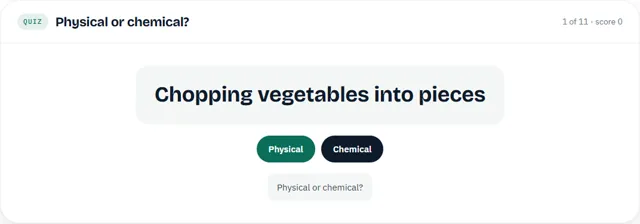
Physical or chemical?
Physical: same substance, new form.
Chopping vegetables, shredding paper, melting ice, boiling water. is still .
Chemical: a new substance.
Rotting, burning, rusting, digesting. At the particle level, bonds break and new bonds form: H–H and O=O break, O–H bonds form.
Evidence that a reaction happened.
A new gas, like from .
A solid appears when two solutions mix.
Two clear solutions turn pink.
Energy released by new bonds.
Physical or chemical?
? + → + + . Which observation proves a reaction: bubbles, the total volume, a colorless result, or electrical conductivity?Think, then tap to check
Bubbles: gas is a new substance. Both solutions were already colorless and already conducted.
?Water bubbles at 100 °C. Which gas in the bubbles would support "physical change"?Think, then tap to check
: same substance, new state. or would mean water decomposed, a chemical change.
Net ionic equations
Show only what actually reacts.
Soluble ionic compounds and strong acids exist as separate ions in water, so write them that way. Ions that appear unchanged on both sides are spectators: cancel them, like subtracting the same number from both sides of an equation.
Always soluble: , , and salts. Solids, liquids, gases and weak acids stay written whole.
| Molecular | + → + |
| Complete ionic | + |
| Net ionic | + → |
Cross out the spectators
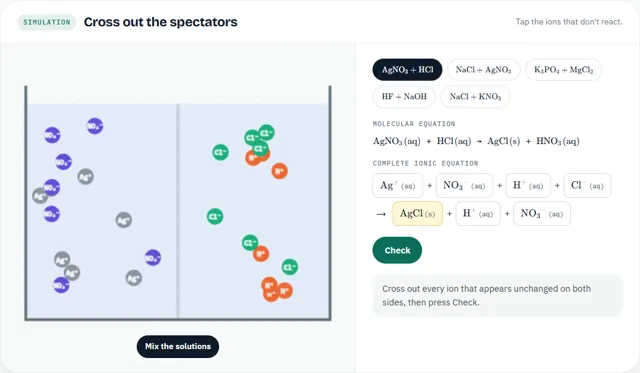
- Balance: .
- Complete ionic:
- and are on both sides: spectators. Cancel them.
Stoichiometry
Coefficients are mole ratios.
means 2 mol react with 1 mol to make 2 mol (or 6 : 3 : 6, or 10 : 5 : 10).
You can never jump from grams to grams. Always go through moles.
- Carbon: 1 gives 1 .
- Oxygen: with , the left has O atoms and the right has 2. So : .
- No fractions: multiply everything by 2.
The mole bridge
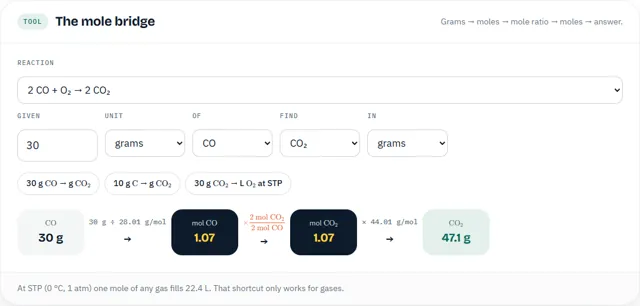
The limiting reactant runs out first.
It decides how much product forms. The other reactant is in excess: some is left over. "Reacts with excess " tells you the other one is limiting.
?50 mL of 1.0 M + 50 mL of 1.0 M gives some . If the is 2.0 M instead, how much forms?Think, then tap to check
The same amount. (still 0.050 mol) is now the limiting reactant, and it limits to 0.050 mol.
? + → + + . 0.010 mol and 0.020 mol make 0.24 L . How do you double the ?Think, then tap to check
Double both reactants. 0.010 : 0.020 is exactly the 1 : 2 ratio, so neither is in excess. Doubling only one leaves the other limiting.
Titration
Find an unknown concentration.
The analyte (unknown) goes in the flask. The titrant (known concentration) goes in the burette. Add titrant until all the analyte has reacted: the equivalence point.
For other ratios (like ) use the mole ratio instead.
Titration of with
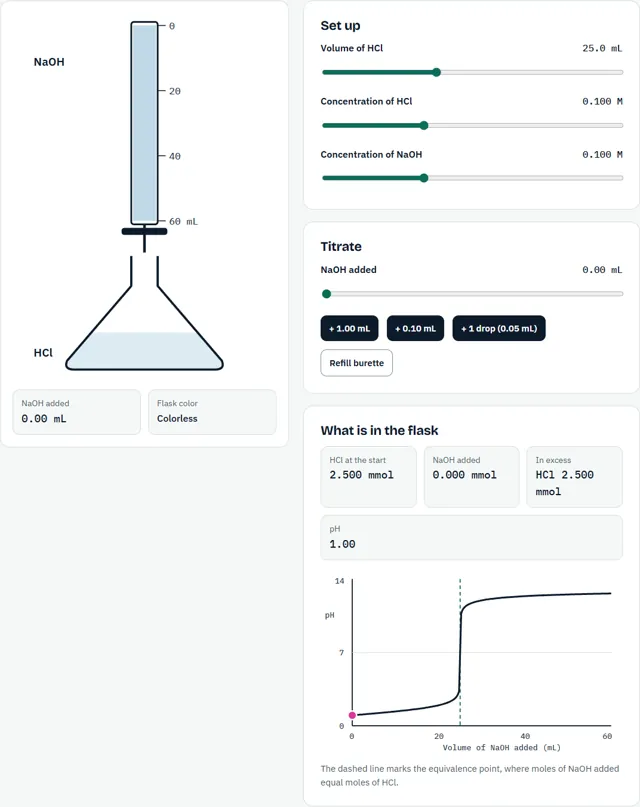
? is titrated with ; equivalence is at 20 mL. Is there more acid left in the flask after 1.0 mL of NaOH or after 5.0 mL?Think, then tap to check
More after 1.0 mL. Every mL of added before equivalence consumes more acid, so after 5.0 mL there is less left.
Types of reactions
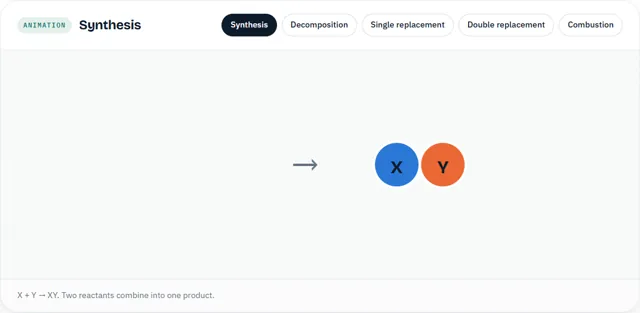
Three kinds of reaction by what moves.
is transferred from an acid to a base. Chapter 06.
Electrons are transferred; oxidation numbers change. Chapter 07.
Two solutions make an insoluble ionic solid. Chapter 02.
Acid–base reactions
Brønsted–Lowry: it's all about .
An acid donates a proton (). A base accepts one. Forget "sour": in AP Chemistry the definition is the proton transfer.
What's left of the acid is its conjugate base. The base that gained becomes its conjugate acid. A conjugate pair differs by exactly one .
Proton transfer
?. What kind of reaction is this, and which reactant is the acid?Think, then tap to check
An acid–base reaction: moves from (the acid) to the N of (the base).
?. Name one conjugate acid–base pair.Think, then tap to check
/ (or / ). Each pair differs by one .
Redox reactions
Electrons move: oxidation and reduction together.
Oxidation is loss of electrons; the oxidation number goes up. Reduction is gain; the oxidation number goes down. One can't happen without the other.
+ → +
Oxidation number finder
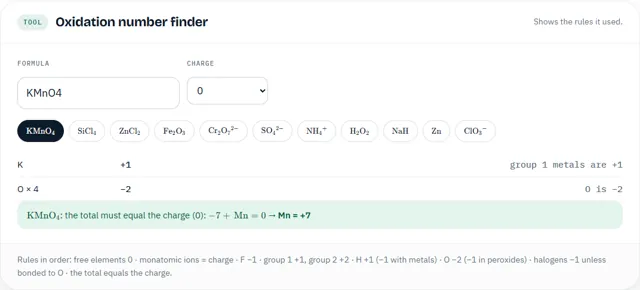
Combine half-reactions
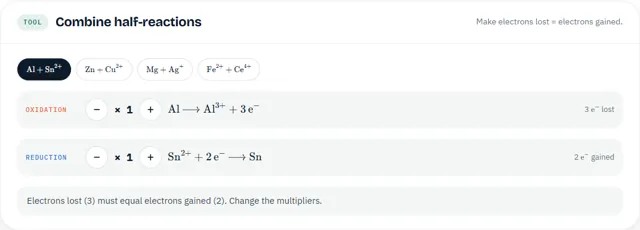
? releases heat. Is it combustion, double replacement, acid–base or redox?Think, then tap to check
Redox. Zn goes 0 → +2 (oxidized) and H goes +1 → 0 (reduced). No , so not combustion; Zn is an element, so not double replacement.
?. Which way do electrons move?Think, then tap to check
From Mg to Si. Mg goes 0 → +2 (oxidized); Si goes +4 → 0 (reduced). Cl stays −1.
Topics in this unit
Everything on one screen
grams → mol → ratio → mol → gramsstoichiometry path1 mol gas = 22.4 L at STP0 °C, 1 atmacid donates · base acceptsBrønsted–LowryOIL RIGoxidation loss, reduction gainReady to test yourself?
157 exam-style questions on Unit 4, each with a worked explanation.
Stuck on a unit? Let us fix it this week.
Book a 30-minute one-to-one session for $20. Bring a test, a homework set or the topic that is not clicking.