 AP Chemistry Tutoring
Balanced, not stopped
At equilibrium nothing seems to change, yet reactions run both ways at the same speed. Learn to write K, predict the shift, and push it around.

The whole of Unit 7 in one video
Every topic in this unit explained step by step, with the simulations on this page, worked examples and quick checks. Watch it first, then work through the lessons and practice questions below.
Dynamic equilibrium
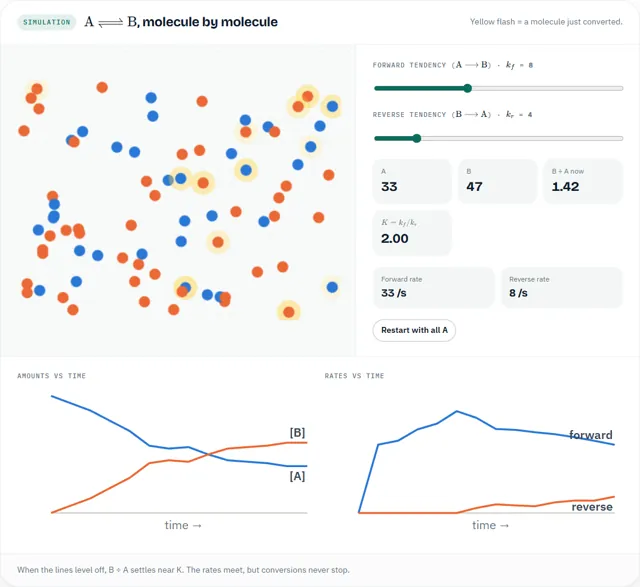
Forward rate = reverse rate.
Picture LA and San Francisco. Every year 100,000 people move LA → SF and 100,000 move SF → LA. Both populations stay fixed (6 million and 4 million) even though people keep moving.
At equilibrium the amounts are constant, but not necessarily equal.
| Concentration vs time | curves level off (not at the same height) |
| Rate vs time | forward falls, reverse rises, they meet |
\(\ce{A <=> B}\), molecule by molecule
The equilibrium constant
Products over reactants, raised to coefficients.
Leave out pure solids and liquids: their concentrations don't change, so they are left out of the expression. has no units, and it changes only with temperature.
e.g. at equilibrium.
e.g. . is never negative.
Same expression with partial pressures.
= moles of gas, products − reactants.
Change the equation, watch K
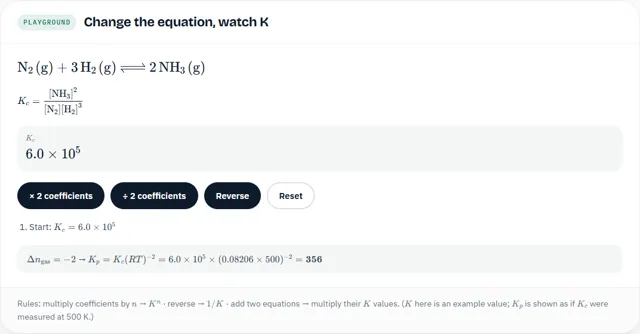
? has . What is for ?Think, then tap to check
Doubled: . Reversed: .
Q vs K: which way?
is 's formula with the concentrations you have now.
: not enough products yet → shifts toward products.
: too many products → shifts toward reactants.
: at equilibrium.
On the AP exam, say "toward products/reactants", not "right/left".
,
Le Chatelier's principle
Stress it, and it pushes back.
A system at equilibrium shifts to partly undo any change.
Remove → shift toward what was removed.
Expand → more gas moles. Inert gas at constant volume: no shift.
Exothermic: heat is a product. The only stress that changes .
Reaches equilibrium faster, same position.
\(\ce{N2 + 3H2 <=> 2NH3}\) ·
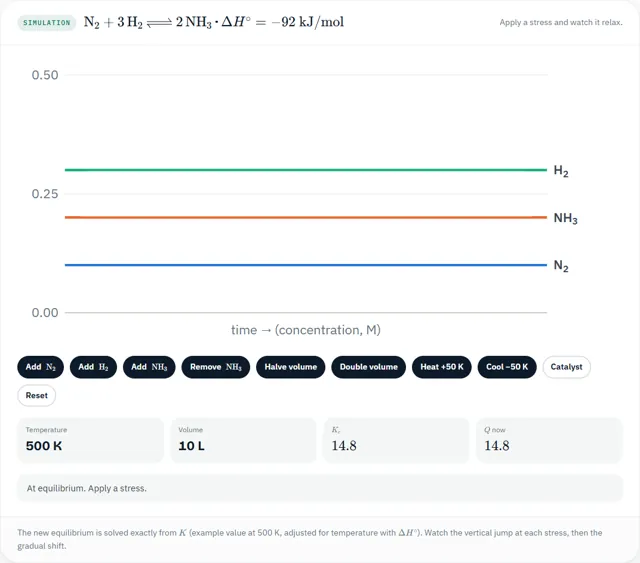
? is at equilibrium in a rigid container. More is added. What happens right away?Think, then tap to check
The forward rate increases and becomes greater than the reverse rate, so the system shifts toward products until the rates match again.
is at equilibrium. At time , jumps up suddenly; then rises and falls. Explain.
- A sudden vertical jump means was added at .
- More product makes .
- By Le Chatelier's principle the system shifts toward reactants: forms and is used up.
Solubility equilibria
: the solid isn't in the expression.
gives . The molar solubility is how many moles dissolve per liter.
You can compare values directly only for salts with the same ion ratio (, , are all 1 : 1). Otherwise, solve for .
Common ions and pH.
Common-ion effect: dissolves less in solution than in pure water (Le Chatelier).
pH: salts with a basic anion (, , , …) dissolve more in acid, because removes the anion. dissolves more in acid, less in base.
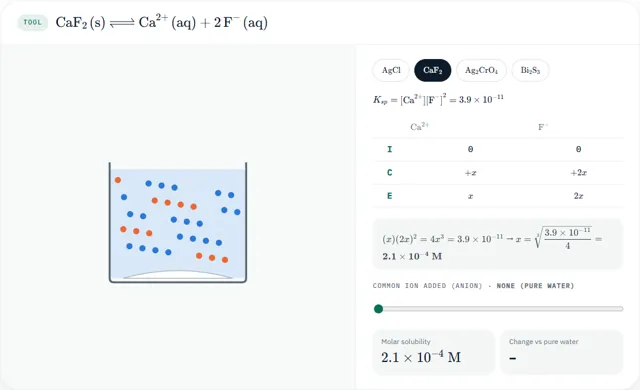
- ICE: , .
- (watch the exponent: it's cubed).
Topics in this unit
- 7.1Introduction to equilibrium
- 7.2Direction of reversible reactions
- 7.3Reaction quotient and equilibrium constant
- 7.4Calculating the equilibrium constant
- 7.5Magnitude of the equilibrium constant
- 7.6Properties of the equilibrium constant
- 7.7Calculating equilibrium concentrations
- 7.8Representations of equilibrium
- 7.9Introduction to Le Chatelier's principle
- 7.10Reaction quotient and Le Chatelier's principle
- 7.11Introduction to solubility equilibria
- 7.12Common-ion effect
- 7.13pH and solubility
- 7.14Free energy of dissolution
Everything on one screen
· reverse · add manipulating products · reactantsdirectiononly temperature changes Le ChatelierReady to test yourself?
99 exam-style questions on Unit 7, each with a worked explanation.
Stuck on a unit? Let us fix it this week.
Book a 30-minute one-to-one session for $20. Bring a test, a homework set or the topic that is not clicking.