 AP Chemistry Tutoring
Compound Structure & Properties
Unit 1 built atoms. Now we join them: ionic, covalent and metallic bonds, and the shapes they make.

The whole of Unit 2 in one video
Every topic in this unit explained step by step, with the simulations on this page, worked examples and quick checks. Watch it first, then work through the lessons and practice questions below.
What a bond is
A bond makes atoms act as one unit.
Two H atoms and one O atom in a box aren't water. Bonded together, they are: liquid at room temperature, freezes at 0 °C, dissolves salt.
Reactions break and make bonds.
Freezing water is not a reaction: stays . Hydrogen burning in oxygen is: H–H and O=O bonds break, O–H bonds form.
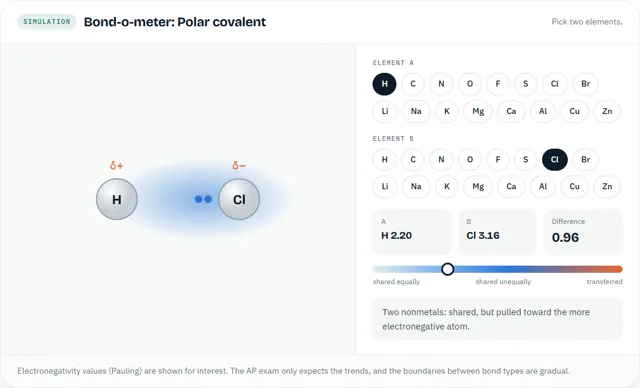
Three kinds of bond. The elements tell you which.
An electron is transferred. Big electronegativity difference.
NaCl, MgOElectrons are shared, equally (nonpolar) or unequally (polar).
, ,Cations in a sea of shared, free-moving electrons.
Cu, Fe, brassRises across a period, falls down a group. F is the highest.
no numbers to memorizeBond-o-meter:
?A binary compound has ionic bonding. Which is most likely true: both elements are metals, the atomic masses are small, electrons are shared equally, or the electronegativity difference is large?Think, then tap to check
The electronegativity difference is large. Ionic bonds form between a metal and a nonmetal; equal sharing is nonpolar covalent, and two metals are metallic.
Ionic bonds & solids
Transfer, then attraction.
Na gives its one valence electron to Cl. Now and have opposite charges, and opposite charges attract. That attraction is the ionic bond.
The crystal lattice explains every property.
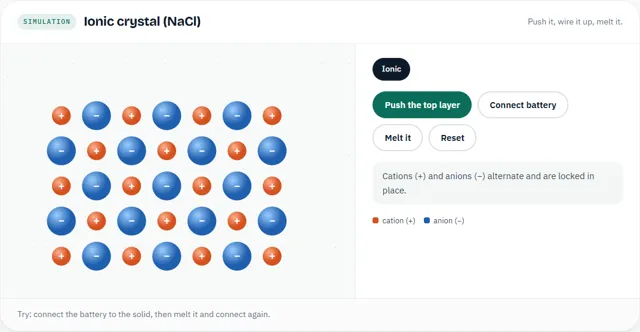
Cations and anions alternate in a fixed, ordered lattice. Each ion is held by all its neighbours.
Every ion is bonded to its neighbours, so the lattice resists being squeezed.
Like charges line up, repel, and the crystal cracks.
Lots of energy is needed to pull the ions apart.
Solid: no free charges. Liquid or aqueous: ions move.
Ionic crystal
How strong? Coulomb's law.
Bigger charges attract more. Smaller ions sit closer, and closer attracts much more.
Stronger attraction → higher melting point, more rigid.
Which lattice holds tighter?
Bar length = from ionic radii. Click a row.
Why does MgO melt at 2852 °C but NaCl at only 801 °C?
- Charges: is . is .
- Size: is smaller than (more protons, same shell). is smaller than (one fewer shell). So is smaller in MgO.
- Bigger and smaller : the attraction in MgO is several times stronger.
- Stronger ionic bonds need more energy to break → higher melting point.
?Does molten NaCl conduct electricity? Why?Think, then tap to check
Yes. Melting frees the and ions to move, and moving ions carry charge. In the solid they're locked in the lattice, so it doesn't conduct.
Covalent bonds
Sharing, equally or not.
In Cl–Cl the twins pull equally: nonpolar. In , oxygen pulls much harder, so the shared electrons spend more time near O: polar.
The O end gets a partial negative charge (), the H ends partial positive ().
Potential energy & bond length
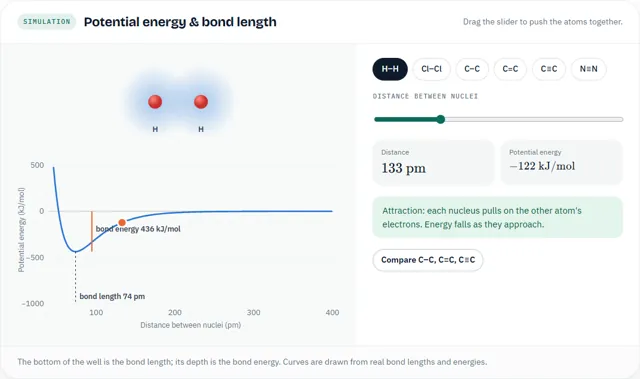
More shared electrons: shorter and stronger.
A single bond shares 2 electrons, a double 4, a triple 6. More overlap pulls the nuclei closer and holds them tighter.
| C–C single · 2 | 154 pm | 347 kJ/mol |
| C=C double · 4 | 134 pm | 614 kJ/mol |
| C≡C triple · 6 | 120 pm | 839 kJ/mol |
Length ↓ and strength ↑ as bond order rises.
Sigma and pi bonds
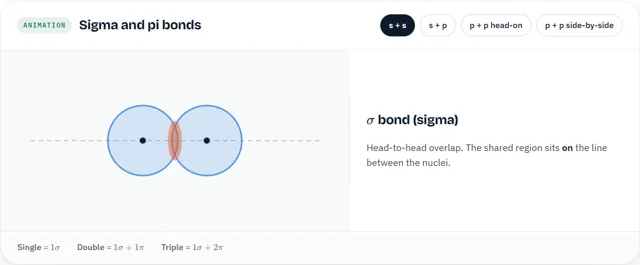
?How many and bonds are in HCN (H–C≡N)?Think, then tap to check
H–C is single (). C≡N is triple (). Total: and .
Metals & alloys
Cations in a sea of electrons.
Metal cations sit in an ordered lattice. Their valence electrons are delocalized: free to move anywhere. The metallic bond is the attraction between the cations and that electron sea.
The electrons carry the current.
Hammer into sheets, draw into wires.
Zn replaces some Cu: brass.
C between Fe atoms: steel.
Metal
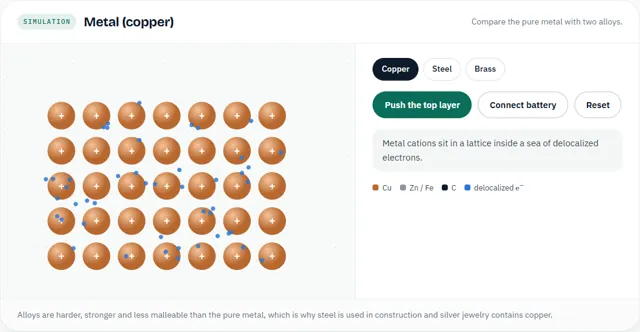
?Which particle diagram shows an interstitial alloy: two kinds of similar-sized atoms mixed, or small atoms sitting in the gaps between larger ones?Think, then tap to check
Small atoms in the gaps between larger ones. Similar-sized atoms swapping places is a substitutional alloy.
Lewis diagrams
Two rules.
1. Count the valence electrons. You can't use more or fewer than the atoms bring (add one for each negative charge).
2. Every atom gets a full shell: 8 electrons (an octet), or 2 for hydrogen.
The shortcut: have, need, share.
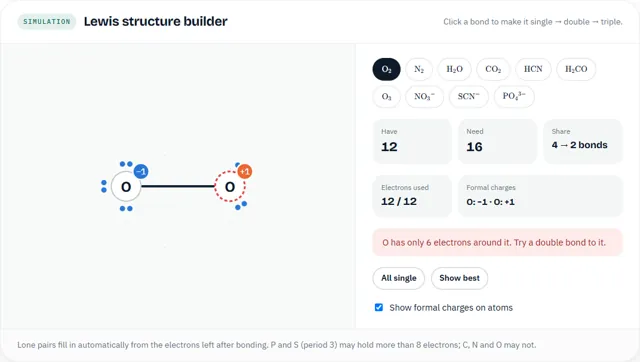
Add up what the atoms have and what they need for full shells. The difference must be shared. Two shared electrons make one bond.
Draw the Lewis diagram of .
- Have: valence electrons.
- Need: for two octets.
- Share: electrons → a double bond.
- Each O: electrons left = 2 lone pairs. Check: 12 electrons, both atoms have 8.
Draw the Lewis diagram of .
- Have: . Need: .
- Share: electrons → a triple bond.
- Each N: electrons → 1 lone pair.
- Check: electrons, and each N has 8.
Lewis structure builder
Formal charge & resonance
When more than one diagram works, compare formal charges.
All zeros beats +1 / −1.
If a −1 can't be avoided, put it on N rather than S.
: four P–O single bonds, or one P=O double bond and three singles?
- All singles: P . Each O .
- One double: P . The double-bonded O .
- The other three O are −1 in both, so compare only P and that one O.
- The P=O structure has charges closer to zero. (P is in period 3, so it can hold 10 electrons.)
: S–C≡N or S=C=N?
- S–C≡N: S , C , N .
- S=C=N: S , C , N .
- Both have one −1, so rule 1 is a tie.
- N is more electronegative than S, so S=C=N (−1 on N) is better.
Resonance: the real molecule is an average.
can put its double bond on either side. Neither picture is real. Both O–O bonds are actually identical, in between a single and a double bond.
Try and in the builder above and press "Next resonance structure".
?O=C=O or O≡C–O: which Lewis diagram of is better?Think, then tap to check
O=C=O: every atom has formal charge 0. In O≡C–O the oxygens are +1 and −1.
Shapes: VSEPR
Electron domains spread out as far as they can.
Count the electron domains around the central atom: each bond (single, double or triple counts once) and each lone pair. They repel, so they get as far apart as possible.
Lone pairs push harder than bonds, squeezing the bond angles.
| 2 domains · linear | 180° | |
| 3 domains · trigonal planar | 120° | |
| 4 domains · tetrahedral | 109.5° | |
| 5 domains · trigonal bipyramidal | 90°, 120° | – |
| 6 domains · octahedral | 90° | – |
Electron-domain geometry and hybridization. The molecular shape names only the atoms.
Molecule shapes
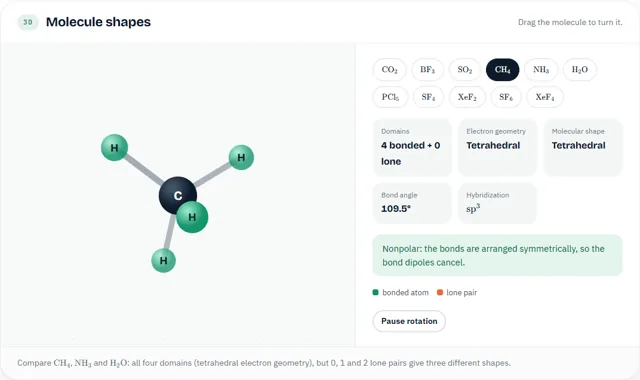
Find the shape, angle, hybridization and polarity of .
- Lewis: N has 3 single bonds to H and 1 lone pair.
- 4 domains → tetrahedral electron geometry, .
- 1 lone pair → molecular shape trigonal pyramidal, angle ≈ 107° (squeezed below 109.5°).
- The lopsided shape means the N–H dipoles don't cancel: polar.
? has polar C=O bonds. Is the molecule polar?Think, then tap to check
No. is linear, so the two bond dipoles point in opposite directions and cancel.
Everything on one screen
single · double · triple counting bonds2 · 3 · 4 domains → hybridizationlength: single > double > triplestrength is the reverseReady to test yourself?
146 exam-style questions on Unit 2, each with a worked explanation.
Stuck on a unit? Let us fix it this week.
Book a 30-minute one-to-one session for $20. Bring a test, a homework set or the topic that is not clicking.