 AP Chemistry Tutoring
Will it go?
Entropy, free energy and equilibrium in one equation, then the same idea running a battery.
The whole of Unit 9 in one video
Every topic in this unit explained step by step, with the simulations on this page, worked examples and quick checks. Watch it first, then work through the lessons and practice questions below.
Entropy
Entropy () measures dispersal.
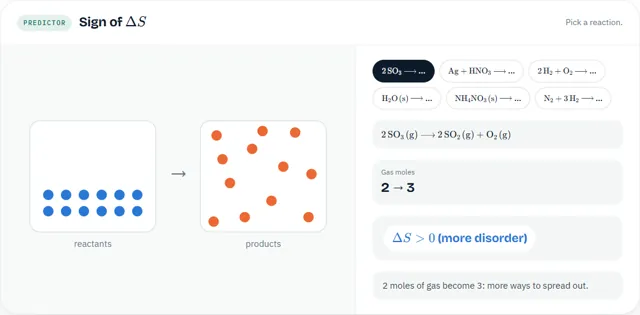
More ways to arrange the particles and their energy means higher entropy. To predict the sign of , count moles of gas first. Gas beats everything else.
Units: . Divide by 1000 before combining with in kJ.
: 2 → 3 mol gas.
A solid spreads out into ions.
: 4 → 2 mol gas.
Faster particles, more energy states.
Sign of
Gibbs free energy
One number decides: .
means thermodynamically favorable. Temperature sets how much entropy counts.
in kelvin. in (divide J by 1000).
| favorable at all | |
| never favorable | |
| favorable at low | |
| favorable at high |
against temperature
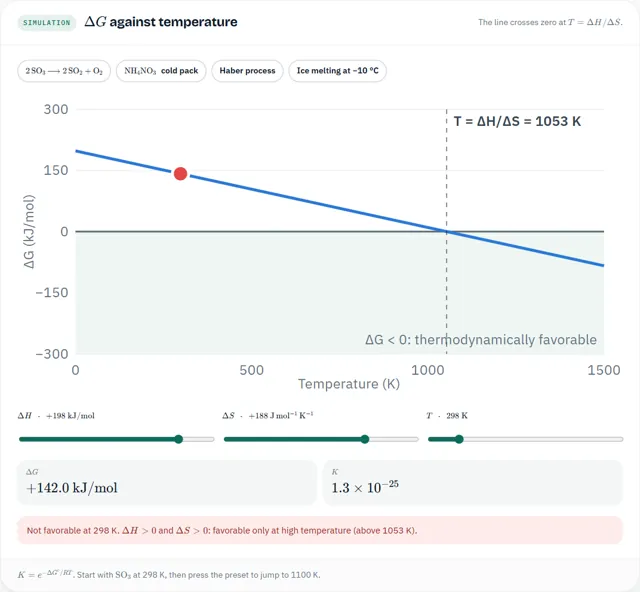
: , . Is it favorable at 25 °C? At what temperature does it become favorable?
- makes sense: 2 moles of gas become 3.
- At 298 K: . Not favorable.
- and : favorable only when outweighs .
has . Is it more favorable at 25 °C or at 95 °C?
- A gas () forms from no gas, so .
- and : the term is what makes negative.
- A larger makes more negative.
- More favorable at 95 °C.
Favorable ≠ fast.
has , yet diamonds last forever. The activation energy is enormous, so the reaction is under kinetic control: thermodynamics says it can happen, kinetics says not in your lifetime.
?A reaction has but no product forms after a week. Give one reason.Think, then tap to check
Free energy & equilibrium
and say the same thing.
. A negative means : products are favored at equilibrium.
Away from equilibrium, compare to : runs forward, runs in reverse.
| · products favored | |
| · reactants favored |
Coupled reactions.
An unfavorable step can be driven by pairing it with a very favorable one. Add the reactions; add their values.
| glucose + → glucose-6-phosphate | |
| glucose + ATP → glucose-6-phosphate + ADP |
?A reaction has at 298 K. Find .Think, then tap to check
. Positive, as expected for .
? of a salt is . After mixing, . Does a precipitate form?Think, then tap to check
Yes. , so the reaction runs in reverse (toward the solid) until .
Galvanic & electrolytic cells
An Ox, Red Cat.
Anode = oxidation. Reduction = cathode. True in every cell.
Electrons flow through the wire from anode to cathode. The salt bridge keeps both beakers neutral: anions drift to the anode, cations to the cathode.
Spontaneous. Makes electricity. Anode is (−).
A battery forces it. Anode is (+).
It wins the electrons.
; = moles of electrons transferred.
Build a cell
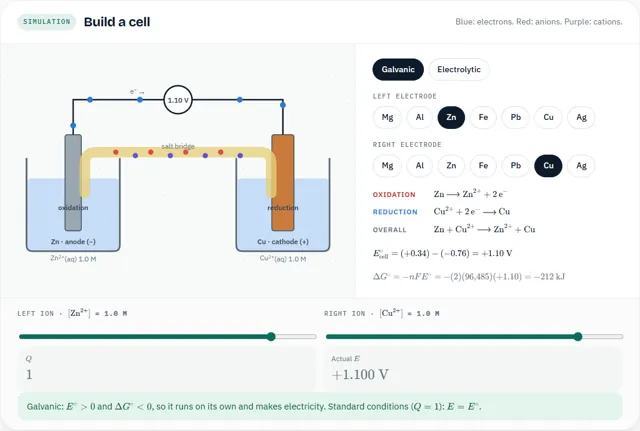
A cell is built from () and (). Find the overall reaction, and .
- has the higher , so silver is the cathode. Copper is oxidized at the anode.
- Reverse the copper half: (). Double the silver half for 2 electrons: (; is not doubled).
- Add: . .
- : favorable.
?In the / cell, which way do the electrons flow, and which electrode gains mass?Think, then tap to check
Electrons flow through the wire. is reduced to metal at the cathode, so the copper electrode gains mass and the zinc electrode loses mass.
Nonstandard cells & Faraday's law
Concentration moves the voltage.
Treat the cell like any equilibrium. A smaller (more reactant ions) raises . A larger (more product ions) lowers . At equilibrium and : the battery is dead.
The AP exam asks for the direction qualitatively. Try the concentration sliders on the cell above.
?In the / cell, is lowered to 0.010 M while stays at 1.0 M. Is above or below 1.10 V?Think, then tap to check
Current × time = charge. Charge ÷ = moles of electrons.
Then use the half-reaction's mole ratio to get moles of metal, and the molar mass to get grams.
| current in amperes () | |
| time in seconds | |
| per mole of |
Electroplating calculator
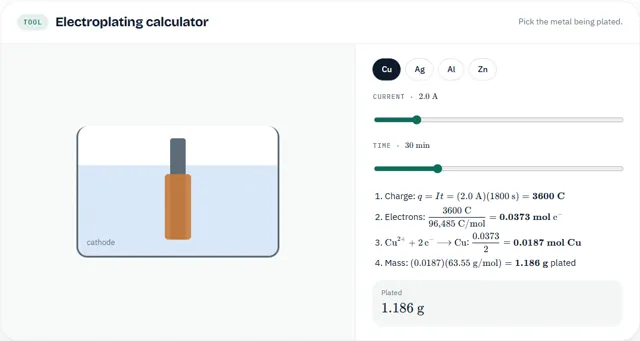
?How long does a 2.00 A current take to plate 1.00 g of copper from ?Think, then tap to check
; ; . .
?The same charge passes through and solutions. Which plates more moles of metal?Think, then tap to check
Silver, twice as many moles. needs 1 electron per atom; needs 2.
Topics in this unit
- 9.1Introduction to entropy
- 9.2Absolute entropy and entropy change
- 9.3Gibbs free energy and thermodynamic favorability
- 9.4Thermodynamic and kinetic control
- 9.5Free energy and equilibrium
- 9.6Coupled reactions
- 9.7Galvanic (voltaic) and electrolytic cells
- 9.8Cell potential and free energy
- 9.9Cell potential under nonstandard conditions
- 9.10Electrolysis and Faraday's law
Everything on one screen
Ready to test yourself?
174 exam-style questions on Unit 9, each with a worked explanation.
Stuck on a unit? Let us fix it this week.
Book a 30-minute one-to-one session for $20. Bring a test, a homework set or the topic that is not clicking.