 AP Chemistry Tutoring
How fast?
Diamond turning into graphite takes billions of years. Hydrogen and oxygen explode. Kinetics explains the difference, and how to speed a reaction up.

The whole of Unit 5 in one video
Every topic in this unit explained step by step, with the simulations on this page, worked examples and quick checks. Watch it first, then work through the lessons and practice questions below.
Reaction rate
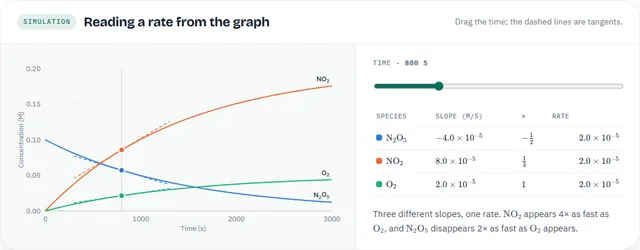
Rate = change in concentration per unit time.
Making a grilled cheese takes 5 minutes and uses 2 slices of bread and 1 slice of cheese. You can describe the speed as 1 sandwich, 2 slices of bread or 1 slice of cheese per 5 minutes. They all describe the same speed.
So divide each species' rate by its coefficient, and make reactants positive with a minus sign.
Reading a rate from the graph
Four ways to speed up a reaction.
More collisions per second. (For gases, higher pressure means higher concentration.)
Powdered sugar dissolves faster than a cube.
Why the fridge slows food spoiling.
Lowers the activation energy. Chapter 04.
Rate laws
The exponents are the orders. They come only from experiments, never from the coefficients of the balanced equation. That's the most common mistake in this unit.
Method: compare two trials where only one concentration changes. If doubling quadruples the rate, , so .
| Order 0 | double → rate unchanged |
| Order 1 | double → rate × 2 |
| Order 2 | double → rate × 4 |
Units of depend on the overall order: (0th), (1st), (2nd), (3rd).
Find the rate law
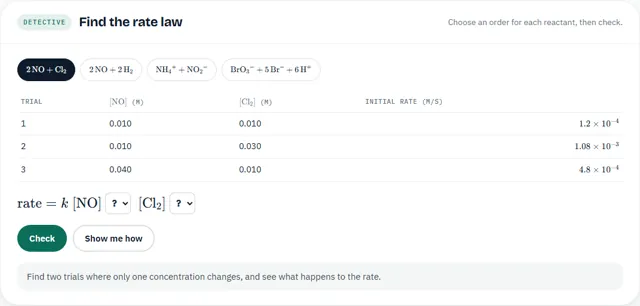
- : , so .
- : , so .
- : third order overall, even though the coefficients are 2 and 1.
Concentration over time
Find the straight line.
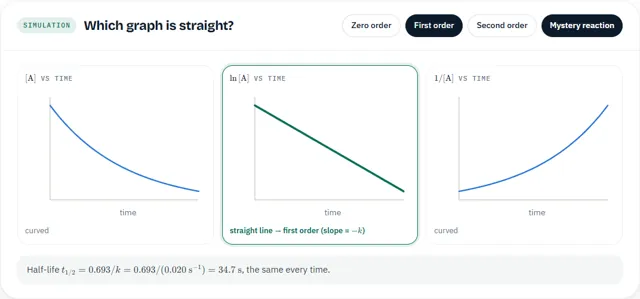
One experiment, three graphs. Whichever one is a straight line tells you the order.
| vs straight | zero order | |
| vs straight | first order | |
| vs straight | second order |
Which graph is straight?
A first-order reaction: falls 0.160 → 0.080 → 0.040 M, every 1.67 hours. Find .
- Concentration halves in equal times: constant half-life, so first order. .
- (on the formula sheet), so .
- . Always give units.
? at equal time steps gives = 2.00, 2.75, 3.50, 4.25 . What is the order?Think, then tap to check
Second order. rises by the same 0.75 each step: a straight line of against time.
Collisions & energy
Most collisions bounce off.
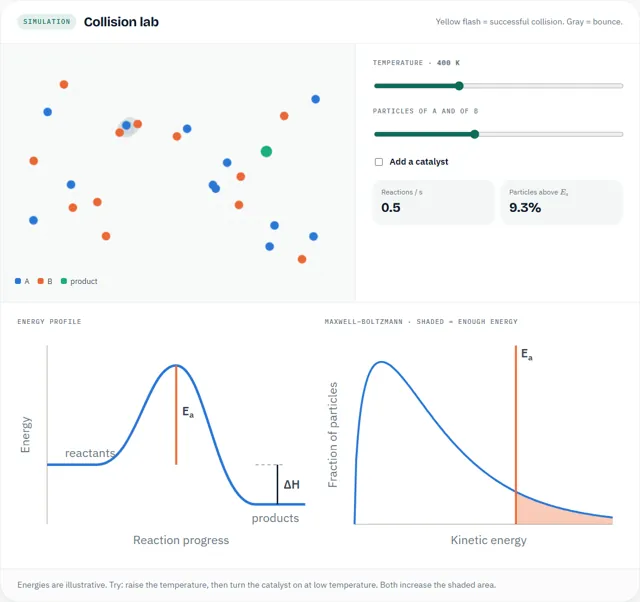
A collision only reacts if the particles have enough energy to break bonds (at least the activation energy, ) and the right orientation. Three particles meeting at once with both is so unlikely that elementary steps almost never involve more than two.
Why heat and catalysts work.
Higher temperature shifts the Maxwell–Boltzmann curve right: more particles clear . A catalyst gives a new pathway with a lower , so more particles clear it at the same temperature. doesn't change.
Collision lab
A catalyst is used, then given back.
Contact-lens cleaner: a platinum (or palladium) disc makes decompose fast, fizzing . The metal isn't used up. In a mechanism, a catalyst appears as a reactant first and a product later; an intermediate is the opposite.
One hump per step.
A two-step mechanism has two peaks on its energy profile. The step with the highest barrier is the slow, rate-determining step.
Reaction mechanisms
The recipe behind the equation.
A balanced equation is an ingredients list. A mechanism is the recipe: a series of elementary steps that add up to the overall equation.
For an elementary step (and only then) the coefficients are the orders.
The slowest step sets the pace.
Mixing pizza dough takes minutes; letting it rise takes hours. The slowest step is the rate-determining step, and its reactants give the rate law.
A valid mechanism must (1) add up to the overall equation and (2) give the experimental rate law.
Mechanism checker
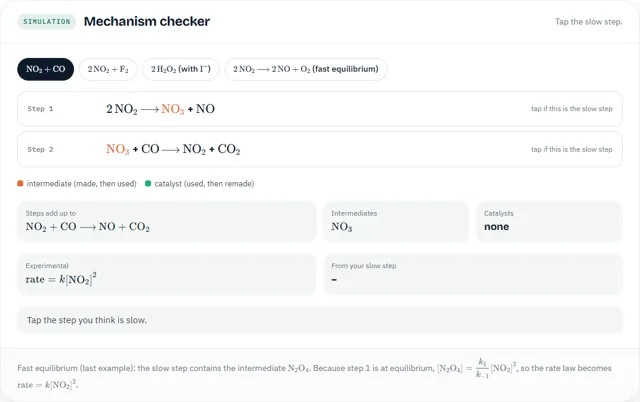
- Step 1 = overall − step 2. Move step 2's species to the opposite side and cancel.
- Step 1: ( is an intermediate).
- Slow step 1 has as reactants: . doesn't appear at all: zero order in .
Topics in this unit
- 5.1Reaction rates
- 5.2Introduction to rate law
- 5.3Concentration changes over time
- 5.4Elementary reactions
- 5.5Collision model
- 5.6Reaction energy profile
- 5.7Introduction to reaction mechanisms
- 5.8Reaction mechanism and rate law
- 5.9Steady-state approximation
- 5.10Multistep reaction energy profile
- 5.11Catalysis
Everything on one screen
slow step → rate lawrate-determining stepReady to test yourself?
180 exam-style questions on Unit 5, each with a worked explanation.
Stuck on a unit? Let us fix it this week.
Book a 30-minute one-to-one session for $20. Bring a test, a homework set or the topic that is not clicking.