 AP Chemistry Tutoring
2.3 Structure of ionic solids
AP Chemistry Unit 2: Compound Structure and Properties · 1 simulation · 17 practice questions
Updated · Aligned to the AP Chemistry Course and Exam Description
An ionic solid is a three-dimensional lattice of cations and anions arranged to maximize attractions and minimize repulsions. The strength of the lattice follows Coulomb's law, : ions with larger charges and smaller radii attract more strongly, giving higher lattice energy and higher melting points. Ionic solids are brittle and conduct electricity only when melted or dissolved.
Ionic bonds & solids
Transfer, then attraction.
Na gives its one valence electron to Cl. Now and have opposite charges, and opposite charges attract. That attraction is the ionic bond.
The crystal lattice explains every property.
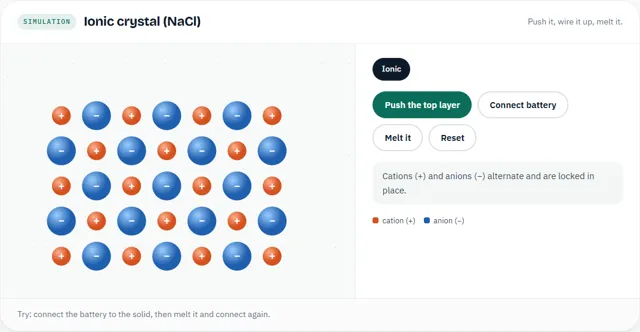
Cations and anions alternate in a fixed, ordered lattice. Each ion is held by all its neighbours.
Every ion is bonded to its neighbours, so the lattice resists being squeezed.
Like charges line up, repel, and the crystal cracks.
Lots of energy is needed to pull the ions apart.
Solid: no free charges. Liquid or aqueous: ions move.
Ionic crystal
How strong? Coulomb's law.
Bigger charges attract more. Smaller ions sit closer, and closer attracts much more.
Stronger attraction → higher melting point, more rigid.
Which lattice holds tighter?
Bar length = from ionic radii. Click a row.
Why does MgO melt at 2852 °C but NaCl at only 801 °C?
- Charges: is . is .
- Size: is smaller than (more protons, same shell). is smaller than (one fewer shell). So is smaller in MgO.
- Bigger and smaller : the attraction in MgO is several times stronger.
- Stronger ionic bonds need more energy to break → higher melting point.
?Does molten NaCl conduct electricity? Why?Think, then tap to check
Yes. Melting frees the and ions to move, and moving ions carry charge. In the solid they're locked in the lattice, so it doesn't conduct.
Study notes
Key concepts
The ionic lattice (SAP-3.C.1). An ionic solid is not made of separate "NaCl molecules". It is a systematic, repeating, three-dimensional array of cations and anions. The ions are arranged so that:
-
each cation is surrounded by anions and each anion is surrounded by cations, which maximizes the attractions between oppositely charged ions; and
-
ions of the same charge are kept as far apart as possible, which minimizes repulsions.
The chemical formula (NaCl, CaF₂, Al₂O₃) gives only the ratio of ions needed for electrical neutrality. This smallest whole-number ratio is called a formula unit.
Writing the formula from ion charges. The total positive charge must equal the total negative charge.
| Ions | Charge balance | Formula |
|---|---|---|
| Mg²⁺ and Cl⁻ | 1(+2) + 2(−1) = 0 | MgCl₂ |
| Al³⁺ and O²⁻ | 2(+3) + 3(−2) = 0 | Al₂O₃ |
| Ag⁺ and P³⁻ | 3(+1) + 1(−3) = 0 | Ag₃P |
| Ba²⁺ and H⁻ | 1(+2) + 2(−1) = 0 | BaH₂ |
| Ca²⁺ and PO₄³⁻ | 3(+2) + 2(−3) = 0 | Ca₃(PO₄)₂ |
Drawing a particulate model (what the AP exam looks for). When asked to draw or choose a particle diagram of an ionic solid, check four things:
-
Alternation. Every cation's nearest neighbours are anions and vice versa. No two like charges touch.
-
Correct ratio. For CaF₂ there must be twice as many F⁻ as Ca²⁺ in the drawing.
-
Relative sizes. Draw ions to scale relative to each other. Within a period, cations are smaller than anions (Na⁺ 102 pm, Cl⁻ 181 pm). Down a group, ions get larger (K⁺ > Na⁺; I⁻ > Cl⁻). A cation can be larger than an anion when the cation is from a much lower period (Cs⁺ 167 pm vs F⁻ 133 pm; K⁺ 138 pm vs F⁻ 133 pm).
-
No bonds drawn as lines and no molecules. Show a continuous array, not isolated pairs.
In words, a correct diagram of KI(s) is a square grid of circles in which large I⁻ circles alternate with slightly smaller K⁺ circles in every row and every column, extending to the edges of the box.
Linking structure to macroscopic properties.
| Property | Particle-level explanation |
|---|---|
| High melting point | Many strong Coulombic attractions must be overcome for ions to move past each other. |
| Hard but brittle | A force that shifts one layer of ions by half an ion spacing puts like charges next to each other. Repulsion pushes the layers apart and the crystal shatters along a plane. |
| Does not conduct as a solid | Ions are held in fixed positions; electrons are localized on the ions. |
| Conducts when molten or dissolved | Ions are free to move and carry charge. |
| Many dissolve in water | Polar water molecules surround and separate the ions (ion–dipole attractions, Unit 3). |
Not tested. The CED states that knowledge of specific crystal structures (for example, the rock-salt or cesium chloride unit cell) will not be assessed. You do need to know the general principle of alternating charges and the effect of ion charge and size.
Common misconceptions.
-
"A 2:1 formula means the anion is twice as charged" is only true if the cation has charge +1; always check charges.
-
"All cations are smaller than all anions." This holds only when comparing ions from the same period.
-
Diagrams that show Na⁺ and Cl⁻ as identical-size circles, or that pair ions into separate NaCl units, lose points.
Worked examples
Worked example 2.3-A. Choosing an ion pair from a description. An ionic compound has a cation-to-anion ratio of 2:1, and in its particle diagram the cations are drawn larger than the anions. Which pair fits: Li⁺ and S²⁻, Ag⁺ and S²⁻, or Na⁺ and Cl⁻?
Step 1. A 2:1 ratio needs a 1+ cation with a 2− anion, so Na⁺/Cl⁻ (1:1) is out.
Step 2. Size: S²⁻ is about 184 pm. Li⁺ is about 76 pm (smaller). Ag⁺ is about 115 pm (still smaller than S²⁻). Neither cation is actually larger than S²⁻. A better pair for the description is K⁺ (138 pm) with O²⁻ (140 pm, nearly equal) or Rb⁺ (152 pm) with O²⁻ (140 pm), which gives Rb₂O with the cation larger than the anion.
The lesson: always compare real sizes using periodic trends rather than guessing.
Worked example 2.3-B. Explaining brittleness. A crystal of NaCl is struck with a hammer and splits cleanly. Explain.
In the lattice, rows of ions alternate Na⁺, Cl⁻, Na⁺, Cl⁻. A sharp force shifts one plane of ions relative to the next by one ion position. Now Na⁺ sits next to Na⁺ and Cl⁻ sits next to Cl⁻ across the plane. The like charges repel strongly, so the two halves are pushed apart and the crystal cleaves.
Unit 2 study guide: exam-style free-response set, worksheet and answers.
Worked example
- has and ions; the others have and ions, so has the strongest attractions.
- is smaller than , so the ions in are closer together and attract more strongly than in .
- Stronger Coulombic attraction gives a higher melting point.
- Answer:
Free-response practice
Write your answer first, then open the solution and mark yourself against it.
FRQ 2.3-1. Calcium fluoride, CaF₂, is an ionic solid. Radii: Ca²⁺ 100 pm, F⁻ 133 pm.
(a) Describe, in words, a particle diagram of CaF₂(s) that is consistent with Coulomb's law and the relative sizes of the ions. Include at least three specific features.
(b) CaF₂ does not conduct electricity as a solid but conducts when melted. Explain.
(c) Explain why CaF₂ is brittle.
Show the solution
(a) Any three of the following, 1 point each (maximum 2 points): ions in a regular repeating array; each Ca²⁺ surrounded only by F⁻ ions (and each F⁻ by Ca²⁺ ions), with no like charges adjacent; twice as many F⁻ as Ca²⁺; F⁻ drawn larger than Ca²⁺; no lines or discrete molecules.
(b) In the solid the ions are fixed in lattice positions and cannot move. In the melt the ions are mobile and carry charge. 1 point.
(c) Displacing one layer of ions relative to its neighbour brings like-charged ions together; the repulsion splits the crystal. 1 point.
Common mistake
Students say an ionic solid does not conduct because it has no ions. It has ions, but they are locked in fixed positions; conduction requires mobile charged particles, which exist only in the molten state or in solution.
Frequently asked questions
?Why are ionic compounds brittle?
A force that shifts one layer of ions moves cations next to cations and anions next to anions; the repulsion splits the crystal.
?Does a larger ion mean a stronger ionic bond?
No. Larger ions have a larger distance between nuclei, which weakens the Coulombic attraction and lowers the lattice energy.
Practice questions on 2.3
- Q1Which compound has the largest lattice energy?
- Q2Does molten (liquid) NaCl conduct electricity?
- Q3A layer of an ionic crystal is pushed so that it shifts by one ion. Which property does this explain?
- Q4Why does MgO have a much higher melting point than NaCl?
- Q5Magnesium reacts with hydrogen gas to form an ionic hydride. What is its formula?
- Q6What is the empirical formula of the compound formed between silver and phosphorus, if silver forms Ag⁺ and phosphorus forms P³⁻?
- Q7A sample of an ionic solid is placed in a hydraulic press and squeezed until it fails. What is the most likely result?
- Q8Which description of a correct particle diagram of solid potassium iodide, KI(s), is best?
- Q9One mole of each solid is dissolved in water. Which gives the largest number of moles of ions?
- Q10Calcium reacts with bromine. What is the product?
- Q11Which ions form a compound with a 2:1 cation-to-anion ratio in which the cation is larger than the anion?
- Q12Which conducts electricity and has a cation larger than its anion?
- Q13Aluminium reacts with selenium. What is the formula of the product?
- Q14One mole of each compound is dissolved in water. Which releases the most moles of ions?
- Q15An ionic crystal is struck with a hammer. What happens, and why?
- Q16In solid NaCl, each ion is directly surrounded by:
- Q17Lithium reacts with hydrogen gas. What is the product, and what type of bonding does it have?
Terms used in this topic
Stuck on a unit? Let us fix it this week.
Book a 30-minute one-to-one session for $20. Bring a test, a homework set or the topic that is not clicking.
Book a session