 AP Chemistry Tutoring
2.4 Structure of metals and alloys
AP Chemistry Unit 2: Compound Structure and Properties · 1 simulation · 19 practice questions
Updated · Aligned to the AP Chemistry Course and Exam Description
Metals are modeled as a lattice of cations in a sea of delocalized valence electrons, which explains their conductivity, malleability and ductility. Alloys are mixtures of a metal with other elements: in a substitutional alloy (e.g. brass, and ) atoms of similar size replace host atoms; in an interstitial alloy (e.g. steel, in ) much smaller atoms fill the gaps between host atoms.
Metals & alloys
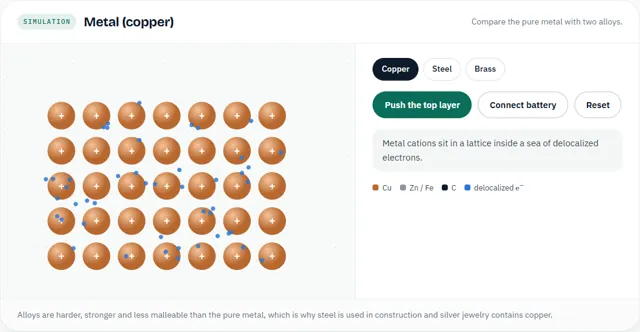
Cations in a sea of electrons.
Metal cations sit in an ordered lattice. Their valence electrons are delocalized: free to move anywhere. The metallic bond is the attraction between the cations and that electron sea.
The electrons carry the current.
Hammer into sheets, draw into wires.
Zn replaces some Cu: brass.
C between Fe atoms: steel.
Metal
?Which particle diagram shows an interstitial alloy: two kinds of similar-sized atoms mixed, or small atoms sitting in the gaps between larger ones?Think, then tap to check
Small atoms in the gaps between larger ones. Similar-sized atoms swapping places is a substitutional alloy.
Study notes
Key concepts
The electron-sea model (SAP-3.D.1). A metallic solid is represented as a regular array of positive metal ions (the nuclei plus core electrons) surrounded by a "sea" of delocalized valence electrons. The bonding is the attraction between the cations and the mobile electron sea. It is non-directional: each cation is attracted to the electron sea all around it, not to one particular neighbour.
This one model explains the typical metallic properties:
| Property | Explanation from the electron-sea model |
|---|---|
| Electrical conductivity (solid and liquid) | Delocalized electrons move freely when a voltage is applied. |
| Thermal conductivity | Mobile electrons carry kinetic energy quickly through the solid. |
| Malleable (hammered into sheets) and ductile (drawn into wires) | Layers of cations can slide past each other; the electron sea moves with them, so no strong repulsions develop and the bonding is not broken. |
| Shiny lustre | Free electrons absorb and re-emit light over many wavelengths. |
| Wide range of melting points | More valence electrons per atom and smaller cations give stronger metallic bonding (Na melts at 98 °C; Fe at 1538 °C). |
Compare this with an ionic solid: shifting a layer of ions brings like charges together, so ionic solids shatter; shifting a layer of a metal does not, so metals bend.
Alloys. An alloy is a mixture of a metal with one or more other elements that still has metallic properties. Alloys are made to change properties such as hardness, strength, corrosion resistance or colour. The CED requires two types.
Interstitial alloys (SAP-3.D.2). These form when the added atoms are much smaller than the host metal atoms. The small atoms fit into the interstices (the holes) between the larger host atoms; they do not replace any host atoms. The classic example is steel: carbon atoms (radius about 77 pm) sit in the holes between iron atoms (radius about 126 pm). Typical small interstitial atoms are H, B, C and N.
Substitutional alloys (SAP-3.D.3). These form when the two kinds of atom have comparable radii. Atoms of the added element take the place of (substitute for) host atoms at lattice sites. The classic example is brass, in which zinc atoms (about 134 pm) replace some copper atoms (about 128 pm).
| Alloy | Main components | Type |
|---|---|---|
| Carbon steel | Fe with up to about 2% C | interstitial |
| Brass | Cu with Zn | substitutional |
| Bronze | Cu with Sn | substitutional |
| Sterling silver | 92.5% Ag with Cu | substitutional |
| 14-karat gold | Au with Ag and Cu | substitutional |
| Stainless steel | Fe with Cr and Ni (substitutional) plus a little C (interstitial) | both |
A useful guide: if the radii differ by less than roughly 15%, a substitutional alloy is possible; if the added atom is much smaller (often a nonmetal from period 2), it goes into interstitial holes.
How alloying changes properties. (The CED states these in SAP-5.B.6, Unit 3, but they are always tested together with this topic.)
-
Rigidity, malleability and ductility. In a pure metal the identical atoms form smooth layers that slide easily. Interstitial atoms sit in the holes between layers and act like pins, so the lattice becomes more rigid and the alloy is less malleable and less ductile (steel is much harder than iron). In substitutional alloys, the slightly different-sized atoms make the layers bumpy, which also makes sliding harder, so brass is harder than copper.
-
Conductivity. Alloys keep a sea of mobile electrons, so they still conduct electricity and heat. Conductivity is usually a little lower than that of the pure host metal because the irregular lattice scatters the electrons.
-
Density. In the simple model, interstitial atoms add mass while hardly changing the volume of the host lattice, so an interstitial alloy tends to have a higher density than the pure metal. Real alloys don't always follow the model: carbon steel (about ) is even very slightly less dense than pure iron (), because the carbon atoms push the iron atoms a little apart. When a question says "according to the particle model", give the model's answer. For a substitutional alloy, density goes up or down depending on whether the substituting atom has a greater or smaller mass (and size) than the host atom it replaces.
Describing a particle diagram. A correct diagram of a pure metal is an orderly array of identical circles (cations), with the space understood to hold the electron sea; some diagrams show small dots or minus signs scattered among the cations. An interstitial alloy shows the same array of large circles with small circles sitting in the gaps between them; no large circles are missing. A substitutional alloy shows an orderly array of circles of nearly the same size, two different shadings, with the second kind occupying some ordinary lattice positions.
Common misconceptions.
-
"Steel is a compound of iron and carbon." Steel is a mixture (alloy) with variable composition, not a compound with a fixed formula.
-
"In steel, carbon atoms replace iron atoms." That would be substitutional. Carbon is far too small; it goes into holes.
-
"Alloys don't conduct." They do, because the electron sea remains.
Worked examples
Worked example 2.4-A. Choosing an alloying element. Approximate atomic radii: Cu 128 pm, Ni 124 pm, Ag 144 pm, C 77 pm, N 75 pm. Which element would most likely form (a) a substitutional alloy with Cu, (b) an interstitial alloy with Cu?
(a) Ni. Its radius differs from Cu by only (128 − 124)/128 × 100 = 3%. Cu and Ni in fact mix in all proportions (cupronickel, used in coins).
(b) C or N, which are much smaller than Cu (about 40% smaller) and can fit in the holes.
Worked example 2.4-B. Explaining why steel is harder than iron. In pure iron, all atoms are the same size and pack in regular layers. When a force is applied, whole layers slide past each other, so iron bends easily. In steel, small carbon atoms occupy holes between iron atoms. These carbon atoms disrupt the regular layers and get in the way of sliding, so more force is needed to deform the metal. The steel is harder and less malleable, but it still conducts because the delocalized electrons are still present.
Unit 2 study guide: exam-style free-response set, worksheet and answers.
Worked example
- Carbon atoms are much smaller than iron atoms, so they fit in the spaces between iron atoms: an interstitial alloy.
- The interstitial atoms disrupt the regular layers and make it harder for layers to slide past one another.
- Answer: An interstitial alloy (steel) that is harder and less malleable than pure iron.
Free-response practice
Write your answer first, then open the solution and mark yourself against it.
FRQ 2.4-1. Sterling silver is 92.5% silver and 7.5% copper by mass. Approximate atomic radii: Ag 144 pm, Cu 128 pm.
(a) Identify sterling silver as an interstitial or a substitutional alloy. Justify your answer using the atomic radii.
(b) Describe, in words, a particle diagram of a small region of sterling silver.
(c) Pure silver is softer than sterling silver. Explain at the particle level.
(d) Would you expect sterling silver to conduct electricity? Explain.
Show the solution
(a) Substitutional. The radii differ by (144 − 128)/144 × 100 = 11%, so Cu atoms are similar enough in size to take the place of Ag atoms at lattice sites. Cu is far too large to fit into the holes between Ag atoms. 1 point.
(b) An orderly array of circles of nearly the same size, mostly one type (Ag), with a few slightly smaller circles of a second type (Cu) occupying regular lattice sites in place of Ag atoms; no atoms in the gaps. 1 point.
(c) In pure silver the identical atoms form regular layers that slide past each other easily. The slightly smaller Cu atoms distort the layers, so it is harder for the layers to slide, and the alloy resists deformation. 1 point.
(d) Yes. The alloy still consists of metal cations surrounded by a sea of delocalized valence electrons that can move when a voltage is applied. 1 point.
FRQ 2.4-2. A student has samples of pure iron and of an interstitial alloy of iron containing nitrogen atoms (nitrided iron).
(a) Explain why nitrogen forms an interstitial rather than a substitutional alloy with iron.
(b) According to the particle model of an interstitial alloy, predict whether the alloy has a greater or smaller density than pure iron. Justify your prediction.
(c) Predict which sample is more ductile. Justify.
Show the solution
(a) N atoms (about 75 pm) are much smaller than Fe atoms (about 126 pm), so they fit into the spaces between Fe atoms rather than replacing them. 1 point.
(b) Greater. The N atoms add mass but occupy holes that were empty, so the volume of the lattice changes very little; more mass in about the same volume means higher density. 1 point.
(c) Pure iron is more ductile. In the alloy, N atoms in the holes pin the layers of Fe atoms, making the lattice more rigid so layers cannot slide as easily. 1 point.
Common mistake
Students think alloys are compounds with a fixed formula. Alloys are mixtures, so their composition can vary and they keep metallic properties such as conductivity.
Frequently asked questions
?Why do metals conduct electricity?
Their valence electrons are delocalized and free to move through the whole lattice, so they carry charge when a voltage is applied.
?Is brass interstitial or substitutional?
Substitutional: copper and zinc atoms are similar in size, so zinc atoms take the place of some copper atoms.
Practice questions on 2.4
- Q1Steel contains carbon atoms in the spaces between much larger iron atoms. Steel is best described as
- Q2Why can a metal be hammered into a thin sheet without breaking?
- Q3Why is a solid metal a good conductor of electricity?
- Q4Brass is made by replacing some copper atoms with zinc atoms of similar size. Brass is
- Q5Brass is made by mixing copper and zinc. Which statement best describes brass?
- Q6A chemist wants to make an interstitial alloy with iron (atomic radius about 126 pm). Which element is the best choice?
- Q7Which statement correctly compares steel (Fe with about 1% C) with pure iron?
- Q8Which model best describes the bonding in a solid metal?
- Q9Pure copper and pure aluminium are both very malleable. An alloy of the two is much less malleable. The best explanation is that
- Q10A particle diagram shows a regular array of large circles with small circles located in the spaces between some of the large circles. No large circles are missing. The diagram best represents
- Q11According to the particle model of alloys, adding a small amount of carbon to iron to make steel is expected to
- Q12Copper (128 pm) is alloyed with a small amount of each element below. Based on atomic radii, which alloy is likely to be the most rigid?
- Q13Steel contains carbon atoms in the spaces between iron atoms. According to the particle model, how does steel compare with pure iron?
- Q14Which element is best for forming a substitutional alloy with Ni (124 pm)?
- Q15Which element is most likely to form an interstitial alloy with Ti (147 pm)?
- Q16Why are metals malleable?
- Q17Nickel and copper have very similar atomic radii. What type of alloy do they form?
- Q18Brass (Cu and Zn) is harder and less malleable than pure copper. Why?
- Q19Which model best describes metallic bonding?
Terms used in this topic
Stuck on a unit? Let us fix it this week.
Book a 30-minute one-to-one session for $20. Bring a test, a homework set or the topic that is not clicking.
Book a session