 AP Chemistry Tutoring
2.5 Lewis diagrams
AP Chemistry Unit 2: Compound Structure and Properties · 1 simulation · 15 practice questions
Updated · Aligned to the AP Chemistry Course and Exam Description
A Lewis diagram shows how the valence electrons of a molecule or ion are arranged as bonding pairs and lone pairs. To draw one, count the total valence electrons (adding electrons for negative charge and removing them for positive charge), connect atoms with single bonds, complete octets on outer atoms, and form multiple bonds if the central atom lacks an octet, e.g. has 10 valence electrons.
Lewis diagrams
Two rules.
1. Count the valence electrons. You can't use more or fewer than the atoms bring (add one for each negative charge).
2. Every atom gets a full shell: 8 electrons (an octet), or 2 for hydrogen.
The shortcut: have, need, share.
Add up what the atoms have and what they need for full shells. The difference must be shared. Two shared electrons make one bond.
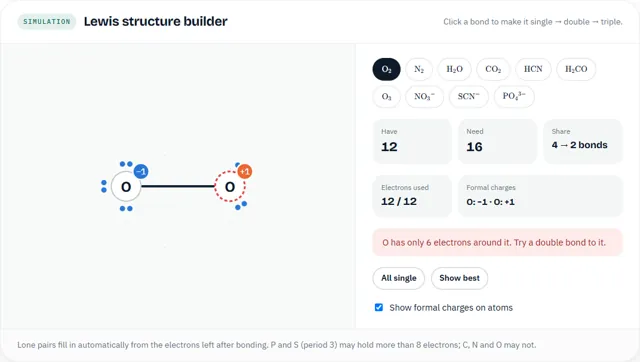
Draw the Lewis diagram of .
- Have: valence electrons.
- Need: for two octets.
- Share: electrons → a double bond.
- Each O: electrons left = 2 lone pairs. Check: 12 electrons, both atoms have 8.
Draw the Lewis diagram of .
- Have: . Need: .
- Share: electrons → a triple bond.
- Each N: electrons → 1 lone pair.
- Check: electrons, and each N has 8.
Lewis structure builder
Study notes
Key concepts
What a Lewis diagram shows (SAP-4.A.1). A Lewis diagram (Lewis electron-dot diagram) shows how the valence electrons are arranged in a molecule or polyatomic ion. Each bonding pair is drawn as a line between two atom symbols (a single bond is one line, a double bond two lines, a triple bond three lines). Each nonbonding pair (lone pair) is drawn as a pair of dots on one atom. Only valence electrons appear.
How diagrams are described here. Because these notes have no drawings, Lewis diagrams are written in a line form with the lone pairs listed in words. For example, "O=C=O, two lone pairs on each O" means the drawing with the C in the middle, a double bond to each O, and two pairs of dots on each O. On the exam you must draw all the dots.
Lewis symbols for atoms. The number of dots equals the number of valence electrons, which equals the last digit of the group number for main-group elements: H 1, C 4, N 5, O 6, F 7, Ne 8. Atoms usually form enough bonds to complete an octet: C forms 4 bonds, N 3 bonds (plus 1 lone pair), O 2 bonds (plus 2 lone pairs), halogens 1 bond (plus 3 lone pairs), H 1 bond (no lone pairs).
The octet rule. Atoms in molecules tend to have eight valence electrons around them (counting both electrons of every bond they are in plus their own lone pairs). Hydrogen is satisfied with two.
Step-by-step method.
-
Count the total valence electrons. Add the valence electrons of all atoms. For an anion add one electron per negative charge; for a cation subtract one per positive charge.
-
Choose the skeleton. The central atom is usually the least electronegative atom that is not hydrogen (C in CO₂, S in SO₄²⁻, N in NO₃⁻). Hydrogen and fluorine are always terminal (they form only one bond). Formulas are often written in bonding order (HCN means H–C–N), and in oxyacids the acidic H is bonded to O (HNO₃ is H–O–N with two more O on N).
-
Connect the atoms with single bonds. Each bond uses 2 electrons.
-
Complete the octets of the outer (terminal) atoms with lone pairs (H gets none).
-
Put any remaining electrons on the central atom as lone pairs, even if this gives it more than eight (allowed only for period 3 and below).
-
If the central atom has fewer than eight electrons, make multiple bonds. Move a lone pair from a terminal atom into a bond with the central atom, turning a single bond into a double (or triple) bond, until the central atom has an octet.
-
Check: total electrons drawn equals the count in step 1; every atom has an appropriate count; ions go in square brackets with the charge written outside at the upper right.
Exceptions to the octet rule.
| Kind of exception | Examples | Notes |
|---|---|---|
| Incomplete octet (fewer than 8) | BeCl₂ (4 electrons on Be), BF₃ and BH₃ (6 on B), AlCl₃ molecule (6 on Al) | Be and B (and Al in molecules) are stable with fewer than 8. Such molecules are electron-deficient and act as Lewis acids (BF₃ + NH₃ → F₃B–NH₃). |
| Expanded octet (more than 8) | PCl₅ (10 on P), SF₄ (10 on S), SF₆ (12 on S), XeF₂ (10 on Xe), XeF₄ (12 on Xe), I₃⁻ (10 on central I) | Only central atoms from period 3 or below (n ≥ 3). Period-2 atoms (C, N, O, F) can never exceed 8. |
| Odd number of electrons | NO (11), NO₂ (17), ClO₂ (19) | At least one atom must have an unpaired electron and cannot have an octet. This is a limitation of the Lewis model (SAP-4.B.3). |
Fully worked set of common diagrams.
| Species | Total valence e⁻ | Lewis diagram in words |
|---|---|---|
| CH₄ | 4 + 4(1) = 8 | C with four single bonds to H; no lone pairs |
| NH₃ | 5 + 3 = 8 | N with three single bonds to H; one lone pair on N |
| H₂O | 6 + 2 = 8 | O with two single bonds to H; two lone pairs on O |
| CO₂ | 4 + 2(6) = 16 | O=C=O; two lone pairs on each O; none on C |
| HCN | 1 + 4 + 5 = 10 | H–C≡N; one lone pair on N |
| CH₂O (formaldehyde) | 2 + 4 + 6 = 12 | C central, single bonds to two H, double bond to O; two lone pairs on O |
| CN⁻ | 4 + 5 + 1 = 10 | [C≡N]⁻; one lone pair on C and one on N |
| NH₄⁺ | 5 + 4 − 1 = 8 | [N with four single bonds to H]⁺; no lone pairs |
| SiF₄ | 4 + 4(7) = 32 | Si with four single bonds to F; three lone pairs on each F |
| BF₃ | 3 + 3(7) = 24 | B with three single bonds to F; three lone pairs on each F; only 6 electrons on B |
| PCl₅ | 5 + 5(7) = 40 | P with five single bonds to Cl; three lone pairs on each Cl; none on P |
| SF₄ | 6 + 4(7) = 34 | S with four single bonds to F; three lone pairs on each F; one lone pair on S |
| XeF₂ | 8 + 2(7) = 22 | F–Xe–F; three lone pairs on each F; three lone pairs on Xe |
| C₂H₄ | 2(4) + 4 = 12 | H₂C=CH₂ (each C has two H and the C=C double bond); no lone pairs |
| CH₃OH | 4 + 4 + 6 = 14 | C with three H and a single bond to O; O bonded to one H; two lone pairs on O |
Common errors that lose points.
-
Wrong electron count, especially forgetting the extra electrons of an anion.
-
Forgetting lone pairs on terminal atoms (each F, Cl, Br, I needs three).
-
Giving C, N, O or F more than eight electrons.
-
Putting H in the middle or giving it two bonds.
-
Leaving the brackets and charge off a polyatomic ion.
Worked examples
Worked example 2.5-A. Nitric acid, HNO₃.
Step 1. Valence electrons: H 1 + N 5 + 3 O × 6 = 24.
Step 2. Skeleton: N is central with three O atoms around it; H is attached to one O.
Step 3. Four single bonds (H–O, O–N, N–O, N–O) use 8 electrons; 16 remain.
Step 4. Complete octets of the O atoms: the O bonded to H needs 2 lone pairs (4 e⁻), and each of the other two O atoms needs 3 lone pairs (6 e⁻ each). That uses 4 + 12 = 16 electrons; 0 remain.
Step 5. N has only three bonds (6 electrons). Move one lone pair from one of the terminal O atoms into a N=O double bond.
Result: H–O–N(=O)–O, meaning N has one double bond to an O (two lone pairs on that O), one single bond to another O (three lone pairs), and one single bond to the O–H oxygen (two lone pairs); N has no lone pairs. Check: 4 bonds plus 1 extra bond = 5 bonding pairs (10 e⁻) plus 7 lone pairs (14 e⁻) = 24. Correct.
Worked example 2.5-B. Sulfur tetrafluoride, SF₄ (expanded octet).
Step 1. Valence electrons: 6 + 4 × 7 = 34.
Step 2–3. S central, four S–F single bonds: 8 electrons used, 26 left.
Step 4. Each F gets 3 lone pairs: 4 × 6 = 24 electrons used, 2 left.
Step 5. Put the last pair on S. S now has 4 bonding pairs + 1 lone pair = 10 electrons. This is allowed because S is in period 3.
Worked example 2.5-C. Cyanide ion, CN⁻.
Valence electrons: 4 + 5 + 1 = 10. A single bond (2 e⁻) leaves 8; giving N three lone pairs (6) and C one lone pair (2) leaves C with only 4 electrons. Convert two lone pairs from N into bonds: triple bond. Result: [C≡N]⁻ with one lone pair on C and one on N. Each atom has 8 electrons; 3 × 2 + 2 + 2 = 10. Correct.
Unit 2 study guide: exam-style free-response set, worksheet and answers.
Worked example
- Valence electrons: .
- Skeleton H-C-N uses 4 electrons; placing the remaining 6 as lone pairs on N leaves C with only 4 electrons.
- Convert two N lone pairs into bonds: a C-N triple bond gives C and N full octets, with one lone pair left on N.
- Answer: with one lone pair on nitrogen (10 electrons total).
Free-response practice
Write your answer first, then open the solution and mark yourself against it.
FRQ 2.5-1. (Modelled on 2018 AP FRQ Q2(d), nitrous acid Lewis diagram and nitrogen hybridization.) The skeleton of nitrous acid, HNO₂, is H–O–N–O.
(a) Calculate the total number of valence electrons in HNO₂.
(b) Complete the Lewis diagram, describing all bonds and lone pairs.
(c) Explain why the bond between N and the terminal O is shorter than the bond between N and the O that carries the H atom.
(d) Based on your diagram, identify the hybridization of the nitrogen atom.
Show the solution
(a) 1 + 5 + 2 × 6 = 18. 1 point.
(b) H–O–N=O: the O bonded to H has two lone pairs; N has one lone pair; the terminal O (double-bonded to N) has two lone pairs. Check: 4 bonding pairs (8 e⁻) + 5 lone pairs (10 e⁻) = 18. 1 point for correct electron count, 1 point for a valid arrangement in which every atom except H has an octet.
(c) The terminal N=O bond is a double bond (bond order 2), while the N–O bond to the OH oxygen is a single bond (bond order 1). More shared pairs between the nuclei make the bond shorter. 1 point.
(d) N has three electron domains (a single bond to O, a double bond to O, and one lone pair), so it is sp² hybridized. 1 point.
FRQ 2.5-2. Answer the following about BF₃ and NH₃.
(a) Draw (describe) the Lewis diagram of each molecule.
(b) Identify which molecule does not obey the octet rule and state how many electrons surround its central atom.
(c) BF₃ and NH₃ react to form a single product, F₃BNH₃. Using your diagrams, explain how a new B–N bond can form.
Show the solution
(a) BF₃: B with three single bonds to F, three lone pairs on each F, no lone pair on B (24 e⁻). NH₃: N with three single bonds to H and one lone pair on N (8 e⁻). 1 point.
(b) BF₃; B is surrounded by only 6 electrons. 1 point.
(c) N in NH₃ has a lone pair, and B in BF₃ has room for two more electrons. The N lone pair is shared with B to form a covalent B–N bond in which both electrons come from N; after this, both B and N have octets. 1 point.
Common mistake
Students forget to account for an ion's charge when counting electrons. For , subtract one: valence electrons.
Frequently asked questions
?Which atom goes in the middle of a Lewis structure?
Usually the least electronegative atom other than hydrogen, which can form only one bond.
?Can atoms have more than eight electrons?
Atoms in period 3 and below, such as S, P and Cl, can have expanded octets; period 2 atoms like C, N, O and F cannot exceed eight.
Practice questions on 2.5
- Q1How many lone pairs are on each nitrogen atom in the Lewis diagram of ?
- Q2How many valence electrons are shown in a correct Lewis diagram of the sulfite ion, SO₃²⁻?
- Q3In which species does the central atom have an expanded octet in its Lewis diagram?
- Q4A neutral molecule XF₃ has a Lewis diagram in which X forms three single bonds, each F has three lone pairs, and X has no lone pairs. X is most likely
- Q5Which describes the correct Lewis diagram of the cyanide ion?
- Q6Which of the following molecules has an odd number of valence electrons, so that its Lewis diagram cannot give every atom an octet?
- Q7In the correct Lewis diagram of XeF₂, how many lone pairs are on the xenon atom?
- Q8Which species exhibits resonance?
- Q9How many double bonds are in a correct Lewis structure of acetic acid, ?
- Q10In , which atom is stable with only six valence electrons?
- Q11Which species has the strongest carbon–oxygen bond?
- Q12How many lone pairs are on the central Xe atom in ?
- Q13Which describes the Lewis structure of ?
- Q14How many lone pairs in total are in the Lewis structure of ?
- Q15In one valid Lewis structure of , how many N=O double bonds are there?
Stuck on a unit? Let us fix it this week.
Book a 30-minute one-to-one session for $20. Bring a test, a homework set or the topic that is not clicking.
Book a session