 AP Chemistry Tutoring
2.7 VSEPR and bond hybridization
AP Chemistry Unit 2: Compound Structure and Properties · 1 simulation · 23 practice questions
Updated · Aligned to the AP Chemistry Course and Exam Description
VSEPR (valence shell electron pair repulsion) theory predicts molecular shape from the number of electron domains (bonds and lone pairs) around a central atom, which arrange to be as far apart as possible. Two, three and four domains give linear, trigonal planar and tetrahedral electron geometries with , and hybridization; lone pairs change the molecular shape and compress bond angles, e.g. is trigonal pyramidal at about .
Shapes: VSEPR
Electron domains spread out as far as they can.
Count the electron domains around the central atom: each bond (single, double or triple counts once) and each lone pair. They repel, so they get as far apart as possible.
Lone pairs push harder than bonds, squeezing the bond angles.
| 2 domains · linear | 180° | |
| 3 domains · trigonal planar | 120° | |
| 4 domains · tetrahedral | 109.5° | |
| 5 domains · trigonal bipyramidal | 90°, 120° | – |
| 6 domains · octahedral | 90° | – |
Electron-domain geometry and hybridization. The molecular shape names only the atoms.
Molecule shapes
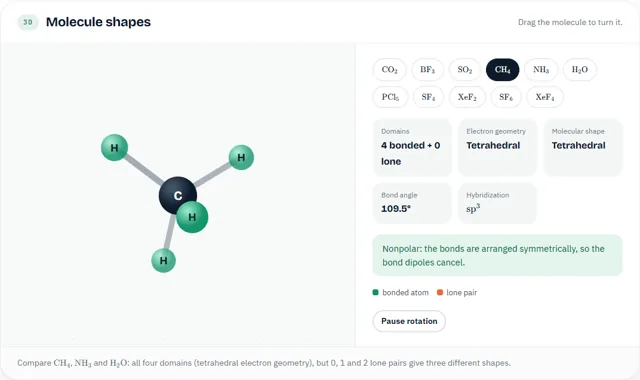
Find the shape, angle, hybridization and polarity of .
- Lewis: N has 3 single bonds to H and 1 lone pair.
- 4 domains → tetrahedral electron geometry, .
- 1 lone pair → molecular shape trigonal pyramidal, angle ≈ 107° (squeezed below 109.5°).
- The lopsided shape means the N–H dipoles don't cancel: polar.
? has polar C=O bonds. Is the molecule polar?Think, then tap to check
No. is linear, so the two bond dipoles point in opposite directions and cancel.
Study notes
Key concepts
The idea behind VSEPR (SAP-4.C.1). Valence-Shell Electron-Pair Repulsion (VSEPR) theory says that the groups of electrons around a central atom repel each other (they are all negative, so this is Coulombic repulsion) and therefore spread out to be as far apart as possible. The arrangement that minimizes repulsion fixes the shape of the molecule.
Electron domains. An electron domain is a region of electron density around the central atom. Count:
-
each lone pair as one domain;
-
each bond to another atom as one domain, whether it is single, double or triple (a double bond is still one region pointing toward one atom).
The number of domains gives the electron-domain geometry (also called electron-pair geometry). The molecular geometry describes only where the atoms are. If there are no lone pairs on the central atom, the two geometries are the same. If there are lone pairs, the molecular geometry is named from the atom positions only.
The VSEPR table. (A = central atom, X = bonded atom, E = lone pair.)
| Domains | Bonded atoms | Lone pairs | Type | Electron-domain geometry | Molecular geometry | Ideal bond angle(s) | Example |
|---|---|---|---|---|---|---|---|
| 2 | 2 | 0 | AX₂ | linear | linear | 180° | CO₂, BeCl₂, HCN |
| 3 | 3 | 0 | AX₃ | trigonal planar | trigonal planar | 120° | BF₃, SO₃, CO₃²⁻ |
| 3 | 2 | 1 | AX₂E | trigonal planar | bent | less than 120° (SO₂ 119°, NO₂⁻ 115°) | SO₂, O₃, NO₂⁻ |
| 4 | 4 | 0 | AX₄ | tetrahedral | tetrahedral | 109.5° | CH₄, NH₄⁺, SO₄²⁻ |
| 4 | 3 | 1 | AX₃E | tetrahedral | trigonal pyramidal | less than 109.5° (NH₃ 107°) | NH₃, PCl₃, H₃O⁺ |
| 4 | 2 | 2 | AX₂E₂ | tetrahedral | bent | less than 109.5° (H₂O 104.5°) | H₂O, H₂S, OF₂ |
| 5 | 5 | 0 | AX₅ | trigonal bipyramidal | trigonal bipyramidal | 90°, 120°, 180° | PCl₅ |
| 5 | 4 | 1 | AX₄E | trigonal bipyramidal | seesaw | about 90° and less than 120° | SF₄ |
| 5 | 3 | 2 | AX₃E₂ | trigonal bipyramidal | T-shaped | about 90° | ClF₃, BrF₃ |
| 5 | 2 | 3 | AX₂E₃ | trigonal bipyramidal | linear | 180° | XeF₂, I₃⁻ |
| 6 | 6 | 0 | AX₆ | octahedral | octahedral | 90°, 180° | SF₆ |
| 6 | 5 | 1 | AX₅E | octahedral | square pyramidal | about 90° | BrF₅, IF₅ |
| 6 | 4 | 2 | AX₄E₂ | octahedral | square planar | 90° | XeF₄, ICl₄⁻ |
Any molecule with only two atoms (HCl, O₂) is linear regardless of lone pairs.
Why lone pairs squeeze bond angles. A lone pair is held by only one nucleus, so its electron cloud is fatter and closer to the central atom than a bonding pair. Repulsions decrease in the order lone pair–lone pair > lone pair–bonding pair > bonding pair–bonding pair. Each added lone pair pushes the bonding pairs closer together:
| Molecule | Lone pairs on central atom | H–X–H angle |
|---|---|---|
| CH₄ | 0 | 109.5° |
| NH₃ | 1 | 107° |
| H₂O | 2 | 104.5° |
Multiple bonds also squeeze angles. A double bond holds more electron density than a single bond, so it repels more. In formaldehyde (H₂C=O) the H–C–H angle is about 116°, slightly less than 120°, and each H–C=O angle is a little more than 120°. On the AP exam an answer of 120° is accepted for "approximate" angles at an sp² carbon.
Five and six domains: where lone pairs go. In a trigonal bipyramid there are two kinds of position: three equatorial (in a triangle, 120° apart) and two axial (above and below, 90° from the equator). Lone pairs go into equatorial positions, where they have fewer 90° neighbours. This is why SF₄ is a seesaw, ClF₃ is T-shaped, and XeF₂ is linear. In an octahedron all positions are equal; with two lone pairs they go opposite each other (180° apart), giving square planar XeF₄. The CED says that for more than four electron pairs you are responsible only for the shape.
Large molecules. For molecules with several "central" atoms, describe the geometry around each atom separately. In ethanol (CH₃CH₂OH) each C is tetrahedral and the O is bent (C–O–H about 109.5°, approximate). In acetic acid (CH₃COOH) the CH₃ carbon is tetrahedral and the COOH carbon is trigonal planar.
Molecular polarity and dipole moment (SAP-4.C.2e). A molecule has a dipole moment (is polar) when its bond dipoles do not cancel. Follow these steps:
-
Draw the Lewis diagram.
-
Determine the molecular geometry with VSEPR.
-
Decide whether the bonds are polar (different EN).
-
Decide whether the bond dipoles cancel. They cancel only when identical polar bonds are arranged symmetrically around the central atom with no lone pairs disturbing the symmetry (or lone pairs arranged symmetrically, as in XeF₂ and XeF₄).
| Molecule | Shape | Polar? | Reason |
|---|---|---|---|
| CO₂ | linear | no | two equal C=O dipoles point in opposite directions |
| OCS | linear | yes | C=O and C=S dipoles are unequal |
| H₂O | bent | yes | O–H dipoles do not cancel |
| BF₃ | trigonal planar | no | three equal dipoles at 120° cancel |
| NH₃ | trigonal pyramidal | yes | N–H dipoles add toward N side |
| CH₄ | tetrahedral | no | effectively nonpolar bonds, symmetric |
| CCl₄ | tetrahedral | no | four equal C–Cl dipoles cancel |
| CH₂Cl₂ | tetrahedral (distorted) | yes | different atoms around C |
| SF₄ | seesaw | yes | lone pair makes the shape asymmetric |
| ClF₃ | T-shaped | yes | dipoles do not cancel |
| XeF₄ | square planar | no | opposite Xe–F dipoles cancel |
| SF₆ | octahedral | no | symmetric |
Hybridization (SAP-4.C.3). Hybridization is a way of describing the orbitals that the central atom uses. The atom's valence s and p orbitals are mixed to form a set of equivalent hybrid orbitals that point toward the electron domains. The number of hybrid orbitals equals the number of orbitals mixed, and equals the number of electron domains.
| Electron domains | Hybridization | Orbitals mixed | Ideal angle | Unhybridized p orbitals left (available for π bonds) |
|---|---|---|---|---|
| 2 | sp | one s + one p | 180° | 2 |
| 3 | sp² | one s + two p | 120° | 1 |
| 4 | sp³ | one s + three p | 109.5° | 0 |
The fast route on the exam: count the electron domains (σ bonds plus lone pairs) on the atom; 2 → sp, 3 → sp², 4 → sp³. Examples: C in CH₄, N in NH₃, O in H₂O are all sp³ (four domains). C in H₂C=O and in C₂H₄ is sp² (three domains). C in CO₂, HCN and C₂H₂ is sp (two domains). N in HNO₂ (O–N=O with one lone pair) is sp² (three domains).
The CED states that hybridization involving d orbitals is not assessed. Class notes sometimes label five domains "sp³d" and six domains "sp³d²" (for example, SF₄ and XeF₄). You may see these labels in other books, but on the AP exam you need only the shape for five- and six-domain molecules. The derivation and drawing of hybrid orbitals are also not assessed.
Sigma and pi bonds (SAP-4.C.4). A covalent bond forms when orbitals on two atoms overlap and the shared electrons are attracted by both nuclei.
| Feature | Sigma (σ) bond | Pi (π) bond |
|---|---|---|
| How the orbitals overlap | end-on (head-to-head) along the line joining the nuclei; can involve s, p or hybrid orbitals | side-by-side overlap of two parallel unhybridized p orbitals |
| Where the electron density is | concentrated on the internuclear axis, cylindrically symmetric around it | in two lobes, above and below (or in front of and behind) the internuclear axis; zero on the axis |
| Extent of overlap | greater | smaller |
| Strength | stronger (higher bond energy) | weaker |
| Rotation about the bond | free rotation (overlap is unchanged when one end turns) | rotation is blocked, because turning one end twists the p orbitals out of line and breaks the π overlap |
| Found in | every covalent bond (the first bond between two atoms) | only in double and triple bonds |
How many of each:
| Bond | σ bonds | π bonds |
|---|---|---|
| single | 1 | 0 |
| double | 1 | 1 |
| triple | 1 | 2 (in two perpendicular planes) |
Evidence that π is weaker than σ. Using average bond energies: C–C 347 kJ/mol (one σ). C=C 614 kJ/mol (σ + π), so adding the π bond adds only 614 − 347 = 267 kJ/mol, which is less than the σ bond. The third bond in C≡C adds 839 − 614 = 225 kJ/mol. A double bond is stronger than a single bond, but less than twice as strong.
How hybridization and π bonds fit together. An sp² carbon uses its three hybrid orbitals to make three σ bonds in a plane at 120°. Its one remaining p orbital stands perpendicular to that plane and overlaps side-on with a p orbital on the neighbouring atom to form the π bond. Because the p orbitals must stay parallel, the two sp² atoms and all four atoms attached to them lie in one plane (ethene, C₂H₄, is flat). An sp carbon has two p orbitals left, at right angles to each other, so it can form two π bonds, as in H–C≡C–H or O=C=O.
Restricted rotation and isomers. Because a π bond blocks rotation, the groups on a C=C double bond are locked in place. This gives isomers with the same formula and the same bonds but different arrangements in space. 1,2-dichloroethene, ClHC=CHCl, exists as:
-
cis isomer: both Cl atoms on the same side of the double bond; the C–Cl dipoles do not cancel, so it is polar (boiling point about 60 °C);
-
trans isomer: the Cl atoms on opposite sides; the dipoles cancel, so it is nonpolar (boiling point about 48 °C).
These two compounds do not interconvert at room temperature. In contrast, 1,2-dichloroethane, ClH₂C–CH₂Cl, has only a single C–C bond; the ends rotate freely and there are no such isomers.
Delocalized π bonds. In species with resonance (O₃, NO₃⁻, CO₃²⁻, benzene), the π electrons are spread over three or more atoms. In NO₃⁻, the N and all three O atoms are sp² hybridized and each has a p orbital perpendicular to the plane; these four p orbitals overlap side-by-side to form one π system shared by the whole ion. That is the orbital picture behind the bond order of 4/3.
Putting it together (SAP-4.C.2). From a correct Lewis diagram plus VSEPR you can predict: (a) molecular geometry, (b) bond angles, (c) relative bond energies from bond order, (d) relative bond lengths from bond order and atomic radius, (e) whether there is a dipole moment, and (f) the hybridization of each atom. An AP free-response part often asks for two or three of these at once.
Not tested. Molecular orbital diagrams, filling molecular orbitals, and the distinction between bonding, nonbonding and antibonding orbitals are not assessed on the AP exam. The slide definition "bond order = (bonding electrons − antibonding electrons)/2" comes from molecular orbital theory; for the AP exam use bond order = number of shared pairs between two atoms (averaged over resonance structures).
Common misconceptions.
-
Counting a double bond as two electron domains. It is one.
-
Naming the shape of H₂O as "tetrahedral". Tetrahedral is its electron-domain geometry; its molecular geometry is bent.
-
Thinking that "symmetric formula" means nonpolar. CH₂Cl₂ looks symmetric on paper but is polar in three dimensions.
-
Stating that a double bond is "two σ bonds" or that a π bond can exist alone.
Worked examples
Worked example 2.7-A. Full analysis of four species.
| Species | Lewis summary | Domains on central atom | Electron geometry | Molecular geometry | Angle | Hybridization | Polar? |
|---|---|---|---|---|---|---|---|
| PCl₃ | P with 3 single bonds to Cl, 1 lone pair on P (26 e⁻) | 4 | tetrahedral | trigonal pyramidal | less than 109.5° | sp³ | yes |
| SO₃ | S with three S–O bonds (one double in each resonance structure, or three double bonds with expanded octet); no lone pair on S (24 e⁻) | 3 | trigonal planar | trigonal planar | 120° | sp² | no |
| ICl₄⁻ | I with 4 single bonds to Cl, 2 lone pairs on I (36 e⁻) | 6 | octahedral | square planar | 90° | not assessed | no |
| HCN | H–C≡N, 1 lone pair on N (10 e⁻) | 2 (on C) | linear | linear | 180° | sp (C) | yes |
Worked example 2.7-B. Counting σ and π bonds and hybridization in acetic acid, CH₃COOH.
Lewis diagram: the CH₃ carbon has three C–H bonds and a C–C bond; the second carbon has the C–C bond, a C=O double bond (O has two lone pairs) and a C–O single bond to an O that carries H (two lone pairs).
σ bonds: 3 (C–H) + 1 (C–C) + 1 (C=O, σ part) + 1 (C–O) + 1 (O–H) = 7. π bonds: 1 (in C=O).
Hybridization: CH₃ carbon 4 domains, sp³, tetrahedral, about 109.5°. Carboxyl carbon 3 domains, sp², trigonal planar, about 120°. The OH oxygen has 2 bonds + 2 lone pairs = 4 domains, sp³, C–O–H angle about 109.5° (actual about 105°).
Worked example 2.7-C. Explaining a decrease in bond angle. Explain why the H–N–H angle in NH₄⁺ (109.5°) is larger than in NH₃ (107°), and the angle in NH₂⁻ (about 104°) is smaller still.
All three have 4 electron domains on N (tetrahedral electron geometry). NH₄⁺ has 0 lone pairs, NH₃ has 1 and NH₂⁻ has 2. Lone pairs repel more strongly than bonding pairs, so each additional lone pair pushes the N–H bonds closer together and the H–N–H angle decreases.
Unit 2 study guide: exam-style free-response set, worksheet and answers.
Worked example
- Lewis diagram: N has three N-H bonds and one lone pair, so 4 electron domains.
- Four domains: tetrahedral electron geometry and hybridization; with one lone pair the shape is trigonal pyramidal.
- The lone pair compresses the angle to about ; the bond dipoles do not cancel, so the molecule is polar.
- Answer: Tetrahedral electron geometry, trigonal pyramidal shape, about , , polar.
Free-response practice
Write your answer first, then open the solution and mark yourself against it.
FRQ 2.7-1. (Modelled on 2019 AP FRQ Q1(a) and the 2015 AP FRQ ethanol bond-angle part.) Methyl carbamate has the structure H₂N–C(=O)–O–CH₃: an N atom bonded to two H atoms and to a carbonyl carbon; the carbonyl carbon is double-bonded to one O and single-bonded to a second O, which is bonded to a CH₃ group.
(a) Calculate the total number of valence electrons and describe the complete Lewis diagram, including lone pairs.
(b) Identify the hybridization of the carbonyl carbon and of the CH₃ carbon.
(c) Give the approximate C–O–C bond angle at the single-bonded oxygen. Justify.
(d) Determine the number of σ bonds and π bonds in the molecule.
(e) Explain why the C=O bond is shorter than the C–O single bond.
Show the solution
(a) Formula C₂H₅NO₂: 2(4) + 5(1) + 5 + 2(6) = 30 valence electrons. N: three single bonds (two H, one C) and one lone pair. Carbonyl C: single bond to N, double bond to O, single bond to O; no lone pairs. Carbonyl O: two lone pairs. Ester O: single bonds to both carbons, two lone pairs. CH₃ carbon: three H and the O. Check: bonding pairs = 2 (N–H) + 1 (N–C) + 2 (C=O) + 1 (C–O) + 1 (O–CH₃) + 3 (C–H) = 10 pairs = 20 e⁻; lone pairs = 1 + 2 + 2 = 5 pairs = 10 e⁻; total 30. 1 point.
(b) Carbonyl carbon: three electron domains, sp². CH₃ carbon: four domains, sp³. 1 point.
(c) About 109.5°. The O has two bonding domains and two lone pairs: four domains, tetrahedral electron geometry, bent molecular shape. 1 point. (The measured angle in real esters is a little larger, but the VSEPR answer of about 109.5° is what a scoring guide expects.)
(d) σ bonds: 2 (N–H) + 1 (N–C) + 1 (C=O) + 1 (C–O) + 1 (O–C) + 3 (C–H) = 9. π bonds: 1. 1 point.
(e) The C=O bond has bond order 2 (one σ and one π), so more electron density is shared between the nuclei, pulling them closer than in the single (σ only) C–O bond. 1 point.
FRQ 2.7-2. (Modelled on 1999 AP FRQ Q8(b), polarity of CF₄ versus SF₄.) Consider SiCl₄ and SeCl₄.
(a) Describe the Lewis diagram of each molecule.
(b) Identify the molecular geometry of each.
(c) In terms of molecular geometry, explain why SiCl₄ is nonpolar whereas SeCl₄ is polar.
Show the solution
(a) SiCl₄: 4 + 28 = 32 e⁻; Si with four single bonds to Cl, three lone pairs on each Cl, no lone pair on Si. SeCl₄: 6 + 28 = 34 e⁻; Se with four single bonds to Cl, three lone pairs on each Cl, one lone pair on Se. 1 point each.
(b) SiCl₄: tetrahedral (4 domains, 0 lone pairs). SeCl₄: seesaw (5 domains, 1 lone pair in an equatorial position). 1 point.
(c) In tetrahedral SiCl₄ the four identical Si–Cl bond dipoles point symmetrically from the centre and cancel, giving no net dipole. In seesaw SeCl₄ the lone pair occupies one equatorial position, so the four Se–Cl bonds are not arranged symmetrically; their dipoles do not cancel and the molecule has a net dipole moment. 1 point.
FRQ 2.7-3. Ethene (C₂H₄) and ethyne (C₂H₂) are hydrocarbons.
(a) Give the hybridization of carbon and the H–C–C angle in each.
(b) Describe the orbitals that overlap to form each of the bonds between the carbon atoms in ethyne.
(c) Explain why all six atoms of ethene lie in the same plane.
(d) Use the bond energies C–C 347 kJ/mol, C=C 614 kJ/mol and C≡C 839 kJ/mol to estimate the strength of the first π bond and of the second π bond. Explain what this shows about σ versus π bonds.
Show the solution
(a) Ethene: sp², about 120°. Ethyne: sp, 180°. 1 point.
(b) One σ bond from end-on overlap of an sp hybrid orbital on each carbon along the C–C axis; two π bonds, each from side-by-side overlap of parallel unhybridized p orbitals, with the two π bonds perpendicular to each other. 1 point.
(c) Each carbon is sp² hybridized, so its three σ bonds lie in one plane at 120°. The remaining p orbital on each carbon must be parallel to the other for side-on π overlap, which locks both CH₂ planes into the same plane. Rotating one end would break the π bond. 1 point.
(d) First π bond ≈ 614 − 347 = 267 kJ/mol. Second π bond ≈ 839 − 614 = 225 kJ/mol. Both are smaller than the σ bond (347 kJ/mol), showing that side-on π overlap is less effective than end-on σ overlap, so π bonds are weaker than σ bonds. 1 point.
Common mistake
Students decide that a molecule is polar just because it contains polar bonds. Polarity depends on whether the bond dipoles cancel: has polar bonds but is nonpolar because it is linear and symmetric.
Frequently asked questions
?What is the difference between electron geometry and molecular geometry?
Electron geometry counts all electron domains, including lone pairs; molecular geometry describes only the positions of the atoms.
?How do you find hybridization quickly?
Count electron domains on the atom: 2 domains is , 3 is , 4 is .
Practice questions on 2.7
- Q1What is the molecular geometry of ?
- Q2What is the hybridization of the carbon atom in ?
- Q3Which molecule has polar bonds but is nonpolar overall?
- Q4How many sigma () and pi () bonds are in a molecule of ethene, ?
- Q5What is the molecular geometry of ?
- Q6What is the molecular geometry of the hydronium ion, H₃O⁺?
- Q7What is the molecular geometry of carbonyl sulfide, OCS (C is central)?
- Q8A molecule of CH₃Cl is best described as
- Q9Which compound contains the strongest carbon–nitrogen bond?
- Q10In the actual H₂C=O (formaldehyde) molecule, the H–C–H bond angle is closest to
- Q11How many σ bonds and π bonds are in acrylonitrile, H₂C=CH–C≡N?
- Q12Which statement explains why there are two different compounds with the structure ClHC=CHCl, but only one compound ClH₂C–CH₂Cl?
- Q13According to VSEPR theory, which correctly describes BrF₃?
- Q14Which pair has the same molecular geometry?
- Q15Which hybridization corresponds to ideal bond angles of 109.5°?
- Q16What are the geometry and hybridization of the carbon atom in ?
- Q17In propyne, , how many carbons are , and hybridized?
- Q18What is the molecular geometry of ?
- Q19What bond angle is associated with hybridization?
- Q20Which describes ?
- Q21Which compound has the strongest carbon–carbon bond?
- Q22What is the geometry around the nitrogen atom in methylamine, ?
- Q23Trigonal planar and trigonal pyramidal molecules both have three atoms bonded to a central atom. How do they differ?
Stuck on a unit? Let us fix it this week.
Book a 30-minute one-to-one session for $20. Bring a test, a homework set or the topic that is not clicking.
Book a session