 AP Chemistry Tutoring
3.1 Intermolecular forces
AP Chemistry Unit 3: Properties of Substances and Mixtures · 2 simulations · 24 practice questions
Updated · Aligned to the AP Chemistry Course and Exam Description
Intermolecular forces (IMFs) are attractions between separate molecules, much weaker than covalent bonds within molecules. London dispersion forces act between all molecules and grow with the number of electrons (polarizability); dipole-dipole forces act between polar molecules; hydrogen bonds form when H bonded to N, O or F is attracted to a lone pair on N, O or F; ion-dipole forces hold ions in polar solvents. Stronger IMFs mean higher boiling points and lower vapor pressures.
Intermolecular forces
Intermolecular: between molecules.
Bonds hold atoms together inside a molecule. Intermolecular forces (IMFs) are the weaker attractions between molecules.
They explain melting and boiling points, why oil is thicker than water, why oil won't mix with water, and why salt dissolves.
Every molecule. The only force for nonpolar molecules and noble gases.
Polar molecules: permanent and ends attract.
H bonded to N, O or F, attracted to N, O or F on another molecule.
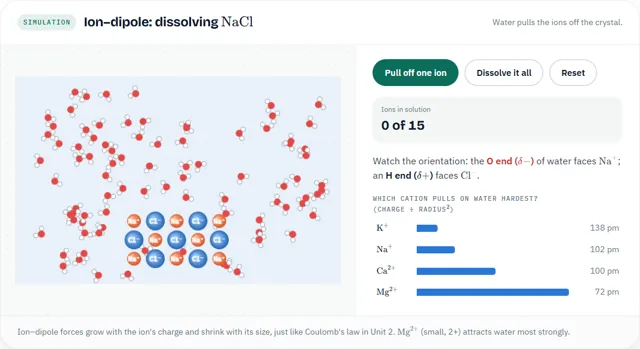
An ion and a polar molecule, like and water.
London dispersion: dipoles that flicker.
Electrons move. For an instant they bunch at one end, making a temporary dipole. That pushes the electrons in the next molecule away, inducing a dipole there. Opposite ends attract.
Bigger electron clouds, stronger LDFs.
Polarizability is how easily the cloud distorts. More electrons means a more lopsided split is possible, like a wealth gap: $10,000 can be divided far more unevenly than $1,000.
(74 ) beats (10 ). Butane beats ethane .
Shape matters too: contact area.
Butane and isobutane are both . Straight butane molecules lie alongside each other like sheets of paper; round isobutane touches like balls. More contact, stronger LDFs: butane boils higher.
Dipole–dipole: permanent ends.
In or the dipole is always there, so molecules line up to . Polar molecules have dipole–dipole forces and LDFs. LDFs are always present.
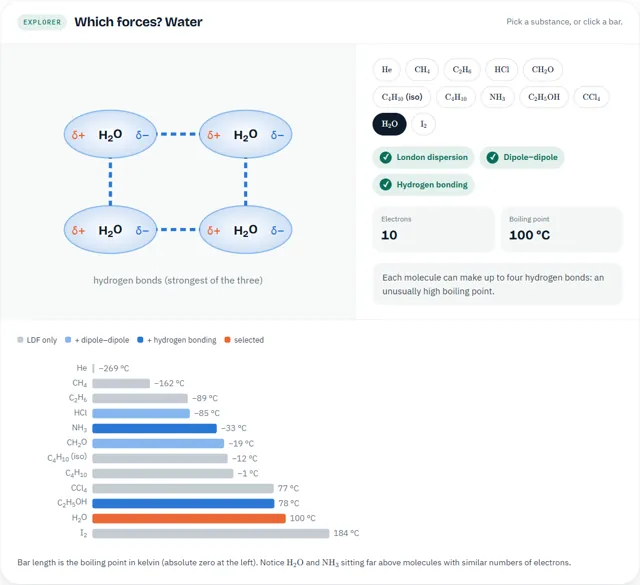
Hydrogen bonding: a strong special case.
H must be bonded to N, O or F. Those atoms strip electrons from H, leaving it strongly . Water and ammonia hydrogen bond.
Trap: has H and O, but its H atoms are on carbon. A bond is nearly nonpolar, so molecules don't hydrogen bond with each other.
Which forces?
Ion–dipole: dissolving
?Two ethanol molecules: is the strongest attraction between two hydrogens, or between the hydrogen of one and the O of the other?Think, then tap to check
. That H is bonded to O, so it's strongly and forms a hydrogen bond. hydrogens are nearly nonpolar and only give LDFs.
?Solid doesn't conduct; molten does. Is that because of free electrons or free ions?Think, then tap to check
Free ions. Molten has and ions that can move. There are no free electrons in either state.
Study notes
Key concepts
Intramolecular vs. intermolecular. Intramolecular forces are the bonds inside a particle (covalent, ionic, metallic bonds). Intermolecular forces (IMFs) are the attractions between separate particles. IMFs are much weaker than covalent bonds. When water boils, the O–H covalent bonds stay intact; only the attractions between H₂O molecules are overcome. Mixing these two ideas up is the most common error on the exam.
All IMFs are Coulombic. Every IMF is an attraction between a region of positive charge (full or partial) and a region of negative charge. The larger the charges and the closer they can get, the stronger the attraction.
1. London dispersion forces (LDFs) (SAP-5.A.1).
-
Electrons are always moving. At any instant the electron cloud of an atom or molecule can be slightly uneven, creating a temporary (instantaneous) dipole. This temporary dipole pushes or pulls on the electrons of a neighbour and induces a dipole in it. The two temporary dipoles attract.
-
LDFs exist between ALL atoms and molecules, polar or nonpolar. For nonpolar substances (He, N₂, CH₄, I₂, CO₂, hexane) they are the only IMF.
-
Strength depends on polarizability: how easily the electron cloud can be distorted. Polarizability increases with the number of electrons and the size of the electron cloud (larger atoms hold outer electrons less tightly), and it is enhanced by pi bonding (pi electrons are spread out and easy to shift).
-
Strength also increases with contact area between molecules. Long, straight-chain molecules touch along their length; compact, branched (spherical) molecules touch only at a few points. Example: n-pentane (bp 36 °C) has stronger LDFs than neopentane, C(CH₃)₄ (bp 9.5 °C), even though both are C₅H₁₂ with the same number of electrons.
-
For large molecules, LDFs are often the strongest net IMF, larger than dipole–dipole contributions. Do not assume LDFs are always "the weakest". Br₂ (bp 59 °C) boils at a higher temperature than HF (bp 19.5 °C) even though HF has hydrogen bonding, because Br₂ has 70 electrons and HF only 10.
-
Vocabulary warning from the CED: the term "London dispersion forces" must NOT be used as a synonym for "van der Waals forces". "Van der Waals forces" is a general collective name for several IMFs (dispersion, dipole–dipole, dipole–induced dipole). On the exam, always name the specific force.
2. Dipole–induced dipole forces (SAP-5.A.2a). A polar molecule can distort the electron cloud of a nearby nonpolar molecule and induce a dipole in it. This is always attractive. It is stronger when the polar molecule has a larger dipole and the nonpolar molecule is more polarizable. Example: the small solubility of O₂ in water depends on H₂O–O₂ dipole–induced dipole attractions (plus LDFs).
3. Dipole–dipole forces (SAP-5.A.2b, SAP-5.A.3). Polar molecules have permanent dipoles. The δ+ end of one molecule attracts the δ− end of a neighbour. Strength depends on the size of the dipoles and on their orientation (head-to-tail or antiparallel side-by-side arrangements are attractive; head-to-head is repulsive, so molecules in a liquid tend to rotate into attractive orientations). Polar molecules have dipole–dipole forces in addition to LDFs, so a polar substance usually has stronger total IMFs than a nonpolar substance of comparable size (similar number of electrons). Example: ICl (70 electrons, polar) boils at 97 °C; Br₂ (70 electrons, nonpolar) boils at 59 °C.
4. Hydrogen bonding (SAP-5.A.4). A hydrogen bond is an especially strong dipole–dipole attraction that forms when an H atom that is covalently bonded to N, O, or F is attracted to a lone pair on an N, O, or F atom in another molecule (or in another part of the same molecule). Two reasons it is strong:
-
N, O and F are very electronegative, so the H atom carries a large δ+ charge; H has no inner electrons, so its nucleus is almost exposed.
-
H is tiny, so the lone pair on the other N, O or F can approach very closely (Coulomb's law: small distance gives strong force).
Requirements for a hydrogen bond: a donor (H directly bonded to N, O, or F) and an acceptor (a lone pair on N, O, or F). Molecules such as CH₃OCH₃ (dimethyl ether), CH₃COCH₃ (acetone) or H₂CO (methanal) have no H on N/O/F, so they cannot hydrogen-bond with each other, but they CAN accept a hydrogen bond from water. A C–H hydrogen never forms a hydrogen bond. On a diagram, a hydrogen bond is drawn as a dashed line from the H of one molecule to a lone pair on the N, O or F of the other molecule, roughly in a straight line O–H····O. Drawing the dashed line from H to H, or from O to O, earns no credit.
5. Ion–dipole forces (SAP-5.A.2c). An ion attracts the oppositely charged end of polar molecules. Cations attract the δ− oxygen end of water; anions attract the δ+ hydrogen ends. Ion–dipole forces are usually stronger than dipole–dipole forces. They are why ionic compounds dissolve in water (hydration). Smaller ions with larger charges have stronger ion–dipole attractions (Coulomb's law).
6. Noncovalent interactions in biomolecules (SAP-5.A.5). In large molecules such as proteins and DNA, IMFs (hydrogen bonds, dipole–dipole, LDFs and ion–dipole/ionic attractions between charged side groups) can act between different molecules or between different parts of the same molecule. Hydrogen bonds between N–H and C=O groups hold the alpha-helix coil of a protein, and hydrogen bonds between base pairs hold the two strands of DNA together. These interactions fix the shape of the molecule and therefore its function.
Summary table of IMFs
| Force | Between | Origin | Relative strength | Example |
|---|---|---|---|---|
| London dispersion | all particles | temporary dipole – induced dipole | weak per contact, but grows with electrons and contact area; can dominate in large molecules | I₂(s), CH₄, hexane |
| Dipole–induced dipole | polar + nonpolar | permanent dipole distorts a neighbour's cloud | weak | O₂ dissolved in H₂O |
| Dipole–dipole | polar + polar | permanent δ+/δ− attraction | moderate; added on top of LDFs | HCl, acetone, ICl |
| Hydrogen bond | H on N/O/F + lone pair on N/O/F | very polar X–H bond; small, exposed H | strongest IMF between neutral molecules of similar size | H₂O, NH₃, HF, CH₃OH |
| Ion–dipole | ion + polar molecule | full charge attracts partial charge | strong | Na⁺(aq), Cl⁻(aq) |
How to compare IMF strength (the exam method).
-
Identify every IMF in each substance (draw the Lewis structure; decide polarity from shape; look for H on N/O/F).
-
If the molecules have similar numbers of electrons, the one with the additional type of force (dipole–dipole, or hydrogen bonding) has stronger IMFs.
-
If the molecules differ a lot in size, the larger, more polarizable one usually has stronger total IMFs because of LDFs, even if the smaller one is polar.
-
Link IMF strength to the property: stronger IMFs → higher boiling point, higher enthalpy of vaporization, lower vapor pressure, higher viscosity and surface tension.
-
On free-response answers, name the forces in BOTH substances and state which is stronger and why. A sentence like "CH₃OH has hydrogen bonding" alone is not enough; add "C₂H₆ has only London dispersion forces, which are weaker, so less energy is needed to separate C₂H₆ molecules."
Properties of liquids caused by IMFs.
-
Viscosity: resistance to flow. It increases with stronger IMFs (and with longer, tangled molecules) and decreases as temperature rises.
-
Surface tension: molecules at the surface feel a net inward pull, so the liquid minimizes its surface area. Stronger IMFs give higher surface tension (water is very high because of hydrogen bonding).
-
Capillary action: a liquid rises up a narrow tube when adhesion (liquid–wall attraction) plus cohesion (liquid–liquid attraction) pull it upward. Water rises in glass because it hydrogen-bonds to the Si–OH groups on the glass surface.
Boiling-point data that illustrate the rules
| Series | Boiling points (°C) | What it shows |
|---|---|---|
| He, Ne, Ar, Kr, Xe | −269, −246, −186, −153, −108 | LDFs increase with number of electrons |
| F₂, Cl₂, Br₂, I₂ | −188, −34, 59, 184 | same; I₂ is a solid at room temperature |
| CH₄, SiH₄, GeH₄, SnH₄ | −162, −112, −88, −52 | nonpolar hydrides follow LDF trend |
| H₂O, H₂S, H₂Se, H₂Te | 100, −60, −41, −2 | H₂O is far too high: hydrogen bonding |
| HF, HCl, HBr, HI | 20, −85, −67, −35 | HF is anomalous: hydrogen bonding |
| n-pentane vs. neopentane | 36 vs. 9.5 | contact area (shape) |
| propane vs. dimethyl ether vs. ethanol (all about 44–46 g/mol) | −42, −24, 78 | LDF only < dipole–dipole < hydrogen bonding |
Worked examples
Worked example 1. Rank CH₃CH₂CH₂CH₃ (butane), CH₃COCH₃ (acetone) and CH₃CH₂CH₂OH (1-propanol) from lowest to highest boiling point. All three have molar masses near 58–60 g/mol.
Solution. The molecules have similar numbers of electrons (34, 32 and 34), so their LDFs are similar. Butane is nonpolar: LDFs only. Acetone is polar (C=O): LDFs plus dipole–dipole. 1-Propanol has an O–H group: LDFs, dipole–dipole and hydrogen bonding. Order of boiling point: butane (−0.5 °C) < acetone (56 °C) < 1-propanol (97 °C).
Worked example 2. CCl₄ is nonpolar and CHCl₃ is polar, yet CCl₄ boils at 76.7 °C and CHCl₃ at 61.2 °C. Explain.
Solution. CHCl₃ has dipole–dipole forces and LDFs; CCl₄ has only LDFs. However, CCl₄ has 74 electrons and CHCl₃ has 58, and Cl atoms have large, polarizable electron clouds. Replacing an H with a fourth Cl makes the CCl₄ electron cloud larger and more polarizable, so its LDFs are stronger. The increase in LDFs in CCl₄ outweighs the dipole–dipole forces in CHCl₃, so CCl₄ has the stronger total IMFs and the higher boiling point. Lesson: "polar always beats nonpolar" is only true for molecules of similar size.
Worked example 3 (hydrogen bonding sites). Which of these can hydrogen-bond to another molecule of the same substance: CH₃NH₂, CH₃F, HCOOH, (CH₃)₃N?
Solution. CH₃NH₂: yes (N–H donor and N lone pair acceptor). CH₃F: no; F is an acceptor, but the H atoms are on C, so there is no donor. HCOOH: yes (O–H donor, O lone pairs acceptors). (CH₃)₃N: no; it has an N lone pair but no N–H. Both CH₃F and (CH₃)₃N can still accept hydrogen bonds from water.
Unit 3 study guide: exam-style free-response set, worksheet and answers.
Worked example
- Both have similar dispersion forces because they have the same number of electrons.
- Ethanol has an O-H group, so its molecules hydrogen bond to each other; dimethyl ether has no H bonded to O, so it cannot.
- Stronger total IMFs require more energy to separate the molecules.
- Answer: Ethanol, because its molecules form hydrogen bonds.
Free-response practice
Write your answer first, then open the solution and mark yourself against it.
Free-response 1 (modelled on 2019 AP FRQ Q2(c) and 2018 FRQ Q4(a)). The table gives data for two compounds.
| Compound | Molar mass (g/mol) | Number of electrons | Normal boiling point (°C) |
|---|---|---|---|
| Br₂ | 159.8 | 70 | 59 |
| ICl | 162.4 | 70 | 97 |
(a) Identify all the types of intermolecular forces present in each liquid.
(b) Explain the difference in boiling points in terms of the types and relative strengths of the intermolecular forces.
(c) A student says "ICl boils at a higher temperature because the I–Cl bond is stronger than the Br–Br bond." Explain the error in the student's reasoning.
Show the solution
(a) Br₂: London dispersion forces only (nonpolar, identical atoms). ICl: London dispersion forces and dipole–dipole forces (I and Cl differ in electronegativity, so the molecule is polar). (1 point)
(b) Both molecules have 70 electrons and similar size, so their LDFs are about equally strong. ICl also has dipole–dipole attractions between its permanent dipoles. The extra dipole–dipole forces make the total IMFs in ICl stronger, so more energy is needed to separate ICl molecules into the gas phase, giving the higher boiling point. (2 points: 1 for comparing LDFs as similar because the electron counts are equal, 1 for linking the extra dipole–dipole forces to the higher boiling point)
(c) Boiling separates whole molecules from each other; it does not break the covalent bond inside a molecule. Boiling point depends on intermolecular forces, not on the strength of the intramolecular I–Cl bond. (1 point)
Free-response 2 (modelled on 2011 AP FRQ Q5(c) and 2014 FRQ Q6(b)). Methanol, CH₃OH (32 g/mol), boils at 65 °C. Ethane, C₂H₆ (30 g/mol), boils at −89 °C.
(a) Explain the large difference in boiling points in terms of the intermolecular forces in each liquid.
(b) Describe, in words, a particulate drawing that shows one hydrogen bond between two methanol molecules. State which atoms the dashed line connects.
Show the solution
(a) Both molecules have 18 electrons, so their London dispersion forces are similar. Ethane is nonpolar and has only LDFs. Methanol has an O–H group, so in addition to LDFs it has dipole–dipole forces and hydrogen bonds between the H on O of one molecule and a lone pair on O of another molecule. Hydrogen bonds are much stronger than the LDFs alone, so much more energy (a much higher temperature) is needed to separate methanol molecules.
(b) Draw two CH₃OH molecules with the lone pairs shown on each O. The dashed line goes from the H atom bonded to O in the first molecule to a lone pair on the O atom of the second molecule, with O–H····O roughly in a straight line. It must not connect to an H on carbon, and it must not be drawn between two H atoms or two O atoms.
Common mistake
Students say water boils when its O-H bonds break. Boiling separates molecules by overcoming hydrogen bonds and other IMFs; the covalent bonds inside each molecule stay intact.
Frequently asked questions
?Are hydrogen bonds stronger than covalent bonds?
No. Hydrogen bonds are the strongest of the common intermolecular forces between neutral molecules, but they are much weaker than covalent bonds.
?Can a nonpolar molecule have stronger IMFs than a polar molecule?
Yes. Large nonpolar molecules can have dispersion forces strong enough to outweigh the dipole forces of small polar molecules; for example, is a solid at room temperature while is a gas.
Practice questions on 3.1
- Q1Which substance has the highest boiling point?
- Q2Why does have a higher boiling point than ?
- Q3Which substance has the strongest London dispersion forces?
- Q4Butane and isobutane are both . Why does butane have the higher boiling point?
- Q5Which pure substance can form hydrogen bonds between its own molecules?
- Q6Which cation has the strongest ion–dipole attraction to water?
- Q7In a diagram of a dissolved ion, the oxygen ends of the surrounding water molecules point toward the ion. The ion is most likely
- Q8Which statement best explains why the boiling points of the noble gases increase from He to Xe?
- Q9Propane, CH₃CH₂CH₃, and dimethyl ether, CH₃OCH₃, both have a molar mass of about 44 g/mol. Propane boils at −42 °C and dimethyl ether at −24 °C. Which statement best explains the difference?
- Q10In which pair can a hydrogen bond form between the two different molecules, even though one of the two substances cannot form hydrogen bonds with itself?
- Q11Two water molecules form a hydrogen bond. Which atoms are directly involved?
- Q12Br₂ has a normal boiling point of 59 °C. HF has a normal boiling point of 20 °C. Which statement explains why Br₂ boils at a higher temperature?
- Q13Which property increases with the number of electrons in a molecule and is also enhanced by pi bonding?
- Q14Which of the following is a gas at 25 °C and 1 atm?
- Q15Which interaction mainly holds the coiled alpha-helix shape of a protein chain?
- Q16For nonpolar molecules, which force increases most as molar mass increases?
- Q17Dipole–dipole forces arise from:
- Q18Which noble gas has the highest boiling point?
- Q19Butane (58 g/mol, b.p. −1 °C) and acetone (58 g/mol, b.p. 56 °C) have the same molar mass. Why does acetone boil higher?
- Q20When two molecules form a hydrogen bond, which atoms are involved?
- Q21Iodine (b.p. 184 °C) boils at a higher temperature than water (b.p. 100 °C). Why?
- Q22Which halomethane has the highest boiling point?
- Q23What holds the two strands of DNA together?
- Q24Which property increases with the size of an atom's or molecule's electron cloud and strengthens dispersion forces?
Stuck on a unit? Let us fix it this week.
Book a 30-minute one-to-one session for $20. Bring a test, a homework set or the topic that is not clicking.
Book a session