 AP Chemistry Tutoring
4.9 Oxidation-reduction (redox) reactions
AP Chemistry Unit 4: Chemical Reactions · 2 simulations · 23 practice questions
Updated · Aligned to the AP Chemistry Course and Exam Description
A redox reaction transfers electrons from one species to another: oxidation is loss of electrons (oxidation number increases) and reduction is gain of electrons (oxidation number decreases). The substance oxidized is the reducing agent, and the substance reduced is the oxidizing agent. Redox equations are balanced with half-reactions so electrons lost equal electrons gained, e.g. .
Redox reactions
Electrons move: oxidation and reduction together.
Oxidation is loss of electrons; the oxidation number goes up. Reduction is gain; the oxidation number goes down. One can't happen without the other.
+ → +
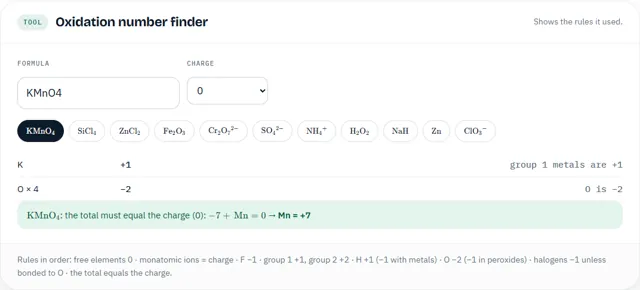
Oxidation number finder
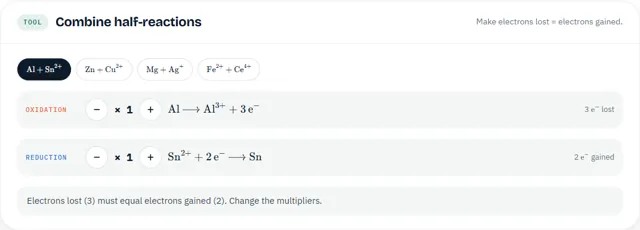
Combine half-reactions
? releases heat. Is it combustion, double replacement, acid–base or redox?Think, then tap to check
Redox. Zn goes 0 → +2 (oxidized) and H goes +1 → 0 (reduced). No , so not combustion; Zn is an element, so not double replacement.
?. Which way do electrons move?Think, then tap to check
From Mg to Si. Mg goes 0 → +2 (oxidized); Si goes +4 → 0 (reduced). Cl stays −1.
Study notes
Key concepts
Redox equations can be built from half-reactions (TRA-2.C.1). A half-reaction shows only the oxidation or only the reduction, with electrons written explicitly.
-
Oxidation half-reaction: electrons appear on the right (products). Example: Zn(s) → Zn²⁺(aq) + 2e⁻.
-
Reduction half-reaction: electrons appear on the left (reactants). Example: Cu²⁺(aq) + 2e⁻ → Cu(s).
The electrons lost in oxidation must equal the electrons gained in reduction. So each half-reaction is multiplied by a whole number until the electrons are equal, and then the two are added. Electrons never appear in the final overall equation.
Why half-reactions? Many redox equations cannot be balanced by trial and error, because the charges and the H and O atoms must all balance at the same time. The half-reaction method always works. Half-reactions are also used in Unit 9 for galvanic and electrolytic cells.
The method in acidic solution (from the slides)
-
Assign oxidation numbers to find which element is oxidised and which is reduced.
-
Write the two unbalanced half-reactions.
-
Balance all atoms other than O and H.
-
Balance O by adding H₂O to the side that needs oxygen.
-
Balance H by adding H⁺ to the side that needs hydrogen.
-
Balance charge by adding electrons (e⁻) to the more positive side.
-
Multiply the half-reactions so the numbers of electrons are equal; add them; cancel anything that appears on both sides (e⁻, H⁺, H₂O); check atoms and charge.
The method in basic solution. Do steps 1–7 exactly as in acid. Then:
-
Add as many OH⁻ ions to both sides as there are H⁺ ions in the equation.
-
On the side that had H⁺, combine each H⁺ + OH⁻ into H₂O.
-
Cancel water molecules that now appear on both sides, and check atoms and charge again. In the final equation there must be no H⁺.
(The slide for basic medium lists the same first seven steps; steps 8–10 are what converts the acidic answer to a basic one.)
Final checks every time
| Check | How |
|---|---|
| Atoms | Count each element on both sides |
| Charge | Add up all charges on each side; they must be equal |
| Electrons | Electrons lost = electrons gained; none in the final equation |
| Lowest terms | Divide all coefficients by any common factor |
| Medium | Acidic answers may contain H⁺ but not OH⁻; basic answers may contain OH⁻ but not H⁺ |
Using oxidation numbers to count electrons. The change in oxidation number per atom, multiplied by the number of atoms, equals the electrons transferred in that half-reaction. Mn in MnO₄⁻ (+7) → Mn²⁺ (+2) gains 5e⁻. Fe²⁺ → Fe³⁺ loses 1e⁻. So 5 Fe²⁺ are needed per MnO₄⁻. This is a quick way to check your half-reactions.
Worked examples
Worked example 4.9-A (simple metal displacement). Write the balanced net ionic equation for magnesium metal reacting with silver ions.
Solution
Oxidation: Mg → Mg²⁺ + 2e⁻.
Reduction: Ag⁺ + e⁻ → Ag. Multiply by 2: 2Ag⁺ + 2e⁻ → 2Ag.
Add: Mg(s) + 2Ag⁺(aq) → Mg²⁺(aq) + 2Ag(s). Two electrons are transferred. Charge: +2 on each side.
Worked example 4.9-B (acidic: permanganate and iron(II)). Balance MnO₄⁻ + Fe²⁺ → Mn²⁺ + Fe³⁺ in acidic solution.
Solution
Step 1. Mn: +7 → +2 (reduced). Fe: +2 → +3 (oxidised).
Step 2–3. Oxidation: Fe²⁺ → Fe³⁺ (Fe already balanced). Reduction: MnO₄⁻ → Mn²⁺ (Mn already balanced).
Step 4. Add 4H₂O to the right of the reduction: MnO₄⁻ → Mn²⁺ + 4H₂O.
Step 5. Add 8H⁺ to the left: MnO₄⁻ + 8H⁺ → Mn²⁺ + 4H₂O.
Step 6. Charges: left −1 + 8 = +7; right +2. Add 5e⁻ to the left: MnO₄⁻ + 8H⁺ + 5e⁻ → Mn²⁺ + 4H₂O. Oxidation: Fe²⁺ → Fe³⁺ + e⁻.
Step 7. Multiply oxidation by 5: 5Fe²⁺ → 5Fe³⁺ + 5e⁻. Add:
MnO₄⁻(aq) + 5Fe²⁺(aq) + 8H⁺(aq) → Mn²⁺(aq) + 5Fe³⁺(aq) + 4H₂O(l)
Check: Mn 1, Fe 5, O 4, H 8 on each side; charge −1 + 10 + 8 = +17 on the left, +2 + 15 = +17 on the right.
Worked example 4.9-C. Balance MnO₄⁻ + I⁻ → MnO₂ + I₂ in acidic solution.
Solution
Oxidation: 2I⁻ → I₂ + 2e⁻.
Reduction: MnO₄⁻ → MnO₂. Balance O: MnO₄⁻ → MnO₂ + 2H₂O. Balance H: MnO₄⁻ + 4H⁺ → MnO₂ + 2H₂O. Charge: left −1 + 4 = +3, right 0, so add 3e⁻ to the left: MnO₄⁻ + 4H⁺ + 3e⁻ → MnO₂ + 2H₂O.
Electrons: LCM of 2 and 3 is 6. Multiply oxidation by 3 and reduction by 2:
6I⁻ → 3I₂ + 6e⁻
2MnO₄⁻ + 8H⁺ + 6e⁻ → 2MnO₂ + 4H₂O
Sum: 2MnO₄⁻(aq) + 8H⁺(aq) + 6I⁻(aq) → 2MnO₂(s) + 3I₂(aq) + 4H₂O(l). Two moles of MnO₂ form. Charge: −2 + 8 − 6 = 0 on the left, 0 on the right.
Worked example 4.9-D (acidic, with a coefficient question; modelled on 2002 released MC Q49). Balance Cr₂O₇²⁻ + SO₃²⁻ → Cr³⁺ + SO₄²⁻ in acidic solution and give the coefficient of H⁺.
Solution
Oxidation: SO₃²⁻ → SO₄²⁻. Add H₂O to the left for O: SO₃²⁻ + H₂O → SO₄²⁻. Add 2H⁺ to the right: SO₃²⁻ + H₂O → SO₄²⁻ + 2H⁺. Charge: left −2, right −2 + 2 = 0, so add 2e⁻ to the right: SO₃²⁻ + H₂O → SO₄²⁻ + 2H⁺ + 2e⁻. (S: +4 → +6, loses 2e⁻. Correct.)
Reduction: Cr₂O₇²⁻ → 2Cr³⁺ (balance Cr first). O: Cr₂O₇²⁻ → 2Cr³⁺ + 7H₂O. H: Cr₂O₇²⁻ + 14H⁺ → 2Cr³⁺ + 7H₂O. Charge: left −2 + 14 = +12, right +6, add 6e⁻ to the left: Cr₂O₇²⁻ + 14H⁺ + 6e⁻ → 2Cr³⁺ + 7H₂O. (Each Cr: +6 → +3, so 2 Cr gain 6e⁻. Correct.)
Multiply oxidation by 3: 3SO₃²⁻ + 3H₂O → 3SO₄²⁻ + 6H⁺ + 6e⁻.
Add and cancel: 14H⁺ − 6H⁺ = 8H⁺ on the left; 7H₂O − 3H₂O = 4H₂O on the right.
Cr₂O₇²⁻(aq) + 3SO₃²⁻(aq) + 8H⁺(aq) → 2Cr³⁺(aq) + 3SO₄²⁻(aq) + 4H₂O(l)
The coefficient of H⁺ is 8. Charge: −2 − 6 + 8 = 0 on the left; +6 − 6 = 0 on the right.
Worked example 4.9-E (basic solution). Balance MnO₄⁻ + I⁻ → MnO₂ + IO₃⁻ in basic solution.
Solution
Work in acid first.
Oxidation: I⁻ → IO₃⁻. O: I⁻ + 3H₂O → IO₃⁻. H: I⁻ + 3H₂O → IO₃⁻ + 6H⁺. Charge: left −1, right −1 + 6 = +5, add 6e⁻ to the right: I⁻ + 3H₂O → IO₃⁻ + 6H⁺ + 6e⁻. (I: −1 → +5, loses 6e⁻.)
Reduction: MnO₄⁻ + 4H⁺ + 3e⁻ → MnO₂ + 2H₂O (as in 4.9-C). Multiply by 2: 2MnO₄⁻ + 8H⁺ + 6e⁻ → 2MnO₂ + 4H₂O.
Add and cancel (8H⁺ − 6H⁺ = 2H⁺ left; 4H₂O − 3H₂O = 1H₂O right):
2MnO₄⁻ + I⁻ + 2H⁺ → 2MnO₂ + IO₃⁻ + H₂O (acidic answer)
Convert to basic: add 2OH⁻ to both sides. 2H⁺ + 2OH⁻ = 2H₂O on the left.
2MnO₄⁻ + I⁻ + 2H₂O → 2MnO₂ + IO₃⁻ + H₂O + 2OH⁻
Cancel one H₂O: 2MnO₄⁻(aq) + I⁻(aq) + H₂O(l) → 2MnO₂(s) + IO₃⁻(aq) + 2OH⁻(aq)
Check: Mn 2, I 1, O 8 + 1 = 9 and 4 + 3 + 2 = 9, H 2 and 2; charge −3 on each side.
Worked example 4.9-F (basic; modelled on 1999 released MC Q42). Balance Cr(OH)₃(s) + ClO₃⁻(aq) → CrO₄²⁻(aq) + Cl⁻(aq) in basic solution and give the coefficient of OH⁻.
Solution
Oxidation (Cr +3 → +6, loses 3e⁻): Cr(OH)₃ → CrO₄²⁻. O: Cr(OH)₃ + H₂O → CrO₄²⁻. H: left has 3 + 2 = 5 H, so add 5H⁺ to the right: Cr(OH)₃ + H₂O → CrO₄²⁻ + 5H⁺. Charge: left 0, right +3, add 3e⁻ right: Cr(OH)₃ + H₂O → CrO₄²⁻ + 5H⁺ + 3e⁻.
Reduction (Cl +5 → −1, gains 6e⁻): ClO₃⁻ + 6H⁺ + 6e⁻ → Cl⁻ + 3H₂O.
Multiply oxidation by 2: 2Cr(OH)₃ + 2H₂O → 2CrO₄²⁻ + 10H⁺ + 6e⁻.
Add and cancel (10H⁺ − 6H⁺ = 4H⁺ right; 3H₂O − 2H₂O = 1H₂O right): 2Cr(OH)₃ + ClO₃⁻ → 2CrO₄²⁻ + Cl⁻ + H₂O + 4H⁺.
Basic: add 4OH⁻ to both sides; 4H⁺ + 4OH⁻ = 4H₂O on the right.
2Cr(OH)₃(s) + ClO₃⁻(aq) + 4OH⁻(aq) → 2CrO₄²⁻(aq) + Cl⁻(aq) + 5H₂O(l)
The coefficient of OH⁻ is 4. Check charge: −1 − 4 = −5; −4 − 1 = −5.
Worked example 4.9-G (disproportionation in base). Balance Cl₂ → Cl⁻ + ClO₃⁻ in basic solution.
Solution
Reduction: Cl₂ + 2e⁻ → 2Cl⁻.
Oxidation: Cl₂ → 2ClO₃⁻; O: Cl₂ + 6H₂O → 2ClO₃⁻; H: Cl₂ + 6H₂O → 2ClO₃⁻ + 12H⁺; charge: left 0, right −2 + 12 = +10, add 10e⁻ right: Cl₂ + 6H₂O → 2ClO₃⁻ + 12H⁺ + 10e⁻.
Multiply reduction by 5: 5Cl₂ + 10e⁻ → 10Cl⁻. Add: 6Cl₂ + 6H₂O → 10Cl⁻ + 2ClO₃⁻ + 12H⁺. Divide by 2: 3Cl₂ + 3H₂O → 5Cl⁻ + ClO₃⁻ + 6H⁺.
Basic: add 6OH⁻ to both sides: 3Cl₂ + 3H₂O + 6OH⁻ → 5Cl⁻ + ClO₃⁻ + 6H₂O. Cancel 3H₂O:
3Cl₂(g) + 6OH⁻(aq) → 5Cl⁻(aq) + ClO₃⁻(aq) + 3H₂O(l)
This has the same pattern as class notes Q7: 3I₂ + 6NaOH → 5NaI + NaIO₃ + 3H₂O (coefficients 3, 6, 5, 1, 3).
Unit 4 study guide: exam-style free-response set, worksheet and answers.
Worked example
- Oxidation: .
- Reduction: (Mn goes from to ).
- Multiply the oxidation by 5 so electrons cancel, then add. Charge check: on the left, on the right.
- Answer:
Free-response practice
Write your answer first, then open the solution and mark yourself against it.
FRQ 4.9-1. (Modelled on 2018 AP FRQ Q1(a) and (g).) In basic solution, thiosulfate ions react with hypochlorite ions: S₂O₃²⁻ + OCl⁻ → SO₄²⁻ + Cl⁻.
(a) Determine the oxidation number of Cl in OCl⁻ and of S in S₂O₃²⁻.
(b) Write the balanced oxidation and reduction half-reactions (you may balance in acid first).
(c) Write the balanced net ionic equation for the reaction in basic solution.
Show the solution
(a) Cl: x + (−2) = −1, so Cl = +1. S: 2S + 3(−2) = −2, so S = +2. (1 point)
(b) Oxidation (S +2 → +6, two S atoms lose 8e⁻): S₂O₃²⁻ + 5H₂O → 2SO₄²⁻ + 10H⁺ + 8e⁻. Reduction (Cl +1 → −1, gains 2e⁻): OCl⁻ + 2H⁺ + 2e⁻ → Cl⁻ + H₂O. (1 point each)
(c) Multiply reduction by 4: 4OCl⁻ + 8H⁺ + 8e⁻ → 4Cl⁻ + 4H₂O. Add: S₂O₃²⁻ + 4OCl⁻ + 5H₂O + 8H⁺ → 2SO₄²⁻ + 4Cl⁻ + 4H₂O + 10H⁺. Cancel: S₂O₃²⁻ + 4OCl⁻ + H₂O → 2SO₄²⁻ + 4Cl⁻ + 2H⁺. Basic: add 2OH⁻ to both sides: S₂O₃²⁻(aq) + 4OCl⁻(aq) + 2OH⁻(aq) → 2SO₄²⁻(aq) + 4Cl⁻(aq) + H₂O(l). Check charge: −2 − 4 − 2 = −8; −4 − 4 = −8. (1 point)
FRQ 4.9-2. (Based on CED Lab Investigation 8, hydrogen peroxide analysis.) Hydrogen peroxide is titrated with acidified potassium permanganate. Products are Mn²⁺ and O₂.
(a) Write the oxidation half-reaction for H₂O₂ and the reduction half-reaction for MnO₄⁻.
(b) Write the balanced net ionic equation.
(c) A 10.00 mL sample of diluted H₂O₂ needs 15.60 mL of 0.0200 M KMnO₄ to reach the end point. Calculate [H₂O₂].
Show the solution
(a) Oxidation (O: −1 → 0): H₂O₂ → O₂ + 2H⁺ + 2e⁻. Reduction: MnO₄⁻ + 8H⁺ + 5e⁻ → Mn²⁺ + 4H₂O.
(b) × 5 and × 2: 5H₂O₂ → 5O₂ + 10H⁺ + 10e⁻; 2MnO₄⁻ + 16H⁺ + 10e⁻ → 2Mn²⁺ + 8H₂O. Sum and cancel: 2MnO₄⁻(aq) + 5H₂O₂(aq) + 6H⁺(aq) → 2Mn²⁺(aq) + 5O₂(g) + 8H₂O(l).
(c) Moles MnO₄⁻ = 0.0200 × 0.01560 = 3.12 × 10⁻⁴ mol. Moles H₂O₂ = 3.12 × 10⁻⁴ × 5/2 = 7.80 × 10⁻⁴ mol. [H₂O₂] = 7.80 × 10⁻⁴ ÷ 0.01000 = 0.0780 M.
Common mistake
Students call the substance that is oxidized the oxidizing agent. The oxidizing agent causes oxidation by accepting electrons, so it is the species that is reduced.
Frequently asked questions
?How do I remember oxidation and reduction?
OIL RIG: Oxidation Is Loss of electrons, Reduction Is Gain of electrons.
?What is the oxidation number of oxygen in most compounds?
Usually ; exceptions include peroxides () and compounds with fluorine.
Practice questions on 4.9
- Q1What is the oxidation number of Mn in ?
- Q2In the reaction , which species is oxidized?
- Q3Which is the oxidation half-reaction for being converted to ?
- Q4 and . What is the balanced overall equation?
- Q5. Which statement is correct?
- Q6Which is the correctly balanced equation for MnO₄⁻ + H⁺ + I⁻ → MnO₂ + H₂O + I₂?
- Q7How many electrons must be added, and to which side, to balance MnO₄⁻ + 4H⁺ → MnO₂ + 2H₂O?
- Q8For the half-reactions 4Al → 4Al³⁺ + Ye⁻ and 3O₂ + Xe⁻ → 6O²⁻, what are X and Y, and how many electrons are transferred overall?
- Q9Aluminium reacts with hydrochloric acid. Which half-reaction for the reduction, written with the electron count that matches the oxidation of 2 Al atoms, is correct?
- Q10Copper metal reacts with AgNO₃(aq) to form Ag and Cu²⁺. Which shows the correct half-reactions?
- Q11For 3Cu(s) + 8H⁺(aq) + 2NO₃⁻(aq) → 3Cu²⁺(aq) + 2NO(g) + 4H₂O(l), which statement is true?
- Q12When MnO₄⁻ + C₂O₄²⁻ → Mn²⁺ + CO₂ is balanced in acidic solution with lowest whole-number coefficients, what is the coefficient of H⁺?
- Q13When the equation 2MnO₄⁻ + 6I⁻ + 8H⁺ → 2MnO₂ + 3I₂ + 4H₂O is rewritten for basic solution, which is correct?
- Q14What is the oxidation number of O in ?
- Q15Which species is reduced in ?
- Q16Which species is oxidized in ?
- Q17In the balanced reaction of with in acid (giving and ), how many ions react per ?
- Q18Which equation is correctly balanced?
- Q19How many electrons are transferred in ?
- Q20For the half-reactions and , what are and ?
- Q21How many electrons balance , and on which side?
- Q22Zinc reacts with HCl. What is the reduction half-reaction?
- Q23For , which are the correct half-reactions?
Stuck on a unit? Let us fix it this week.
Book a 30-minute one-to-one session for $20. Bring a test, a homework set or the topic that is not clicking.
Book a session