 AP Chemistry Tutoring
5.1 Reaction rates
AP Chemistry Unit 5: Kinetics · 1 simulation · 17 practice questions
Updated · Aligned to the AP Chemistry Course and Exam Description
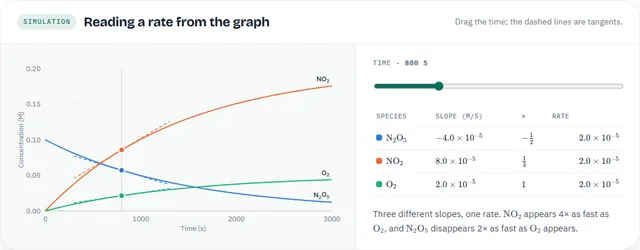
The rate of a reaction is the change in concentration of a reactant or product per unit time, usually in . Rates of different species are related by their coefficients: for , . Rate depends on concentration, temperature, surface area and the presence of a catalyst.
Reaction rate
Rate = change in concentration per unit time.
Making a grilled cheese takes 5 minutes and uses 2 slices of bread and 1 slice of cheese. You can describe the speed as 1 sandwich, 2 slices of bread or 1 slice of cheese per 5 minutes. They all describe the same speed.
So divide each species' rate by its coefficient, and make reactants positive with a minus sign.
Reading a rate from the graph
Four ways to speed up a reaction.
More collisions per second. (For gases, higher pressure means higher concentration.)
Powdered sugar dissolves faster than a cube.
Why the fridge slows food spoiling.
Lowers the activation energy. Chapter 04.
Study notes
Key concepts
What a rate is (TRA-3.A.1). The kinetics of a reaction is the rate at which reactants are turned into products per unit time. We usually measure it as a change in molar concentration per second, so the unit of rate is M s⁻¹ (mol L⁻¹ s⁻¹). Other time units (min⁻¹, h⁻¹) are fine if used consistently.
Rate of disappearance and rate of appearance. Reactant concentrations go down, so Δ[reactant]/Δt is negative. We put a minus sign in front so that a rate is always a positive number. Product concentrations go up, so their Δ[product]/Δt is already positive.
Stoichiometry links the rates (TRA-3.A.2). In a balanced equation, the coefficients tell you how the rates compare. For N₂ + 3 H₂ → 2 NH₃, three H₂ molecules are used for every one N₂, so H₂ disappears three times as fast as N₂. NH₃ appears twice as fast as N₂ disappears. To get one single "rate of reaction" that is the same no matter which species you watch, divide each rate by its coefficient.
Average rate vs. instantaneous rate vs. initial rate.
| Kind of rate | How you get it | What it means |
|---|---|---|
| Average rate | Δ[A]/Δt between two times (slope of a secant line) | Rate over an interval |
| Instantaneous rate | Slope of the tangent to the [A] vs. t curve at one time | Rate at one moment |
| Initial rate | Slope of the tangent at t = 0 | Rate when only reactants are present; used in the method of initial rates (5.2) |
For most reactions the rate slows down as time passes, because reactants are being used up. So the [reactant] vs. time curve gets flatter over time.
How rates are measured (lab connection). You can follow any property that changes with the amount of a reactant or product: color/absorbance (Beer's law, A = εbc), pressure of a gas in a rigid container, volume of gas collected, mass lost as a gas escapes, conductivity, pH, or titration of samples taken out at set times.
Factors that change the rate (TRA-3.A.3).
| Factor | Effect on rate | Particle-level reason |
|---|---|---|
| Reactant concentration (or partial pressure of a gas) | Usually increases rate | More particles per volume, so more collisions per second |
| Temperature | Increases rate (almost always) | Particles move faster: more collisions per second and, much more important, a larger fraction of collisions have energy ≥ Ea |
| Surface area of a solid reactant | Increases rate | Only particles on the surface can collide; powder exposes more surface than a lump |
| Catalyst | Increases rate | Provides a different pathway with a lower activation energy |
| Other environmental factors (solvent, light, mixing) | Varies | Can change how often or how effectively particles meet |
Common misconceptions.
- Pressure changes only matter for reactions with gaseous reactants. Squeezing a reaction that has only aqueous and solid reactants does not change the rate.
- A big equilibrium constant K does not mean a fast reaction. K tells you how far a reaction goes; rate tells you how fast. They are separate ideas.
- Raising the temperature does not lower the activation energy. It increases the fraction of particles that have enough energy to get over the same barrier.
- "Rate" and "time" are opposites: a faster rate means a shorter time to finish.
Key equations
For a general balanced reaction a A + b B → c C + d D:
Worked examples
Worked example 5.1-A (relating rates). In the Haber process, N₂(g) + 3 H₂(g) → 2 NH₃(g), ammonia forms at 0.024 M s⁻¹ at one moment. Find the rates at which N₂ and H₂ are used up, and the rate of reaction.
Step 1: Write the rate relationship.
Step 2: Rate of reaction = ½ × 0.024 = 0.012 M s⁻¹.
Step 3: N₂ disappears at 1 × 0.012 = 0.012 M s⁻¹. H₂ disappears at 3 × 0.012 = 0.036 M s⁻¹.
Check: H₂ (coefficient 3) has the biggest rate, N₂ (coefficient 1) the smallest. That matches the coefficients.
Worked example 5.1-B (average rate from data). For 2 N₂O₅(g) → 4 NO₂(g) + O₂(g), [N₂O₅] falls from 0.0200 M at t = 0 to 0.0169 M at t = 100. s.
Average rate of disappearance of N₂O₅ = (0.0200 − 0.0169) M / 100. s = 3.1 × 10⁻⁵ M s⁻¹.
NO₂ appears 4/2 = 2 times as fast: 6.2 × 10⁻⁵ M s⁻¹. O₂ appears 1/2 as fast as N₂O₅ disappears: 1.6 × 10⁻⁵ M s⁻¹ (1.55 × 10⁻⁵ before rounding).
Unit 5 study guide: exam-style free-response set, worksheet and answers.
Worked example
- : .
- : .
- Answer: : ; :
Free-response practice
Write your answer first, then open the solution and mark yourself against it.
FRQ 5.1-1. A student drops 2.00 g of calcium carbonate chips into 50.0 mL of 1.0 M HCl(aq) in an open flask on a balance. The reaction is CaCO₃(s) + 2 HCl(aq) → CaCl₂(aq) + H₂O(l) + CO₂(g). The total mass of the flask is recorded.
| Time (s) | 0 | 30 | 60 | 90 | 120 |
|---|---|---|---|---|---|
| Mass lost (g) | 0.000 | 0.240 | 0.400 | 0.500 | 0.560 |
(a) Explain why the flask loses mass.
(b) Calculate the average rate of CO₂ production, in mol s⁻¹, between 0 and 30 s and between 90 and 120 s.
(c) Explain, in terms of particles, why the rate in the later interval is smaller.
(d) The experiment is repeated with 2.00 g of powdered CaCO₃. Predict how the initial rate changes, and explain at the particle level.
Show the solution
(a) CO₂ gas escapes from the open flask. The mass lost equals the mass of CO₂ produced.
(b) Molar mass of CO₂ = 44.01 g mol⁻¹. From 0 to 30 s: 0.240 g ÷ 44.01 g mol⁻¹ = 5.45 × 10⁻³ mol; rate = 5.45 × 10⁻³ mol ÷ 30 s = 1.8 × 10⁻⁴ mol s⁻¹. From 90 to 120 s: (0.560 − 0.500) g = 0.060 g = 1.36 × 10⁻³ mol; rate = 1.36 × 10⁻³ ÷ 30 = 4.5 × 10⁻⁵ mol s⁻¹.
(c) HCl is being used up, so [H⁺] is lower later on. Fewer H⁺ ions per volume means fewer collisions per second with the CaCO₃ surface, so the rate drops. (The solid is also getting smaller, which reduces its surface area.)
(d) The initial rate increases. Powder has much more surface area than chips, so many more CaCO₃ particles are exposed to H⁺ ions, giving more collisions per second.
Common mistake
Students assume all species in a reaction change concentration at the same rate. Each species changes in proportion to its coefficient, so in forms twice as fast as is used up.
Frequently asked questions
?Why is there a negative sign in the rate expression for reactants?
Reactant concentrations decrease, so their change is negative; the minus sign makes the reaction rate a positive number.
?Why does a powdered solid react faster than a lump?
Powder has more surface area, so more particles are exposed and collisions with the other reactant happen more often.
Practice questions on 5.1
- Q1For , is disappearing at 0.020 M/s. At what rate is forming?
- Q2For , forms at 0.040 M/s. At what rate is forming?
- Q3For the reaction 4 Na(s) + O₂(g) → 2 Na₂O(s), the rate of disappearance of sodium is 1.5 × 10⁻³ M s⁻¹ (treat the sodium as dispersed so a molarity can be defined). What is the rate of disappearance of O₂?
- Q4For the reaction 2 X → Y, Y is formed at 1.0 × 10⁻² M s⁻¹. What is the rate of disappearance of X?
- Q5When heated, 2 KClO₃ → 2 KCl + 3 O₂. If O₂ appears at 4.00 × 10⁻² M s⁻¹, at what rate does KClO₃ disappear?
- Q6Equal 0.10 g pieces of magnesium ribbon are added to excess HCl(aq) of concentrations 0.050 M, 0.10 M, 0.25 M and 0.50 M, and the time for each piece to disappear is recorded. As [HCl] increases, what happens?
- Q7Cadmium metal reacts with hydrochloric acid. With the same mass of Cd each time, which conditions give the fastest reaction?
- Q81 M HCl(aq) and 1 M NaOH(aq) react in a closed container at 35 °C. The pressure above the solution is increased by 50%. What happens to the rate of the neutralization?
- Q9A reaction reaches equilibrium very quickly. What can you say about its equilibrium constant K?
- Q10For , the rate of disappearance equals:
- Q11For , is consumed at 0.060 M/s. At what rate does form?
- Q12For , B forms at 0.010 M/s. At what rate is A consumed?
- Q13Why does reaction rate usually increase with temperature?
- Q14Zinc reacts with HCl. Which conditions give the fastest rate?
- Q15How does increasing the pressure affect the rate of ?
- Q16What does a large equilibrium constant tell you about how fast equilibrium is reached?
- Q17Which statement about reaction rates is true?
Terms used in this topic
Stuck on a unit? Let us fix it this week.
Book a 30-minute one-to-one session for $20. Bring a test, a homework set or the topic that is not clicking.
Book a session