 AP Chemistry Tutoring
7.7 Calculating equilibrium concentrations
AP Chemistry Unit 7: Equilibrium · 1 simulation · 5 practice questions
Updated · Aligned to the AP Chemistry Course and Exam Description
Equilibrium concentrations are found from initial concentrations and by setting up an ICE table, writing changes in terms of using the stoichiometry, and substituting the equilibrium expressions into the expression. When is very small, is small compared with the initial concentration and can often be dropped (); otherwise the equation is solved exactly, sometimes by taking a square root.
The equilibrium constant
Products over reactants, raised to coefficients.
Leave out pure solids and liquids: their concentrations don't change, so they are left out of the expression. has no units, and it changes only with temperature.
e.g. at equilibrium.
e.g. . is never negative.
Same expression with partial pressures.
= moles of gas, products − reactants.
Change the equation, watch K
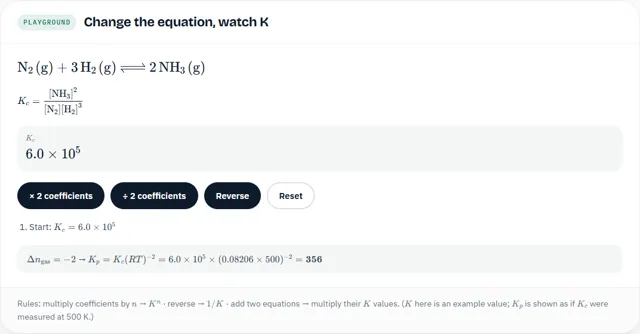
? has . What is for ?Think, then tap to check
Doubled: . Reversed: .
Study notes
Key concepts
The goal (TRA-7.E.1). If you know the balanced equation, the initial amounts and K, you can predict the equilibrium concentrations or partial pressures.
The ICE method
- Write the balanced equation and the K expression.
- If both reactants and products are present at the start, calculate Q and compare it with K to decide the direction (see 7.10). This tells you which side gets "−x".
- Fill in the Initial row. Write the Change row in terms of one unknown, x, using the coefficients (for example −x, −2x, +3x).
- Write the Equilibrium row (initial + change) and substitute it into K.
- Solve for x, then calculate every equilibrium value. Check: substitute back to see that you get K.
Three ways to solve for x
| Situation | Method |
|---|---|
| Both sides are perfect squares (for example (2x)²/(a − x)²) | Take the square root of both sides |
| K is very small compared with the initial concentrations | Assume x is small, so (a − x) ≈ a. Then check that x is less than about 5% of a |
| Neither applies | Rearrange into ax² + bx + c = 0 and use the quadratic formula, keeping the physically sensible (positive, not too large) root |
The AP exam usually designs these questions so that one of the first two shortcuts works, but you should be able to recognise when the "small x" assumption fails.
Sanity checks. No equilibrium concentration can be negative. x cannot be larger than the initial amount of a reactant that is being used up. If K is large, most of the limiting reactant should be gone; if K is small, very little should have reacted.
Key equations
Worked examples
Example 7.7a (perfect square). At 448 °C, Kc = 50.5 for H₂(g) + I₂(g) ⇌ 2 HI(g). A flask starts with [H₂] = [I₂] = 0.100 M and no HI. Find the equilibrium concentrations.
| [H₂] | [I₂] | [HI] | |
|---|---|---|---|
| I | 0.100 | 0.100 | 0 |
| C | −x | −x | +2x |
| E | 0.100 − x | 0.100 − x | 2x |
So 2x = 0.7106 − 7.106x, which gives 9.106x = 0.7106 and x = 0.0780. Equilibrium: [HI] = 0.156 M, [H₂] = [I₂] = 0.022 M. Check: (0.156)²/(0.022)² = 50.
Example 7.7b (small K). At a high temperature, Kp = 1.0 × 10⁻⁵ for N₂(g) + O₂(g) ⇌ 2 NO(g). A vessel starts with P_N₂ = 0.80 atm and P_O₂ = 0.20 atm. Find PNO at equilibrium.
ICE: P_N₂ = 0.80 − x, P_O₂ = 0.20 − x, PNO = 2x. K is small, so assume 0.80 − x ≈ 0.80 and 0.20 − x ≈ 0.20.
PNO = 2x = 1.3 × 10⁻³ atm. Check: x is 0.32% of 0.20, which is well under 5%, so the assumption is fine.
Example 7.7c. For B(g) ⇌ 2 A(g), Kc = 2.0. 3.0 mol A and 3.0 mol B are placed in a 2.00 L flask. (a) Is the system at equilibrium? (b) Which way will it shift? (c) Find the equilibrium concentrations.
Solution. (a) [A] = [B] = 3.0 mol / 2.00 L = 1.5 M. Qc = [A]²/[B] = (1.5)²/1.5 = 1.5. Q ≠ K, so it is not at equilibrium. (b) Q < K, so there is too little product: the reaction shifts right. [B] will decrease and [A] will increase. (c) [B] = 1.5 − x, [A] = 1.5 + 2x.
[A] = 1.68 M, [B] = 1.41 M. Check: (1.68)²/1.41 = 2.0.
Unit 7 study guide: exam-style free-response set, worksheet and answers.
Worked example
- ICE: , .
- ; take square roots: , so .
- ; .
- Answer: ,
Free-response practice
Write your answer first, then open the solution and mark yourself against it.
FRQ 7.7. At a certain temperature Kc = 0.040 for PCl₅(g) ⇌ PCl₃(g) + Cl₂(g). A 0.20 mol sample of PCl₅ is placed in an evacuated 1.0 L flask.
(a) Set up an ICE table.
(b) Calculate [Cl₂] at equilibrium.
(c) Calculate the percentage of the PCl₅ that decomposed.
(d) A student tries to use the approximation 0.20 − x ≈ 0.20. Explain why this approximation is not valid here.
Show the solution
(a)
| [PCl₅] | [PCl₃] | [Cl₂] | |
|---|---|---|---|
| I | 0.20 | 0 | 0 |
| C | −x | +x | +x |
| E | 0.20 − x | x | x |
(b) x²/(0.20 − x) = 0.040, so x² + 0.040x − 0.0080 = 0.
[Cl₂] = 0.072 M (and [PCl₅] = 0.13 M). Check: (0.0717)²/0.128 = 0.040.
(c) (0.072 / 0.20) × 100% = 36%.
(d) x is 36% of 0.20, far more than 5%. K (0.040) is not small compared with the initial concentration (0.20 M), so a large fraction reacts and x cannot be ignored.
Common mistake
Students forget the coefficients in the change row, writing for . The change for each species is its coefficient times , so changes by .
Frequently asked questions
?When can I ignore x in an ICE table?
When is small relative to the initial concentration, so is less than about 5% of the value it is subtracted from.
?Will I have to use the quadratic formula on the AP exam?
Rarely. AP problems are usually designed so that an approximation or a perfect square makes the algebra simple.
Practice questions on 7.7
- Q1For , . A container initially holds 1.00 M and 1.00 M and no HI. What is [HI] at equilibrium?
- Q2For A(aq) + B(aq) ⇌ C(aq) + D(aq), Kc = 4.0. A solution starts with [A] = [B] = 1.0 M and no C or D. What is [C] at equilibrium?
- Q3For A(g) ⇌ 2 B(g), Kc = 1.6 × 10⁻⁷. A flask starts with [A] = 0.10 M. What is [B] at equilibrium?
- Q4When solving an equilibrium problem, a student assumes [A]₀ − x ≈ [A]₀. In which situation is this assumption most likely to be valid?
- Q5For 2 SO₂(g) + O₂(g) ⇌ 2 SO₃(g), a flask starts with 0.40 M SO₂, 0.20 M O₂ and no SO₃. If x mol/L of O₂ reacts, which row gives the equilibrium concentrations?
Terms used in this topic
Stuck on a unit? Let us fix it this week.
Book a 30-minute one-to-one session for $20. Bring a test, a homework set or the topic that is not clicking.
Book a session