 AP Chemistry Tutoring
7.6 Properties of the equilibrium constant
AP Chemistry Unit 7: Equilibrium · 1 simulation · 6 practice questions
Updated · Aligned to the AP Chemistry Course and Exam Description
The equilibrium constant changes in predictable ways when its equation is manipulated: reversing a reaction gives ; multiplying all coefficients by gives ; and adding reactions gives . These rules let you find for a target reaction from related reactions, much as Hess's law combines enthalpies.
The equilibrium constant
Products over reactants, raised to coefficients.
Leave out pure solids and liquids: their concentrations don't change, so they are left out of the expression. has no units, and it changes only with temperature.
e.g. at equilibrium.
e.g. . is never negative.
Same expression with partial pressures.
= moles of gas, products − reactants.
Change the equation, watch K
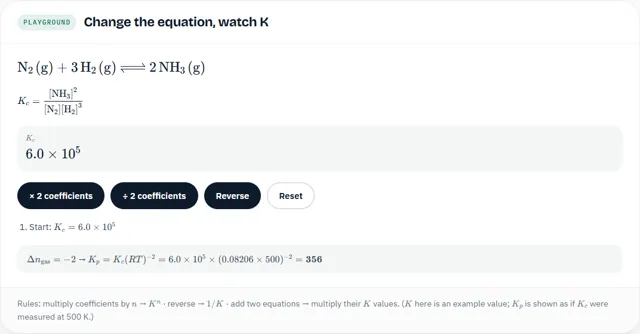
? has . What is for ?Think, then tap to check
Doubled: . Reversed: .
Study notes
Key concepts
You can build K for a new equation from known K values (TRA-7.D).
| What you do to the equation | What happens to K | Slide wording |
|---|---|---|
| Reverse it (TRA-7.D.1) | Knew = 1/K | "The equilibrium constant of the reverse reaction is the reciprocal" |
| Multiply all coefficients by c (TRA-7.D.2) | Knew = K^c (for example ½ → square root) | "raised to a power equal to that number" |
| Add two or more equations (TRA-7.D.3) | Knew = K₁ × K₂ ×.. | "the product of the equilibrium constants for the individual steps" |
Q follows the same rules (TRA-7.D.4). Q and K have the same mathematical form, so reversing, multiplying, or adding equations changes Q in exactly the same way.
Strategy for combining equations (Hess's-law style).
- Look at the target equation. Find each species that appears in only one of the given equations.
- Reverse a given equation if that species is on the wrong side.
- Multiply it if the coefficient is wrong.
- Add the adjusted equations. Cancel species that appear on both sides.
- Apply the matching rule to each K, then multiply them.
Common errors. Adding K values instead of multiplying them. Multiplying K by c instead of raising it to the power c. Forgetting to invert when you reverse.
Key equations
Worked examples
Example 7.6a. Given:
H₂(g) + S(s) ⇌ H₂S(g), K₁ = 1.0 × 10⁻³
S(s) + O₂(g) ⇌ SO₂(g), K₂ = 5.0 × 10⁶
Calculate Kc for H₂(g) + SO₂(g) ⇌ H₂S(g) + O₂(g).
Solution. SO₂ must be a reactant, so reverse the second equation: SO₂(g) ⇌ S(s) + O₂(g), K = 1/K₂ = 2.0 × 10⁻⁷. Add it to the first equation; S(s) cancels.
Example 7.6b. For N₂(g) + 3 H₂(g) ⇌ 2 NH₃(g), K = 4.0 × 10⁸ at a certain temperature. Find K for NH₃(g) ⇌ ½ N₂(g) + 3/2 H₂(g).
Solution. The new equation is the original reversed and multiplied by ½.
Unit 7 study guide: exam-style free-response set, worksheet and answers.
Worked example
- Reverse the reaction: .
- Multiply coefficients by : .
- Answer:
Free-response practice
Write your answer first, then open the solution and mark yourself against it.
FRQ 7.6. Use the following data at 298 K.
N₂(g) + O₂(g) ⇌ 2 NO(g), K₁ = 4.0 × 10⁻³¹
2 NO(g) + O₂(g) ⇌ 2 NO₂(g), K₂ = 2.5 × 10¹²
(a) Calculate K for N₂(g) + 2 O₂(g) ⇌ 2 NO₂(g).
(b) Calculate K for NO₂(g) ⇌ ½ N₂(g) + O₂(g).
(c) The acid HF has Ka = 6.8 × 10⁻⁴ for HF(aq) ⇌ H⁺(aq) + F⁻(aq), and water has Kw = 1.0 × 10⁻¹⁴ for H₂O(l) ⇌ H⁺(aq) + OH⁻(aq). Show how these two equations combine to give F⁻(aq) + H₂O(l) ⇌ HF(aq) + OH⁻(aq), and calculate its K.
Show the solution
(a) Adding the two equations cancels 2 NO, giving the target. K = K₁K₂ = (4.0 × 10⁻³¹)(2.5 × 10¹²) = 1.0 × 10⁻¹⁸.
(b) Reverse the equation from (a) and multiply by ½.
(c) Reverse the Ka equation: H⁺ + F⁻ ⇌ HF, K = 1/Ka. Add the Kw equation. H⁺ cancels, giving F⁻ + H₂O ⇌ HF + OH⁻.
Common mistake
Students add values when they add reactions, or multiply by when coefficients are multiplied. values multiply when reactions add, and is raised to the power .
Frequently asked questions
?What happens to K when you reverse a reaction?
The new constant is the reciprocal of the original: .
?What happens to K when you add two reactions?
Multiply their equilibrium constants: .
Practice questions on 7.6
- Q1For , at a certain temperature. What is for at that temperature?
- Q2 has . What is for ?
- Q3At a certain temperature, K = 4.0 × 10⁴ for H₂(g) + Cl₂(g) ⇌ 2 HCl(g). What is K for 2 HCl(g) ⇌ H₂(g) + Cl₂(g) at the same temperature?
- Q4For 2 A(g) ⇌ B(g), K = 9.0. What is K for 4 A(g) ⇌ 2 B(g)?
- Q5Given A ⇌ B, K₁ = 2.0 and B ⇌ C, K₂ = 5.0 × 10⁻³. What is K for 2 C ⇌ 2 A?
- Q6At one moment in a reaction mixture, Q = 4.0 for X(g) ⇌ 2 Y(g). At the same moment, what is Q for 2 Y(g) ⇌ X(g)?
Terms used in this topic
Stuck on a unit? Let us fix it this week.
Book a 30-minute one-to-one session for $20. Bring a test, a homework set or the topic that is not clicking.
Book a session