 AP Chemistry Tutoring
7.9 Introduction to Le Chatelier's principle
AP Chemistry Unit 7: Equilibrium · 1 simulation · 9 practice questions
Updated · Aligned to the AP Chemistry Course and Exam Description
Le Chatelier's principle states that when a system at equilibrium is disturbed, it shifts in the direction that partly counteracts the change. Adding a reactant shifts it toward products; decreasing volume shifts a gas reaction toward fewer moles of gas; and raising temperature shifts it in the endothermic direction. For , , heating shifts the equilibrium toward and .
Le Chatelier's principle
Stress it, and it pushes back.
A system at equilibrium shifts to partly undo any change.
Remove → shift toward what was removed.
Expand → more gas moles. Inert gas at constant volume: no shift.
Exothermic: heat is a product. The only stress that changes .
Reaches equilibrium faster, same position.
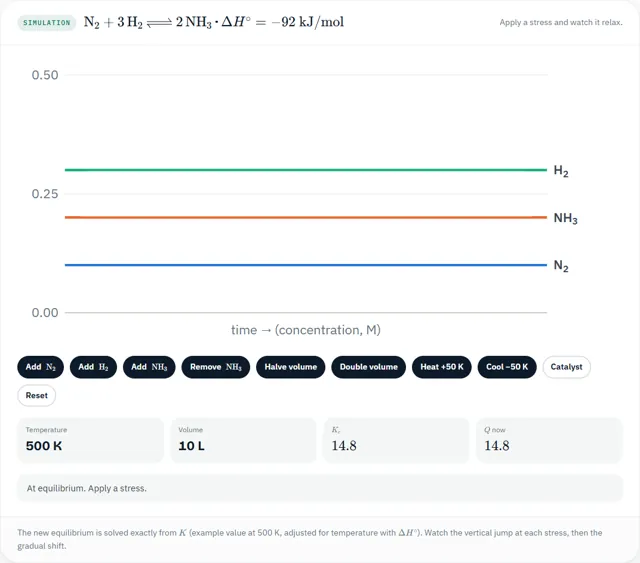
\(\ce{N2 + 3H2 <=> 2NH3}\) ·
? is at equilibrium in a rigid container. More is added. What happens right away?Think, then tap to check
The forward rate increases and becomes greater than the reverse rate, so the system shifts toward products until the rates match again.
is at equilibrium. At time , jumps up suddenly; then rises and falls. Explain.
- A sudden vertical jump means was added at .
- More product makes .
- By Le Chatelier's principle the system shifts toward reactants: forms and is used up.
Study notes
Key concepts
The principle (TRA-8.A.1). The slides define it as: "when we disturb a system at chemical equilibrium, the relative concentrations of reactants and products shift so as to partially undo the effects of the disturbance." The system never fully cancels the stress; it only partly offsets it.
Types of stress and the response
| Stress | Shift | Why |
|---|---|---|
| Add a reactant (or remove a product) | Right (toward products) | System uses up some of what was added |
| Add a product (or remove a reactant) | Left (toward reactants) | Same idea in reverse |
| Increase temperature | In the endothermic direction | Treat heat as a reactant (endothermic) or a product (exothermic) |
| Decrease temperature | In the exothermic direction | System releases heat to offset the cooling |
| Decrease volume (increase pressure) of a gas system | Toward the side with fewer moles of gas | Fewer gas particles lowers the pressure |
| Increase volume (decrease pressure) | Toward the side with more moles of gas | |
| Volume change when moles of gas are equal on both sides | No shift | Neither side reduces the particle count |
| Add an inert gas at constant volume | No shift | Partial pressures of the reacting gases do not change |
| Dilute an aqueous equilibrium with water | Toward the side with more dissolved particles | Same idea as increasing the volume of a gas |
| Add a pure solid or pure liquid | No shift | Not in the K expression |
| Add a catalyst | No shift | Both rates increase equally; equilibrium is just reached faster |
Only temperature changes K. All the other stresses change Q, not K (see 7.10). For an exothermic reaction, raising T makes K smaller; for an endothermic reaction, raising T makes K larger.
Measurable effects (TRA-8.A.2). Le Châtelier lets you predict things you can see or measure:
- Colour. Co(H₂O)₆²⁺(aq) (pink) + 4 Cl⁻(aq) ⇌ CoCl₄²⁻(aq) (blue) + 6 H₂O(l), ΔH > 0. Heating turns the solution blue; cooling turns it pink; adding water turns it pink; adding Cl⁻ (for example concentrated HCl) turns it blue; adding AgNO₃ removes Cl⁻ as AgCl(s) and turns it pink. Another example: Fe³⁺(aq) + SCN⁻(aq) ⇌ FeSCN²⁺(aq) (blood red).
- pH. For NH₃(aq) + H₂O(l) ⇌ NH₄⁺(aq) + OH⁻(aq), adding NH₄Cl shifts the equilibrium left, lowering [OH⁻] and the pH.
- Temperature. If an exothermic equilibrium is pushed to the right (for example by adding a reactant in an insulated container), heat is released and the temperature rises.
The Haber process (from the slides). N₂(g) + 3 H₂(g) ⇌ 2 NH₃(g), ΔH < 0. Adding H₂ consumes N₂ and makes more NH₃. Industrial plants remove NH₃ as a liquid, which keeps pulling the equilibrium to the right. High pressure favours the side with fewer gas moles (NH₃). A low temperature would favour NH₃ but makes the reaction too slow, so a compromise temperature and a catalyst are used.
Worked examples
Example 7.9. For 12.6 kcal + H₂(g) + I₂(g) ⇌ 2 HI(g) (endothermic as written), predict the shift and the change in each concentration.
| Stress | Shift | [H₂] | [I₂] | [HI] |
|---|---|---|---|---|
| 1. Add H₂ | Right | (increases, the added amount) | Decreases | Increases |
| 2. Add I₂ | Right | Decreases | (increases) | Increases |
| 3. Add HI | Left | Increases | Increases | (increases) |
| 4. Remove H₂ | Left | (decreases) | Increases | Decreases |
| 5. Remove I₂ | Left | Increases | (decreases) | Decreases |
| 6. Remove HI | Right | Decreases | Decreases | (decreases) |
| 7. Increase temperature | Right | Decreases | Decreases | Increases |
| 8. Decrease temperature | Left | Increases | Increases | Decreases |
| 9. Increase pressure (smaller volume) | No shift | No change in amount | No change in amount | No change in amount |
| 10. Decrease pressure (larger volume) | No shift | No change in amount | No change in amount | No change in amount |
Notes: For rows 1–6, the species you added or removed ends up changed in the direction of your change, but by less than you changed it. For rows 9 and 10 there are 2 moles of gas on each side, so there is no shift; the amounts do not change, although every concentration changes in proportion to the volume change.
Short-answer questions, with model answers
- What does "equal" mean in equilibrium? The rate of the forward reaction equals the rate of the reverse reaction.
- Why is it called "dynamic" equilibrium? The forward and reverse reactions keep happening at equal rates, so no change is observed even though particles are still reacting.
- If a reaction is endothermic, on which side is the heat term written? On the reactant side.
- Do all reactants get converted to products? Not in a reversible reaction at equilibrium. Products react back to form reactants, so some reactants always remain.
- Can a product convert back to a reactant? Yes. In a reversible reaction products re-form reactants; at equilibrium the rate of this reverse reaction equals the rate of the forward reaction.
Unit 7 study guide: exam-style free-response set, worksheet and answers.
Worked example
- (a) Adding a reactant: shift toward products.
- (b) Smaller volume favors fewer gas moles: 4 mol left vs. 2 mol right, so shift right.
- (c) The reverse reaction is endothermic, so heating shifts left and decreases.
- Answer: (a) right; (b) right; (c) left
Free-response practice
Write your answer first, then open the solution and mark yourself against it.
FRQ 7.9. A solution of cobalt(II) chloride is set up in equilibrium: Co(H₂O)₆²⁺(aq) (pink) + 4 Cl⁻(aq) ⇌ CoCl₄²⁻(aq) (blue) + 6 H₂O(l). At room temperature the solution is purple (a mixture of the two colours). When the beaker is placed in ice, it turns pink.
(a) Is the forward reaction endothermic or exothermic? Justify your answer.
(b) Predict the colour change when concentrated HCl(aq) is added at room temperature. Explain.
(c) Predict the colour change when solid AgNO₃ is added at room temperature. Explain, including the role of a precipitate.
(d) Predict the colour change when a large volume of water is added. Explain.
Show the solution
(a) Endothermic. Cooling shifts an equilibrium in the exothermic direction. The solution turned pink, so the shift was to the left (reverse). The reverse reaction is therefore exothermic and the forward reaction is endothermic.
(b) It turns more blue. HCl adds Cl⁻, a reactant, so the equilibrium shifts right and more blue CoCl₄²⁻ forms.
(c) It turns more pink, and a white precipitate forms. Ag⁺ removes Cl⁻ as AgCl(s). Removing a reactant shifts the equilibrium left, forming more pink Co(H₂O)₆²⁺.
(d) It turns more pink. Water is a product (although it is not in K, adding a lot of it dilutes every dissolved species). Dilution shifts the equilibrium toward the side with more dissolved particles: 5 on the left (1 + 4) vs 1 on the right. So it shifts left.
FRQ 7.9b. Modelled on 2019 AP FRQ Q1(d). A student finds that a saturated aqueous solution of compound Z has a concentration of 4.2 M at 20 °C and 5.6 M at 30 °C. The dissolution is Z(s) ⇌ Z(aq). Is the dissolution of Z endothermic or exothermic? Justify your answer in terms of Le Châtelier's principle.
Show the solution
Endothermic. Raising the temperature increased the amount of Z that dissolves at equilibrium, so the equilibrium shifted right. Adding heat shifts an equilibrium in the endothermic direction, so the forward (dissolving) process must absorb heat.
Common mistake
Students say that adding a solid reactant shifts the equilibrium. Pure solids and liquids do not appear in , so adding more of them does not change and causes no shift.
Frequently asked questions
?Does a catalyst shift equilibrium?
No. It speeds up the forward and reverse reactions equally, so the system just reaches the same equilibrium faster.
?Which change alters the value of K?
Only a change in temperature. Concentration and volume changes shift the position of equilibrium but do not change .
Practice questions on 7.9
- Q1For , is negative. Which change increases the value of ?
- Q2For at equilibrium, the volume of the container is decreased at constant temperature. What happens?
- Q3 is at equilibrium in a rigid container. Immediately after extra is added,
- Q4 (). Which change increases the amount of at equilibrium?
- Q5The equilibrium 2 NOCl(g) ⇌ 2 NO(g) + Cl₂(g) is established in a rigid vessel. Some pure Cl₂(g) is then injected at constant temperature. After equilibrium is re-established, which quantity is LOWER than at the original equilibrium?
- Q6For 2 SO₂(g) + O₂(g) ⇌ 2 SO₃(g), ΔH < 0, which change alone would DECREASE the value of K?
- Q7For HPO₄²⁻(aq) + OH⁻(aq) ⇌ PO₄³⁻(aq) + H₂O(l), ΔH < 0, the ratio [PO₄³⁻]/[HPO₄²⁻] can be increased by
- Q8A pink solution containing Co(H₂O)₆²⁺ and Cl⁻ turns blue when it is heated, because more CoCl₄²⁻ forms: Co(H₂O)₆²⁺ + 4 Cl⁻ ⇌ CoCl₄²⁻ + 6 H₂O. What can be concluded?
- Q9Argon is added to a rigid container holding the equilibrium N₂(g) + 3 H₂(g) ⇌ 2 NH₃(g) at constant temperature. What happens?
Terms used in this topic
Stuck on a unit? Let us fix it this week.
Book a 30-minute one-to-one session for $20. Bring a test, a homework set or the topic that is not clicking.
Book a session