 AP Chemistry Tutoring
7.10 Reaction quotient and Le Chatelier's principle
AP Chemistry Unit 7: Equilibrium · 1 simulation · 4 practice questions
Updated · Aligned to the AP Chemistry Course and Exam Description
The reaction quotient explains Le Chatelier's principle quantitatively. A change in concentration or volume changes immediately while stays the same, so the system shifts to make again: if it shifts forward, if it shifts in reverse. A temperature change instead changes itself, so the system shifts toward the new value of .
Le Chatelier's principle
Stress it, and it pushes back.
A system at equilibrium shifts to partly undo any change.
Remove → shift toward what was removed.
Expand → more gas moles. Inert gas at constant volume: no shift.
Exothermic: heat is a product. The only stress that changes .
Reaches equilibrium faster, same position.
\(\ce{N2 + 3H2 <=> 2NH3}\) ·
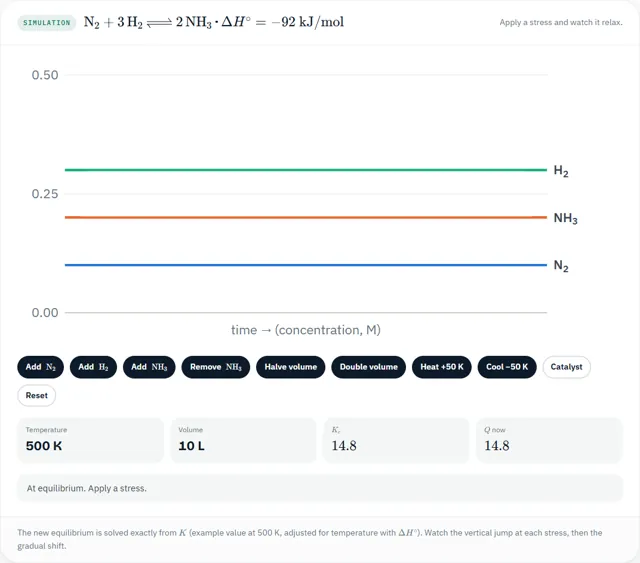
? is at equilibrium in a rigid container. More is added. What happens right away?Think, then tap to check
The forward rate increases and becomes greater than the reverse rate, so the system shifts toward products until the rates match again.
is at equilibrium. At time , jumps up suddenly; then rises and falls. Explain.
- A sudden vertical jump means was added at .
- More product makes .
- By Le Chatelier's principle the system shifts toward reactants: forms and is used up.
Study notes
Key concepts
Q tells you which way to go (TRA-8.B.1). A disturbance makes Q different from K. The system then reacts to bring Q back to K and reaches a new equilibrium state. The slides summarise:
| Comparison | Meaning | Net reaction |
|---|---|---|
| Q = K | At equilibrium | No net change |
| Q < K | Too much reactant, too little product | Forward (shift right) until Q rises to K |
| Q > K | Too much product | Reverse (shift left) until Q falls to K |
Which stresses change Q and which change K (TRA-8.B.2)
| Stress | Changes Q? | Changes K? |
|---|---|---|
| Add or remove a reactant or product (gas or aqueous) | Yes | No |
| Change volume of a gas mixture (Δn ≠ 0) | Yes | No |
| Dilute a solution (unequal numbers of dissolved particles) | Yes | No |
| Change temperature | No (at first) | Yes |
| Add a pure solid or liquid, an inert gas at constant V, or a catalyst | No | No |
In every case the concentrations or partial pressures redistribute so that Q equals K again.
Why volume changes work through Q. Halving the volume doubles every gas pressure (or concentration). For N₂O₄(g) ⇌ 2 NO₂(g), Q = (P_NO₂)²/P_N₂O₄ becomes (2)²/2 = 2 times larger. Now Q > K, so the system shifts left, toward fewer gas moles. This is the Q-based reason behind the Le Châtelier rule.
Why dilution works through Q. For Fe³⁺ + SCN⁻ ⇌ FeSCN²⁺, diluting to double the volume halves every concentration. Q = [FeSCN²⁺]/([Fe³⁺][SCN⁻]) becomes (½)/(½ × ½) = 2 times larger. Q > K, so the reaction shifts left and the red colour fades by more than dilution alone would cause.
Heterogeneous systems. For CaCO₃(s) ⇌ CaO(s) + CO₂(g), Q = P_CO₂. If extra CO₂ is injected, Q > K. CO₂ reacts with CaO until P_CO₂ falls back to exactly the original value of Kp (as long as both solids are present at the end).
Key equations
Worked examples
Example 7.10a. At 375 °C, Kp = 9.87 × 10⁻⁹ for N₂(g) + 3 H₂(g) ⇌ 2 NH₃(g). (a) At equilibrium P_N₂ = 2.17 atm and P_H₂ = 1.24 atm. Find P_NH₃. (b) A different mixture at 375 °C has P_N₂ = 2.17 atm, P_H₂ = 1.24 atm and P_NH₃ = 1.0 × 10⁻³ atm. Which way will it react?
Solution.
(a)
P_NH₃ = 2.02 × 10⁻⁴ atm.
(b)
Q (2.4 × 10⁻⁷) > K (9.87 × 10⁻⁹), so there is too much NH₃. The reaction proceeds in reverse: NH₃ decomposes until Q = K.
Example 7.10b. For B ⇌ 2 A, Kc = 2.0. (From Example 7.7c, Q = 1.5.) Since Q < K, the reaction goes forward: [B] decreases and [A] increases until [A]²/[B] = 2.0.
Unit 7 study guide: exam-style free-response set, worksheet and answers.
Worked example
- Halving the volume doubles both concentrations.
- .
- , so the reaction proceeds in reverse until .
- Answer: The equilibrium shifts toward (fewer moles of gas).
Free-response practice
Write your answer first, then open the solution and mark yourself against it.
FRQ 7.10. For CO(g) + H₂O(g) ⇌ CO₂(g) + H₂(g), Kc = 4.0 at a certain temperature. A 1.00 L flask contains 0.40 mol CO, 0.40 mol H₂O, 1.00 mol CO₂ and 1.00 mol H₂.
(a) Calculate Qc and predict the direction of net reaction.
(b) Calculate the equilibrium concentrations.
(c) The temperature is then raised and the equilibrium [H₂] decreases. Is the forward reaction exothermic or endothermic? Explain in terms of K.
Show the solution
(a) Qc = (1.00)(1.00)/((0.40)(0.40)) = 6.25. Q > K, so the reaction goes in reverse (left).
(b) [CO] = [H₂O] = 0.40 + x and [CO₂] = [H₂] = 1.00 − x.
[CO] = [H₂O] = 0.47 M; [CO₂] = [H₂] = 0.93 M. Check: (0.933)²/(0.467)² = 4.0.
(c) Exothermic. A lower [H₂] at the new equilibrium means the products decreased, so K became smaller at the higher temperature. K decreases with increasing T only when the forward reaction is exothermic (heat is a product, so adding heat shifts the equilibrium left).
Common mistake
Students say a shift happens "to relieve the stress" without justification. On free-response questions, show that the disturbance makes , and state which direction restores .
Frequently asked questions
?How is Q related to Le Chatelier's principle?
A disturbance changes so that it no longer equals ; the system then reacts in the direction that brings back to .
?Why does temperature change K but concentration does not?
depends only on temperature; changing concentrations moves the system away from equilibrium without changing the equilibrium constant.
Practice questions on 7.10
- Q1For a reaction mixture, Q = 3.5 × 10³ and K = 1.2 × 10². Which statement is correct?
- Q2Which change to an equilibrium mixture of H₂(g) + I₂(g) ⇌ 2 HI(g) changes the value of K?
- Q3A red equilibrium solution of Fe³⁺(aq) + SCN⁻(aq) ⇌ FeSCN²⁺(aq) is diluted with an equal volume of water. Immediately after dilution, how does Q compare with K, and what happens next?
- Q4An equilibrium mixture of N₂O₄(g) ⇌ 2 NO₂(g) is compressed to half its volume at constant temperature. Which is true immediately after compression?
Terms used in this topic
Stuck on a unit? Let us fix it this week.
Book a 30-minute one-to-one session for $20. Bring a test, a homework set or the topic that is not clicking.
Book a session