 AP Chemistry Tutoring
1.1 Moles and molar mass
AP Chemistry Unit 1: Atomic Structure and Properties · 1 simulation · 14 practice questions
Updated · Aligned to the AP Chemistry Course and Exam Description
A mole is the amount of substance that contains Avogadro's number of particles, . Molar mass (g/mol) is numerically equal to the average mass of one particle in atomic mass units, so it links the mass of a sample to the number of particles in it: and .
The mole
A mole is a chemist's dozen.
A dozen is 12. A mole is particles, Avogadro's number.
The molar mass is the mass of one mole, read straight off the periodic table: 1 mol of carbon is 12.01 g.
Mole calculator
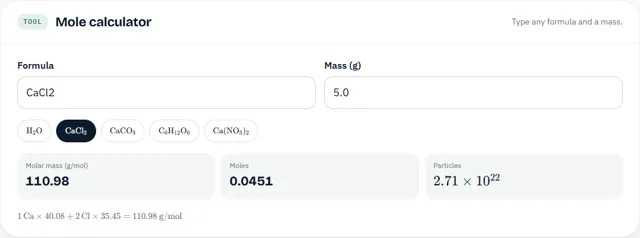
How many moles, formula units and ions are in 5.0 g of ?
- Molar mass:
- Moles:
- Formula units:
- Each is 3 ions ( + 2 ), so ions. (Ionic, so "formula units", not "molecules".)
4.86 mol of : what is its mass, and how much of it is carbonate ion?
- Molar mass:
- Mass:
- 1 mol contains 1 mol ()
- of carbonate
Write units on every number. If the units cancel to what you want, the setup is right.
Study notes
Key concepts
Why we need the mole (SPQ-1.A.1). Atoms and molecules are far too small to count one by one. In the laboratory we measure mass (with a balance) or volume. So we need a bridge between a mass we can weigh and the number of particles that actually react. That bridge is the mole. A mole works like a "chemist's dozen": a dozen is 12 eggs, a ream is 500 sheets of paper, and a mole is 6.022 × 10²³ particles.
Avogadro's number (SPQ-1.A.2). One mole of any substance contains NA = 6.022 × 10²³ particles. The "particles" can be atoms (for an element such as Fe), molecules (for a molecular substance such as H₂O) or formula units (for an ionic compound such as NaCl, which has no separate molecules). Always ask yourself: "a mole of what?" One mole of O₂ molecules contains 2 moles of O atoms.
Atomic mass units and molar mass (SPQ-1.A.3). The atomic mass unit (amu, also written u or Da) is defined so that one atom of carbon-12 has a mass of exactly 12 amu. The average mass of one particle in amu is numerically equal to the mass of one mole of those particles in grams. For example, the average water molecule has a mass of 18.02 amu, and one mole of water has a mass of 18.02 g. This is the reason the periodic table can be read in two ways: "one atom of Na has an average mass of 22.99 amu" or "one mole of Na atoms has a mass of 22.99 g".
Molar mass (M) is the mass of one mole of a substance, in g/mol. For a compound, add up the molar masses of all atoms in the formula.
| Substance | Formula | Molar mass calculation | M (g/mol) |
|---|---|---|---|
| Carbon dioxide | CO₂ | 12.01 + 2(16.00) | 44.01 |
| Sodium hydroxide | NaOH | 22.99 + 16.00 + 1.008 | 40.00 |
| Glucose | C₆H₁₂O₆ | 6(12.01) + 12(1.008) + 6(16.00) | 180.16 |
| Dopamine | C₈H₁₁NO₂ | 8(12.01) + 11(1.008) + 14.01 + 2(16.00) | 153.18 |
The mole "map". Nearly every Unit 1 calculation is a path through this chain, using dimensional analysis (carry the units and make them cancel):
| From | Operation | To |
|---|---|---|
| mass (g) | divide by molar mass (g/mol) | moles |
| moles | multiply by molar mass | mass (g) |
| moles | multiply by 6.022 × 10²³ | number of particles |
| number of particles | divide by 6.022 × 10²³ | moles |
| moles of compound | multiply by subscript | moles of one element in it |
Common misconceptions.
-
Equal masses do not contain equal numbers of particles. 1 g of H₂ and 1 g of O₂ contain very different numbers of molecules because their molar masses differ.
-
Equal numbers of moles do contain equal numbers of particles, whatever the substance.
-
A mole is a number, not a mass. The mass of one mole depends on the substance.
-
A balance (not a graduated cylinder) is the right tool to measure out a given number of moles of a solid.
-
Watch arithmetic with powers of ten: 4.00 × 6.022 × 10²³ = 2.409 × 10²⁴, not 2.409 × 10²³.
Key equations
Here n is the number of moles, m is the mass in grams, M is the molar mass in g/mol and N is the number of particles.
Worked examples
Worked example 1.1a — glucose. A student has 25.0 g of glucose, C₆H₁₂O₆. How many moles, how many molecules and how many hydrogen atoms are present?
Step 1: Molar mass = 180.16 g/mol (see the table above).
Step 2: Moles = 25.0 g ÷ 180.16 g/mol = 0.139 mol.
Step 3: Molecules = 0.139 mol × 6.022 × 10²³ mol⁻¹ = 8.36 × 10²² molecules.
Step 4: Each molecule has 12 H atoms, so H atoms = 12 × 8.36 × 10²² = 1.00 × 10²⁴ H atoms.
Worked example 1.1b — ranking samples (CED think-pair-share idea). Rank these samples by number of particles, by mass and by number of moles. Sample A: 1.0 mol of carbon atoms. Sample B: 18 g of carbon monoxide, CO. Sample C: 3.0 × 10²³ molecules of water.
| Sample | Moles | Particles | Mass |
|---|---|---|---|
| A: C | 1.0 mol | 6.0 × 10²³ atoms | 12 g |
| B: CO | 18 ÷ 28.01 = 0.64 mol | 3.9 × 10²³ molecules | 18 g |
| C: H₂O | 3.0 × 10²³ ÷ 6.022 × 10²³ = 0.50 mol | 3.0 × 10²³ molecules | 0.50 × 18.02 = 9.0 g |
Particles and moles: C < B < A. Mass: C < A < B. Notice that the sample with the largest mass (B) does not have the most particles, because CO molecules are heavier than C atoms.
Unit 1 study guide: exam-style free-response set, worksheet and answers.
Worked example
- Molar mass of : .
- Moles: .
- Molecules: .
- Answer: molecules of
Free-response practice
Write your answer first, then open the solution and mark yourself against it.
FRQ 1.1-1. Dopamine, C₈H₁₁NO₂, is a neurotransmitter.
(a) Calculate the molar mass of dopamine.
(b) Calculate the mass of 0.250 mol of dopamine.
(c) Calculate the number of nitrogen atoms in 10.0 g of dopamine.
(d) How many moles of atoms in total are in 1 mol of dopamine? Explain.
Show the solution
(a) M = 8(12.01) + 11(1.008) + 14.01 + 2(16.00) = 153.18 g/mol.
(b) m = n × M = 0.250 mol × 153.18 g/mol = 38.3 g.
(c) n = 10.0 g ÷ 153.18 g/mol = 0.0653 mol of dopamine. Each molecule has 1 N atom, so N atoms = 0.0653 × 6.022 × 10²³ = 3.93 × 10²² N atoms.
(d) Each molecule contains 8 + 11 + 1 + 2 = 22 atoms, so 1 mol of dopamine contains 22 mol of atoms (22 × 6.022 × 10²³ = 1.32 × 10²⁵ atoms).
FRQ 1.1-2. A student needs exactly 5.00 mol of potassium metal for a reaction.
(a) Identify the most appropriate piece of equipment for measuring this amount and justify your choice.
(b) Calculate the quantity the student should measure.
Show the solution
(a) A balance. Potassium is a solid; the mole is linked to mass through the molar mass, so the amount is measured by mass, not by volume.
(b) m = 5.00 mol × 39.10 g/mol = 196 g (195.5 g) of K.
Common mistake
Students multiply grams by molar mass instead of dividing. Grams cancel only when you divide: .
Frequently asked questions
?What is the difference between atomic mass and molar mass?
Atomic mass is the average mass of one atom in amu; molar mass is the mass of one mole of those atoms in grams. They have the same number, e.g. carbon is 12.01 amu per atom and 12.01 g/mol.
?Is Avogadro's number given on the AP Chemistry exam?
Yes. is on the equations and constants sheet provided with the exam.
Practice questions on 1.1
- Q1How many moles of are in 22.0 g of ? (Molar mass = 44.0 g/mol)
- Q2How many oxygen atoms are in 0.250 mol of ?
- Q3What is the mass of 0.150 mol of ? (Molar mass = 106.0 g/mol)
- Q4Which sample contains the greatest number of atoms?
- Q5What are the mass and the number of formula units in 4.00 mol of NaOH?
- Q6Which of the following pairs contains the same number of oxygen atoms?
- Q7The average mass of one molecule of a substance is 44.01 amu. Which statement must be true?
- Q8Which sample contains the greatest number of atoms in total?
- Q9What is the mass of 2.50 mol of , and how many formula units does it contain?
- Q10Which pair contains the same number of particles?
- Q11A student needs exactly 3.00 mol of calcium metal. What is the most practical way to measure it?
- Q12Cyclohexane has the empirical formula and a molar mass of 84 g/mol. What mass of hydrogen is in 168 g of cyclohexane?
- Q13What mass of sulfur is in 160 g of ?
- Q14Which statement about 0.250 mol of is correct?
Stuck on a unit? Let us fix it this week.
Book a 30-minute one-to-one session for $20. Bring a test, a homework set or the topic that is not clicking.
Book a session