 AP Chemistry Tutoring
1.2 Mass spectroscopy of elements
AP Chemistry Unit 1: Atomic Structure and Properties · 1 simulation · 14 practice questions
Updated · Aligned to the AP Chemistry Course and Exam Description
A mass spectrum of an element shows a peak for each isotope: the position gives the isotope's mass () and the peak height gives its relative abundance. The element's average atomic mass is the abundance-weighted mean of the isotope masses, , which is the value printed on the periodic table.
Mass spectra
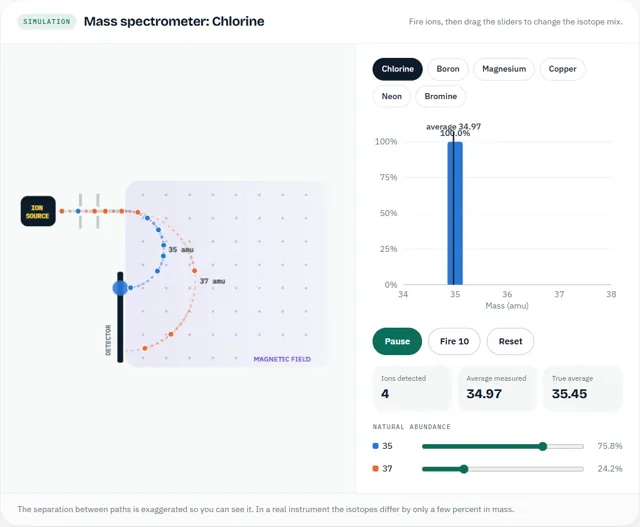
A mass spectrometer sorts atoms by mass.
Atoms are turned into ions and sent through a magnetic field. Heavier ions bend less, so each isotope lands in its own spot.
Each peak is an isotope. Its height is how common it is.
The average is weighted.
Multiply each isotope's mass by its abundance, then add. The average always sits nearest the tallest peak.
Mass spectrometer: Chlorine
Neon averages 20.18 amu. Its isotopes are Ne-20 (19.99 amu) and Ne-22 (21.99 amu). How abundant is each?
- The two fractions add to 1. Call Ne-20's fraction , so Ne-22's is .
- , so
- Ne-20 is 90.5%, Ne-22 is 9.5%. The average is close to 20, as it should be.
Mg-24 (23.99 amu, 78.99%), Mg-25 (24.99 amu, 10.00%), Mg-26 (25.98 amu, 11.01%). Find the average atomic mass.
- Turn each percent into a fraction: 0.7899, 0.1000, 0.1101.
- , the number on the periodic table.
No calculator? Estimate.
The multiple-choice section has no calculator. Read the peaks like a seesaw.
185 (40) and 187 (60). Halfway is 186; more 187 tips it just above.
10 (25) and 11 (100): a 1 : 4 ratio, so . That's boron.
70 (9), 72 (6), 74 (1). The tall pair gives about 70.8; the tiny 74 peak nudges it up to 71.
?Peaks at 63 amu (69%) and 65 amu (31%). Which element?Think, then tap to check
→ copper (63.55). Try it in the spectrometer above.
Study notes
Key concepts
Isotopes. Atoms of the same element always have the same number of protons (the atomic number, Z). They can have different numbers of neutrons. Atoms of one element with different numbers of neutrons are called isotopes. The mass number A = protons + neutrons. An isotope is written with its mass number, for example carbon-12 and carbon-13, or ²⁴Mg. Isotopes of an element have almost identical chemistry, because chemistry depends on electrons, and isotopes have the same number of electrons.
| Isotope | Protons | Neutrons | Electrons (neutral atom) |
|---|---|---|---|
| ¹²C | 6 | 6 | 6 |
| ¹³C | 6 | 7 | 6 |
| ³⁵Cl | 17 | 18 | 17 |
| ³⁷Cl | 17 | 20 | 17 |
| ²⁶Mg | 12 | 14 | 12 |
How a mass spectrometer works (in outline). A sample of the element is vaporized. The atoms are hit with high-energy electrons so that each loses one electron and becomes a +1 ion. The ions are accelerated and sent through a magnetic (or electric) field. Lighter ions are deflected more than heavier ions, so ions of different mass arrive at the detector in different places (or at different times). The detector counts how many ions of each mass arrive.
Reading a mass spectrum (SPQ-1.B.1). The x-axis shows the mass-to-charge ratio, m/z. For singly charged ions this equals the mass of the isotope in amu. The y-axis shows the relative abundance (often as a percentage, or scaled so that the largest peak is 100).
-
Each peak = one isotope of the element.
-
The position of a peak tells you the mass of that isotope.
-
The height of a peak tells you how common that isotope is.
-
The number of peaks tells you how many naturally occurring isotopes the element has.
-
The element itself is identified from the weighted average mass, which should match an atomic mass on the periodic table.
Average atomic mass (SPQ-1.B.2). The atomic mass on the periodic table is a weighted average of the masses of all naturally occurring isotopes. "Weighted" means each isotope's mass counts in proportion to its abundance. Because of this, the average is always closer to the mass of the most abundant isotope, and it is usually not a whole number.
Example of a spectrum described in words. A mass spectrum of magnesium shows three peaks: at m/z = 24 (relative height 100), at m/z = 25 (height 12.66) and at m/z = 26 (height 13.94). To change heights into fractions, divide each height by the total height (126.60). This gives 79.0%, 10.0% and 11.0%. The weighted average is about 24.3 amu, which matches Mg on the periodic table.
What is (and is not) tested. The AP Exam only uses mass spectra of a single element with singly charged monatomic ions. It does not test spectra of mixtures or of molecular ions. (For interest only: chlorine gas, Cl₂, also gives peaks at 70, 72 and 74, which come from ³⁵Cl–³⁵Cl, ³⁵Cl–³⁷Cl and ³⁷Cl–³⁷Cl molecules. You will not be asked to interpret these on the exam.)
Common misconceptions.
-
The atomic mass on the periodic table is not the mass of any single atom. No chlorine atom has a mass of 35.45 amu; chlorine atoms have masses of about 35 or 37 amu.
-
The average is not simply the middle of the isotope masses. It is pulled toward the most abundant isotope.
-
Isotopes are not different elements; the number of protons is the same.
Key equations
For two isotopes with fractional abundances x and (1 − x):
Worked examples
Worked example 1.2a — average atomic mass. Boron has two isotopes: ¹⁰B (mass 10.013 amu, abundance 19.9%) and ¹¹B (mass 11.009 amu, abundance 80.1%). Calculate the average atomic mass.
Average = (0.199)(10.013) + (0.801)(11.009) = 1.993 + 8.818 = 10.81 amu. This matches the periodic table and is closer to 11 because ¹¹B is more abundant.
Worked example 1.2b — finding an abundance. Gallium (average atomic mass 69.72) has two isotopes, ⁶⁹Ga and ⁷¹Ga. Estimate the percent abundance of ⁷¹Ga using whole-number masses.
Let x = fraction of ⁷¹Ga. Then 71x + 69(1 − x) = 69.72, so 69 + 2x = 69.72 and x = 0.36. About 36% ⁷¹Ga and 64% ⁶⁹Ga. (With the exact isotope masses, 68.926 and 70.925 amu, the answer is 39.7%; whole-number masses give a good estimate only.)
Worked example 1.2c — reading a spectrum. A spectrum of a pure element shows peaks at m/z = 28 (92.2%), 29 (4.7%) and 30 (3.1%). Identify the element and the numbers of protons and neutrons in its most abundant isotope.
Average ≈ 28(0.922) + 29(0.047) + 30(0.031) = 28.11. This matches silicon (28.09). The most abundant isotope is ²⁸Si: 14 protons (Si is element 14) and 28 − 14 = 14 neutrons.
Unit 1 study guide: exam-style free-response set, worksheet and answers.
Worked example
- Convert percentages to fractions: 0.758 and 0.242.
- Weighted mean: .
- Check: the result is closer to 35, matching the more abundant isotope.
- Answer: 35.45 amu
Free-response practice
Write your answer first, then open the solution and mark yourself against it.
FRQ 1.2-1. The mass spectrum of a pure sample of an element X shows two peaks. The peak at m/z = 85 has a relative height of 100. The peak at m/z = 87 has a relative height of 38.6.
(a) Calculate the percent abundance of each isotope.
(b) Calculate the average atomic mass of X using whole-number isotope masses, and identify X.
(c) A student claims that every atom of X has a mass of about 85.47 amu. Explain why the claim is incorrect.
Show the solution
(a) Total height = 100 + 38.6 = 138.6. Abundance of mass 85 = 100 ÷ 138.6 = 72.2%. Abundance of mass 87 = 38.6 ÷ 138.6 = 27.8%.
(b) Average = 85(0.722) + 87(0.278) = 85.56 amu (about 85.6). This matches rubidium, Rb (85.47).
(c) 85.47 amu is a weighted average. Each individual Rb atom has a mass of about 85 amu or about 87 amu (it is one isotope or the other). No single atom has the average mass.
FRQ 1.2-2. Naturally occurring magnesium has three isotopes. Data from its mass spectrum are given below.
| Isotope | Mass (amu) | Abundance (%) |
|---|---|---|
| ²⁴Mg | 23.985 | 78.99 |
| ²⁵Mg | 24.986 | 10.00 |
| ²⁶Mg | 25.983 | 11.01 |
(a) How many protons and how many neutrons are in the nucleus of an atom of the most abundant isotope?
(b) Calculate the average atomic mass of magnesium to four significant figures.
(c) Describe how the mass spectrum would look (number of peaks, positions and relative heights).
Show the solution
(a) The most abundant isotope is ²⁴Mg: 12 protons and 24 − 12 = 12 neutrons.
(b) Average = (0.7899)(23.985) + (0.1000)(24.986) + (0.1101)(25.983) = 18.946 + 2.499 + 2.861 = 24.31 amu.
(c) Three peaks, at m/z = 24, 25 and 26. The peak at 24 is by far the tallest (about 79%). The peaks at 25 and 26 are short and nearly the same height (about 10% and 11%), with the peak at 26 very slightly taller.
Common mistake
Students average the isotope masses without weighting by abundance. The average atomic mass lies closer to the mass of the most abundant isotope, so each mass must be multiplied by its fractional abundance.
Frequently asked questions
?What does the height of a peak in a mass spectrum mean?
Peak height (or area) is proportional to the relative abundance of that isotope in the sample.
?Why is chlorine's atomic mass 35.45 and not a whole number?
It is a weighted average of chlorine-35 and chlorine-37, so it falls between the two isotope masses.
Practice questions on 1.2
- Q1The mass spectrum of an element shows two isotopes: 10.0 amu (20.0%) and 11.0 amu (80.0%). What is its average atomic mass?
- Q2Copper has two isotopes, and , and an average atomic mass of 63.55 amu. Which statement is true?
- Q3Neon's average atomic mass is 20.18 amu. Its isotopes are neon-20 (19.99 amu) and neon-22 (21.99 amu). What is the percent abundance of neon-20?
- Q4The mass spectrum of an element has two peaks: 185 amu with relative abundance 40 and 187 amu with relative abundance 60. Its average atomic mass is closest to
- Q5The mass spectrum of a pure element shows two peaks: m/z = 10 with relative abundance 19.9% and m/z = 11 with relative abundance 80.1%. What is the approximate average atomic mass of the element?
- Q6Gallium has an atomic mass of 69.72 and only two naturally occurring isotopes, ⁶⁹Ga and ⁷¹Ga. The natural abundance of ⁷¹Ga is approximately
- Q7A mass spectrum of a pure element shows five peaks, at m/z = 90 (51.5%), 91 (11.2%), 92 (17.2%), 94 (17.4%) and 96 (2.8%). The element is most likely
- Q8Which statement about the two isotopes ³⁵Cl and ³⁷Cl is correct?
- Q9In the mass spectrum of a pure element, what does the height of each peak represent?
- Q10The mass spectrum of an element shows two peaks: (60.1%) and (39.9%). What is its average atomic mass?
- Q11A diatomic element produces mass-spectrum peaks at = 79, 81, 158, 160 and 162. What best explains the peaks at 158, 160 and 162?
- Q12A diatomic element gives mass-spectrum peaks at = 79, 81, 158, 160 and 162. Which element is it?
- Q13A pure sample of nitrogen gas shows a major peak at . This peak is evidence of:
- Q14Chlorine has isotopes of mass 35 and 37 and an average atomic mass of 35.45. What are the approximate abundances?
Terms used in this topic
Stuck on a unit? Let us fix it this week.
Book a 30-minute one-to-one session for $20. Bring a test, a homework set or the topic that is not clicking.
Book a session