 AP Chemistry Tutoring
1.7 Periodic trends
AP Chemistry Unit 1: Atomic Structure and Properties · 2 simulations · 37 practice questions
Updated · Aligned to the AP Chemistry Course and Exam Description
Periodic trends are patterns in atomic radius, ionization energy, electron affinity and electronegativity across the periodic table. They follow from Coulomb's law and shielding: across a period effective nuclear charge increases at similar distance, so atoms shrink and hold electrons more tightly; down a group electrons occupy higher shells farther from the nucleus, so radius increases and ionization energy decreases.
Periodic trends
Across a period: stronger pull.
More protons, same shell, same shielding. Atoms shrink and grip their electrons harder.
Down a group: farther away.
Each row adds a shell. Valence electrons sit farther out, so atoms grow and let go more easily.
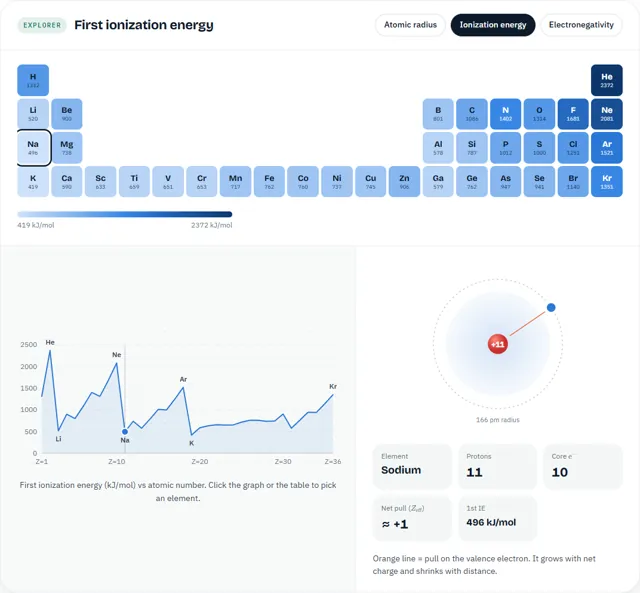
First ionization energy
Successive ionization energies
Explain why the first ionization energy of Mg is greater than that of Na.
- Both remove a 3s electron: same shell (), shielded by the same 10 core electrons.
- Mg has 12 protons, Na has 11, so Mg's valence electron feels a greater net nuclear charge.
- By Coulomb's law the attraction is stronger, so more energy is needed to remove it.
?Rank by size, smallest first: , , , .Think, then tap to check
All have 10 electrons. More protons pull them in tighter: .
Two dips on the graph: B is below Be (2p is higher in energy than 2s) and O is below N (the paired 2p electron is repelled). Find them above.
Study notes
Key concepts
Why the periodic table works (SAP-2.A.1). Elements are arranged in order of atomic number. Elements in the same column (group) have the same valence-electron configuration (for example every group 1 element ends in ns¹), so they have similar chemical properties. Each new row (period) starts a new shell. The repeating pattern of configurations, and especially whether shells and subshells are full or partly full, explains the repeating pattern of properties. Mendeleev used this pattern to leave gaps and predict elements such as germanium ("eka-silicon"). Noble gases were missing from his first table because they are so unreactive that they had not yet been discovered.
The tool for every trend (SAP-2.A.2). All four trends below are explained with the same three ideas.
-
Coulomb's law: attraction increases with charge and decreases with distance.
-
The shell model: going down a group adds a shell, so valence electrons are farther from the nucleus.
-
Shielding and effective nuclear charge: going across a period adds protons, but the added electrons go into the same shell and shield each other poorly. So Zeff felt by the valence electrons increases from left to right. Going down a group, Zeff on the valence electrons stays about the same (for example about +1 for every group 1 element in the simple model).
A good explanation always has three parts: (i) name the relevant difference in structure (more protons in the same shell, or an extra occupied shell); (ii) say what that does to the attraction between the nucleus and the electron(s) in question, using Coulomb's law; (iii) connect the attraction to the property. Avoid vague phrases such as "it wants a full octet" or "it is more stable".
(a) Atomic radius. The bonding atomic radius is half the distance between the nuclei of two bonded identical atoms.
-
Across a period (left to right): radius decreases. Same shell, larger Zeff, so electrons are pulled closer.
-
Down a group: radius increases. Valence electrons are in a higher shell, farther from the nucleus, with about the same Zeff.
| Period 3 atom | Na | Mg | Al | Si | P | S | Cl |
|---|---|---|---|---|---|---|---|
| Radius (pm) | 186 | 160 | 143 | 118 | 110 | 103 | 99 |
(b) Ionic radius.
-
A cation is smaller than its parent atom. For main-group metals the whole valence shell is lost (Na: 186 pm, Na⁺: 102 pm), and fewer electrons means less repulsion.
-
An anion is larger than its parent atom. The added electron(s) increase electron–electron repulsion while the nuclear charge stays the same (Cl: 99 pm, Cl⁻: 181 pm).
-
In an isoelectronic series (same number of electrons), the species with more protons is smaller: O²⁻ (140 pm) > F⁻ (133 pm) > Na⁺ (102 pm) > Mg²⁺ (72 pm) > Al³⁺ (54 pm). All have 10 electrons in 1s² 2s² 2p⁶, but Al³⁺ has 13 protons pulling on them and O²⁻ has only 8.
-
Ions in the same group get larger going down (Li⁺ 76 pm < Na⁺ 102 pm < K⁺ 138 pm).
(c) Ionization energy (IE). First ionization energy is the energy needed to remove the most loosely held electron from a gaseous atom: X(g) → X⁺(g) + e⁻. It is always positive (energy must be supplied).
-
Across a period: IE generally increases. Larger Zeff and smaller radius, so stronger attraction.
-
Down a group: IE decreases. Valence electron is farther from the nucleus.
| Element | Li | Be | B | C | N | O | F | Ne |
|---|---|---|---|---|---|---|---|---|
| IE₁ (kJ/mol) | 520 | 899 | 801 | 1086 | 1402 | 1314 | 1681 | 2081 |
| Element | Na | Mg | Al | Si | P | S | Cl | Ar |
|---|---|---|---|---|---|---|---|---|
| IE₁ (kJ/mol) | 496 | 738 | 578 | 787 | 1012 | 1000 | 1251 | 1521 |
The two exceptions across a period (and how to explain them correctly).
-
Group 2 to group 13 (Be > B, Mg > Al): the electron removed from B is a 2p electron, which is higher in energy and slightly farther from the nucleus (more shielded by the 2s electrons) than the 2s electron removed from Be. So it is easier to remove even though B has more protons.
-
Group 15 to group 16 (N > O, P > S): in O the electron removed is one of a pair in the same 2p orbital. The repulsion between the paired electrons makes it easier to remove. (Explanations based on "the extra stability of a half-filled subshell" are not accepted as complete on AP scoring guides; describe the electron–electron repulsion instead.)
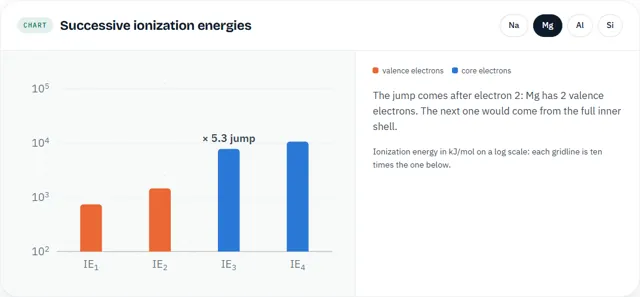
Successive ionization energies. IE₂ is the energy to remove a second electron from the 1+ ion, IE₃ a third electron from the 2+ ion, and so on. Successive IEs always increase, because each electron is removed from an increasingly positive ion with less electron–electron repulsion. A very large jump appears when the first core electron is removed (a new, inner shell much closer to the nucleus). The number of electrons removed before the big jump equals the number of valence electrons.
| Element | IE₁ | IE₂ | IE₃ | IE₄ | IE₅ |
|---|---|---|---|---|---|
| Mg | 738 | 1451 | 7733 | 10 540 | 13 630 |
| Al | 578 | 1817 | 2745 | 11 577 | 14 842 |
| Si | 787 | 1577 | 3232 | 4356 | 16 091 |
(Values in kJ/mol. The big jump is after IE₂ for Mg, after IE₃ for Al and after IE₄ for Si.)
(d) Electron affinity (EA). Electron affinity is the energy change when a gaseous atom gains an electron: X(g) + e⁻ → X⁻(g). For most nonmetals energy is released (the added electron is attracted by the nucleus). The magnitude of energy released generally increases across a period (larger Zeff) and is largest for the halogens; Cl releases the most (349 kJ/mol), slightly more than F (328 kJ/mol), because fluorine's very small 2p shell has a lot of electron–electron repulsion. Noble gases and group 2 elements have little or no tendency to gain an electron (the electron would have to enter a new shell or subshell). Adding a second electron to an anion (O⁻ + e⁻ → O²⁻) always requires energy, because a negative electron is repelled by a negative ion. (Sign conventions differ between books; on the AP Exam you will usually be asked to compare, not to state a sign.)
(e) Electronegativity (EN). Electronegativity is the ability of an atom in a bond to attract the shared bonding electrons toward itself. It is measured on the Pauling scale (0.7 to 4.0). EN increases across a period and decreases down a group, for the same Coulombic reasons as IE: a larger Zeff and a smaller distance between the nucleus and the bonding electrons give a stronger pull. F is the most electronegative element (4.0), then O (3.4), then N and Cl (about 3.0–3.2). Metals have low EN (Cs 0.8). Electron affinity describes an isolated atom gaining an electron; electronegativity describes an atom in a bond.
Summary table.
| Property | Across a period (left → right) | Down a group | Main reason |
|---|---|---|---|
| Atomic radius | Decreases | Increases | Zeff rises across; new shell down |
| First IE | Increases (exceptions at groups 13 and 16) | Decreases | Stronger attraction across; greater distance down |
| Electron affinity (energy released) | Generally increases | Generally decreases | Same as IE |
| Electronegativity | Increases | Decreases | Same as IE |
| Metallic character | Decreases | Increases | Ease of losing electrons |
Estimating values (SAP-2.A.3). Because trends are regular, you can estimate a missing value. For example, if the radii of Cl and I are 99 pm and 133 pm, a reasonable estimate for Br is between them (actual 114 pm). If you are asked to estimate, give a range between neighbours and justify it with the trend.
Common misconceptions.
-
"More electrons make the atom bigger across a period." No: across a period the added electrons go into the same shell, while the increasing nuclear charge pulls all of them closer.
-
"Shielding increases a lot across a period." No: core shielding is about the same across a period; the added protons dominate.
-
"IE of Ne is higher than Ar because Ar has more shielding." The main reason is that Ar's valence electrons are in shell n = 3, much farther from the nucleus than Ne's n = 2 electrons. (Zeff in the simple model is +8 for both.)
Key equations
There are no new equations; use Coulomb's law (Topic 1.5) and Zeff ≈ Z − core electrons.
Worked examples
Worked example 1.7a — ordering by radius and ionization energy. Put Al, S and Cl in order of increasing atomic radius and increasing first ionization energy.
All three are in period 3, so their valence electrons are in shell n = 3. Zeff increases Al < S < Cl. Radius: Cl < S < Al. First IE: Al < S < Cl.
Worked example 1.7b — identifying an element from successive IEs. A period 3 element has the IEs (kJ/mol): 1012, 1900, 2910, 4960, 6270, 22 200. Identify it.
The big jump is between IE₅ (6270) and IE₆ (22 200), more than three times larger. So there are 5 valence electrons and the sixth electron comes from the n = 2 core. The period 3 element with 5 valence electrons is P (3s² 3p³).
Worked example 1.7c — explaining an exception. The first IE of Mg is 738 kJ/mol and that of Al is 578 kJ/mol. Explain.
Mg loses a 3s electron; Al loses a 3p electron. The 3p electron is higher in energy, is on average slightly farther from the nucleus and is partly shielded by the filled 3s subshell. So it is less strongly attracted and easier to remove, even though Al has one more proton.
Unit 1 study guide: exam-style free-response set, worksheet and answers.
Worked example
- All three have valence electrons in the shell, shielded by the same 10 core electrons.
- Nuclear charge increases from Na (11) to Mg (12) to Cl (17), so attraction for the valence electron increases.
- Greater attraction at similar distance means more energy is needed to remove an electron.
- Answer:
Free-response practice
Write your answer first, then open the solution and mark yourself against it.
FRQ 1.7-1. Use the data below to answer the questions.
| Element | Atomic radius (pm) | First IE (kJ/mol) |
|---|---|---|
| Li | 152 | 520 |
| Na | 186 | 496 |
| K | 227 | 419 |
(a) Describe the trend in first ionization energy down group 1.
(b) Using principles of atomic structure and Coulomb's law, explain the trend.
(c) Predict whether the first ionization energy of rubidium is greater than or less than 419 kJ/mol. Justify your prediction.
Show the solution
(a) First IE decreases from Li to Na to K.
(b) Each element down the group has its valence (ns¹) electron in a higher shell, so it is farther from the nucleus (shown by the increasing radius). The core electrons shield the extra protons, so the effective nuclear charge on the valence electron stays about the same (about +1). By Coulomb's law, a larger distance gives a weaker attraction, so less energy is needed to remove the electron.
(c) Less than 419 kJ/mol (actual value 403 kJ/mol). Rb's valence electron is in shell n = 5, farther from the nucleus than K's 4s electron, with similar effective nuclear charge, so it is held less strongly.
FRQ 1.7-2. The successive ionization energies of an unknown element in period 3 are shown (kJ/mol).
| IE₁ | IE₂ | IE₃ | IE₄ | IE₅ | IE₆ | IE₇ |
|---|---|---|---|---|---|---|
| 1000 | 2252 | 3357 | 4556 | 7004 | 8496 | 27 107 |
(a) Identify the element and justify your answer.
(b) Explain why IE₂ is greater than IE₁.
(c) Explain why the increase from IE₆ to IE₇ is much larger than the increase from IE₅ to IE₆.
Show the solution
(a) Sulfur. There is a huge jump between IE₆ and IE₇, so the element has 6 valence electrons (3s² 3p⁴). The period 3 element in group 16 is S.
(b) The second electron is removed from a 1+ ion. The same number of protons now pulls on fewer electrons, so there is less electron–electron repulsion and each electron is held more strongly.
(c) IE₇ removes an electron from the n = 2 shell (a core electron), which is much closer to the nucleus and much less shielded than the n = 3 valence electrons. By Coulomb's law, the attraction is much stronger, so far more energy is needed.
Common mistake
Students answer "because it is further right on the periodic table". AP free-response answers need a reason: more protons with the same number of inner-shell electrons gives a greater attraction for valence electrons at a similar distance.
Frequently asked questions
?Why does atomic radius decrease across a period?
Protons are added while the core shielding stays the same, so effective nuclear charge rises and pulls the valence shell closer.
?Why is there a huge jump in the ionization energies of magnesium after the second electron?
The third electron must come from the core shell, which is much closer to the nucleus and far less shielded.
Practice questions on 1.7
- Q1Which statement best explains why the first ionization energy of Na is lower than that of Li?
- Q2Which of these atoms has the smallest atomic radius?
- Q3Which of these elements has the highest first ionization energy?
- Q4An element has successive ionization energies of 578, 1817, 2745 and 11,577 kJ/mol. Which element is it most likely to be?
- Q5Which list puts these ions in order of increasing radius: , , , ?
- Q6Which property generally decreases across period 3 from sodium to chlorine?
- Q7The valence electron of Na experiences a different effective nuclear charge from a valence electron of Ne. This difference best accounts for which observation?
- Q8Which of the following lists the species in order of increasing radius?
- Q9The first ionization energy of nitrogen is greater than that of oxygen. Which statement best explains this?
- Q10An element has these successive ionization energies (kJ/mol): IE₁ = 787, IE₂ = 1577, IE₃ = 3232, IE₄ = 4356, IE₅ = 16 091. The element is most likely
- Q11Which atom has the highest electronegativity?
- Q12Which statement correctly explains why Mg has a smaller atomic radius than Na?
- Q13Why is the first ionization energy of fluorine greater than that of chlorine?
- Q14An element's successive ionization energies are 590, 1145, 4912 and 6474 kJ/mol. To which group does it belong?
- Q15Rank , S and from highest to lowest first ionization energy.
- Q16Which correctly describes the signs of sulfur's first two ionization energies (IE, IE) and its first two electron affinities (EA, EA)?
- Q17How many valence electrons does an atom with configuration [Xe] have?
- Q18The first ionization energy of Be (899 kJ/mol) is greater than that of B (801 kJ/mol). Why?
- Q19The first ionization energy of P is greater than that of S. Why?
- Q20Which hydrogen-atom transition emits the photon of highest frequency?
- Q21Which set of species is isoelectronic?
- Q22Which process requires the least energy?
- Q23Which atom is smaller, Na or Si, and why?
- Q24Mendeleev's 1869 table had no place for the noble gases. What is the best reason?
- Q25Potassium reacts with water more vigorously than sodium. Why?
- Q26Which of these elements is the most electronegative?
- Q27Which atom has the smallest radius?
- Q28Why does atomic radius generally decrease across a period?
- Q29A procedure calls for , but none is available. Which compound would behave most similarly?
- Q30A hypothetical new element has a valence configuration ending in . How is it expected to behave?
- Q31Why is larger than ?
- Q32Which gives Na, Mg and Si in order of increasing atomic radius, then increasing first ionization energy?
- Q33Why is larger than a Cl atom?
- Q34A binary ionic solid has a 1:1 ratio of ions, and the cation and anion have nearly equal radii. Which is it most likely to be?
- Q35Which metal has a valence configuration most similar to gold's and would behave most like gold in an alloy?
- Q36Rank , and by increasing radius.
- Q37Which is a stronger reducing agent than Mg(s)?
Stuck on a unit? Let us fix it this week.
Book a 30-minute one-to-one session for $20. Bring a test, a homework set or the topic that is not clicking.
Book a session