 AP Chemistry Tutoring
1.6 Photoelectron spectroscopy
AP Chemistry Unit 1: Atomic Structure and Properties · 1 simulation · 15 practice questions
Updated · Aligned to the AP Chemistry Course and Exam Description
Photoelectron spectroscopy (PES) uses high-energy radiation to eject electrons and measures the energy needed to remove electrons from each subshell. Each peak corresponds to one subshell: its position gives the binding energy and its relative height gives the number of electrons in that subshell. Binding energy is found from and is highest for the electrons, closest to the nucleus.
Seeing electrons: PES
Knock electrons out. Measure how hard it was.
Light with a known energy hits the atom and ejects an electron. A tightly held electron leaves with little energy to spare.
Left = held tightly, close to the nucleus.
is three times as tall as .
Na has four: 1s, 2s, 2p, 3s.
Ar's 1s is far left of Na's 1s.
Photoelectron spectrometer: Sodium
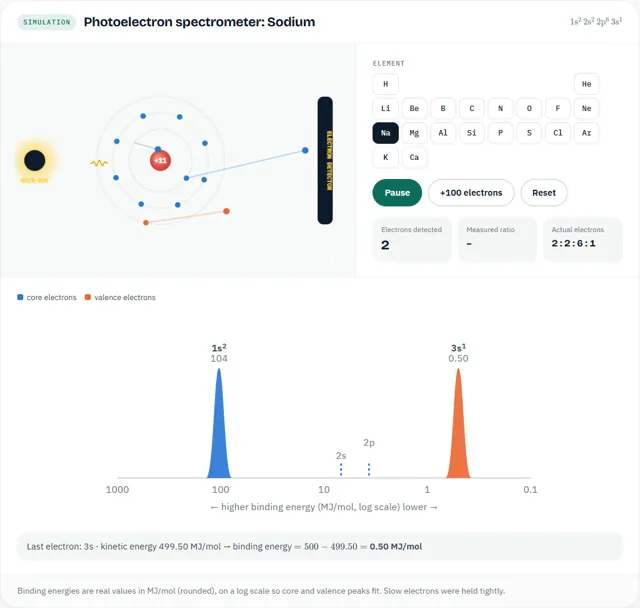
?Peak heights 2, 2, 6, 2, 1, from high to low binding energy. Which element?Think, then tap to check
= 13 electrons: aluminum. Pick Al in the simulation to confirm.
Study notes
Key concepts
Light as photons. Light (electromagnetic radiation) behaves as a wave and as a stream of particles called photons. All light travels at c = 2.998 × 10⁸ m/s. The energy of one photon depends on its frequency (ν): E = hν. Since c = λν, a shorter wavelength means a higher frequency and a higher photon energy.
What PES does (SAP-1.B.1). In photoelectron spectroscopy, a sample of gaseous atoms is hit with high-energy photons (X-ray or ultraviolet) of known energy. A photon can knock out an electron from any occupied subshell. The instrument measures the kinetic energy of each ejected electron. Energy is conserved, so:
binding energy (ionization energy of that electron) = photon energy − kinetic energy of the ejected electron.
Electrons that are held tightly leave with little kinetic energy; electrons held loosely leave with a lot. From the results, the instrument plots a spectrum.
Reading a PES spectrum.
-
The x-axis is binding energy (usually in MJ/mol). By convention, binding energy usually increases to the left. Read the axis labels carefully every time.
-
Each peak corresponds to one subshell (1s, 2s, 2p, 3s, …).
-
The position of a peak shows how much energy is needed to remove an electron from that subshell. A peak further toward high binding energy means the electrons are more strongly attracted to the nucleus (closer to the nucleus and/or feeling a larger effective nuclear charge).
-
The height (area) of a peak is (ideally) proportional to the number of electrons in that subshell. An s peak can be at most 2 units high, a p peak at most 6, a d peak at most 10.
-
The number of peaks equals the number of occupied subshells.
-
The peak with the lowest binding energy belongs to the valence electrons, and its value is the first ionization energy.
Approximate binding energies (MJ/mol) for some elements. These values are the kind given on AP spectra; use them for practice.
| Element | 1s | 2s | 2p | 3s | 3p | 4s |
|---|---|---|---|---|---|---|
| H | 1.31 | |||||
| He | 2.37 | |||||
| Li | 6.26 | 0.52 | ||||
| Be | 11.5 | 0.90 | ||||
| B | 19.3 | 1.36 | 0.80 | |||
| C | 28.6 | 1.72 | 1.09 | |||
| N | 39.6 | 2.45 | 1.40 | |||
| O | 52.6 | 3.12 | 1.31 | |||
| F | 67.2 | 3.88 | 1.68 | |||
| Ne | 84.0 | 4.68 | 2.08 | |||
| Na | 104 | 6.84 | 3.67 | 0.50 | ||
| Mg | 126 | 9.07 | 5.31 | 0.74 | ||
| Al | 151 | 12.1 | 7.19 | 1.09 | 0.58 | |
| Si | 178 | 15.1 | 10.3 | 1.46 | 0.79 | |
| P | 208 | 18.7 | 13.5 | 1.95 | 1.01 | |
| S | 239 | 22.7 | 16.5 | 2.05 | 1.00 | |
| Cl | 273 | 26.8 | 20.2 | 2.44 | 1.25 | |
| Ar | 309 | 31.5 | 24.1 | 2.82 | 1.52 | |
| K | 347 | 37.1 | 29.1 | 3.93 | 2.38 | 0.42 |
| Ca | 390 | 42.7 | 34.0 | 4.65 | 2.90 | 0.59 |
Patterns to explain with Coulomb's law.
-
Within one atom, binding energy falls steeply from 1s to the valence shell. Inner electrons are closer to the nucleus and less shielded.
-
The same subshell moves to higher binding energy as Z increases (for example 1s: 39.6 for N, 52.6 for O). More protons means a stronger attraction at about the same distance.
-
The jump between shells is far larger than the gap between subshells in the same shell (for Na: 2p is 3.67 but 3s is only 0.50). This is the evidence for the shell model.
-
In a given atom, a 2p electron is slightly easier to remove than a 2s electron. 2s electrons penetrate closer to the nucleus.
-
Valence peaks show the exceptions in first ionization energy: B's 2p peak (0.80) is lower than Be's 2s peak (0.90), and O's 2p peak (1.31) is lower than N's 2p peak (1.40). See Topic 1.7.
Using PES to deduce a configuration. Read the peaks from high to low binding energy, assign subshells in Aufbau order and use the relative heights for electron counts. Example: peaks at 151, 12.1, 7.19, 1.09 and 0.58 MJ/mol with relative heights 2: 2: 6: 2: 1 give 1s² 2s² 2p⁶ 3s² 3p¹, which is aluminium.
Predicting a spectrum. To predict the spectrum of the next element (one more proton), every existing peak moves slightly to higher binding energy (greater nuclear charge), and the new electron either increases the height of the valence peak or adds a new peak at low binding energy if it starts a new subshell.
Transition metals. For scandium ([Ar] 4s² 3d¹), the 3d peak (about 0.77 MJ/mol) and the 4s peak (about 0.63 MJ/mol) are close together, while the 3p peak (about 3.2 MJ/mol) is much higher. So removing three electrons (4s² and 3d¹) is relatively easy, but removing a fourth (from 3p) is very costly. This is why Sc forms Sc³⁺.
Common misconceptions.
-
The tallest peak is not the hardest electron to remove; height means number of electrons, position means energy.
-
Binding energy is not "negative" or "released" energy here; it is the (positive) energy you must supply.
-
PES does not show the energy of an electron being added; it shows removal of electrons from a neutral atom (one electron at a time from many atoms, so every subshell appears).
-
PES peaks for different subshells of the same atom are not successive ionization energies. Successive IEs remove electrons one after another from an ion that becomes more positive; PES removes one electron from neutral atoms.
Key equations
To change a binding energy in MJ/mol to J per atom (per electron): multiply by 10⁶ and divide by NA.
Worked examples
Worked example 1.6a — identify an element. A complete PES spectrum shows four peaks.
| Peak | Binding energy (MJ/mol) | Relative height |
|---|---|---|
| 1 | 126 | 2 |
| 2 | 9.07 | 2 |
| 3 | 5.31 | 6 |
| 4 | 0.74 | 2 |
Configuration: 1s² 2s² 2p⁶ 3s². Total electrons = 12, so the element is magnesium.
Worked example 1.6b — wavelength to remove a valence electron. Using the spectrum above, calculate the wavelength of light needed to remove one valence electron from one Mg atom.
E per atom = (0.74 × 10⁶ J/mol) ÷ (6.022 × 10²³ mol⁻¹) = 1.23 × 10⁻¹⁸ J.
λ = hc ÷ E = (6.626 × 10⁻³⁴ J·s)(2.998 × 10⁸ m/s) ÷ (1.23 × 10⁻¹⁸ J) = 1.62 × 10⁻⁷ m (ultraviolet light).
Worked example 1.6c — explaining positions. Why is the 1s peak of Mg (126 MJ/mol) at a much higher binding energy than the 1s peak of Na (104 MJ/mol)?
Both peaks are 1s electrons at about the same distance from the nucleus. Mg has 12 protons and Na has 11. By Coulomb's law, the larger nuclear charge in Mg attracts the 1s electrons more strongly, so more energy is needed to remove them.
Unit 1 study guide: exam-style free-response set, worksheet and answers.
Worked example
- Assign peaks to subshells: , , , , .
- Total electrons: , so the atomic number is 13.
- Answer: Aluminum,
Free-response practice
Write your answer first, then open the solution and mark yourself against it.
FRQ 1.6-1. The complete PES spectrum of an unknown element is given below (binding energy increases to the left on the real spectrum). Modelled on the CED sample free-response Question 1 (short answer).
| Peak | Binding energy (MJ/mol) | Relative number of electrons |
|---|---|---|
| A | 126 | 2 |
| B | 9.07 | 2 |
| C | 5.31 | 6 |
| D | 0.74 | 2 |
(a) Identify the peak that corresponds to the electrons that are, on average, closest to the nucleus. Justify your answer in terms of Coulomb's law.
(b) Write the complete electron configuration of the element.
(c) Describe how the peak(s) for the valence electrons of the element with one more proton would appear on the same spectrum.
Show the solution
(a) Peak A (126 MJ/mol). The electrons closest to the nucleus have the greatest binding energy, because the Coulombic attraction between the electron and the nucleus is greatest when the distance r is smallest. (1 point)
(b) 1s² 2s² 2p⁶ 3s² (magnesium). (1 point)
(c) The next element is Al: [Ne] 3s² 3p¹. Its valence electrons give two peaks: a 3s peak with relative height 2, slightly to the left of (higher energy than) peak D, and a new 3p peak with relative height 1, to the right of (lower energy than) peak D. (1 point for the 3s peak shifted to higher energy with the same height; 1 point for a new 3p peak half as tall at lower energy.)
FRQ 1.6-2. The valence peaks of N and O are given: N 2p at 1.40 MJ/mol (height 3); O 2p at 1.31 MJ/mol (height 4). The 2s peaks are N 2.45 MJ/mol and O 3.12 MJ/mol (both height 2).
(a) Explain why the O 2s peak is at a higher binding energy than the N 2s peak.
(b) Explain why the O 2p peak is at a lower binding energy than the N 2p peak, even though O has a greater nuclear charge.
(c) Calculate the frequency of a photon that has just enough energy to remove a 2p electron from one N atom.
Show the solution
(a) O has 8 protons, N has 7. The 2s electrons are in the same shell, at a similar distance and with the same two 1s core electrons shielding them, so the larger nuclear charge of O attracts them more strongly.
(b) In O the fourth 2p electron must pair with another electron in the same 2p orbital. The repulsion between the two paired electrons raises the energy of one of them, so it is easier to remove, and this effect outweighs the extra proton.
(c) E = (1.40 × 10⁶ J/mol) ÷ (6.022 × 10²³ mol⁻¹) = 2.32 × 10⁻¹⁸ J. ν = E ÷ h = 2.32 × 10⁻¹⁸ J ÷ 6.626 × 10⁻³⁴ J·s = 3.51 × 10¹⁵ s⁻¹.
Common mistake
Students think a taller peak means a higher energy. Peak height shows the number of electrons in a subshell; binding energy is shown by peak position on the horizontal axis.
Frequently asked questions
?Which peak in a PES spectrum is the 1s peak?
The peak with the highest binding energy, because electrons are closest to the nucleus and most strongly attracted.
?Why does the 1s peak of sodium have a higher binding energy than that of neon?
Sodium has 11 protons and neon has 10, so sodium's electrons feel a greater nuclear attraction.
Practice questions on 1.6
- Q1A photoelectron spectrum shows three peaks with relative heights 2, 2 and 3, listed from highest to lowest binding energy. Which element is it?
- Q2In the photoelectron spectrum of magnesium, why is the 1s peak at a much higher binding energy than the 3s peak?
- Q3How does the 1s peak in the photoelectron spectrum of potassium compare with the 1s peak of sodium?
- Q4A complete PES spectrum has three peaks at 84.0, 4.68 and 2.08 MJ/mol with relative heights 2: 2: 6. Which element is it?
- Q5The 2s peak of Be is at 0.90 MJ/mol and is twice as tall as the 2s peak of Li, which is at 0.52 MJ/mol. Which statement best explains both observations?
- Q6Compared with phosphorus, the 2p peak of sulfur is at a higher binding energy, but the 3p peak of sulfur (1.00 MJ/mol) is at a slightly lower binding energy than that of phosphorus (1.01 MJ/mol). Which statement best explains this?
- Q7Scandium's PES spectrum shows its 4s and 3d peaks close together at low binding energy, and its 3p peak at a much higher binding energy. This best explains why scandium usually forms
- Q8How many peaks appear in the complete PES spectrum of a potassium atom?
- Q9A PES spectrum of oxygen has a peak at 52.6 MJ/mol. Where is the corresponding peak for nitrogen, and why?
- Q10In PES, the peak of carbon appears at a lower binding energy than the peak of nitrogen. Why?
- Q11How many peaks appear in the PES of chlorine?
- Q12A PES shows five peaks with relative heights 2 : 2 : 6 : 2 : 3, from highest to lowest binding energy. What is the element's configuration?
- Q13The PES of lithium has peaks at 6.26 MJ/mol and 0.52 MJ/mol. Which orbital produces the 0.52 MJ/mol peak?
- Q14A PES has three peaks with relative heights 2 : 2 : 5. How many unpaired electrons does the atom have?
- Q15For which group 1 element is the longest-wavelength photon able to remove its valence electron?
Terms used in this topic
Stuck on a unit? Let us fix it this week.
Book a 30-minute one-to-one session for $20. Bring a test, a homework set or the topic that is not clicking.
Book a session