 AP Chemistry Tutoring
3.2 Properties of solids
AP Chemistry Unit 3: Properties of Substances and Mixtures · 1 simulation · 18 practice questions
Updated · Aligned to the AP Chemistry Course and Exam Description
Solids are classified by the particles they contain and the forces between them. Ionic solids (ions, Coulombic attraction) have high melting points and conduct only when molten or dissolved; covalent network solids (atoms joined by covalent bonds, e.g. , diamond) are very hard with very high melting points; metallic solids conduct as solids; molecular solids (molecules held by IMFs) have low melting points. Crystalline solids have ordered particles, amorphous solids do not.
Types of solids
Covalent networks: no molecules at all.
Every atom is covalently bonded to its neighbours, on and on, in three dimensions. To melt it you must break covalent bonds, and lots of them. Hence very high melting points and great hardness.
Only nonmetals do this, mainly C and Si: diamond, graphite, (quartz), .
Same element, different structures: allotropes of carbon.
Each C bonded to 4 C. Hardest natural material, no free electrons: an insulator.
Each C bonded to 3 C in flat sheets. Layers slide (pencils), and the leftover electrons move within a layer: conducts.
A football-shaped cage.
Rolled-up or single sheets of graphite.
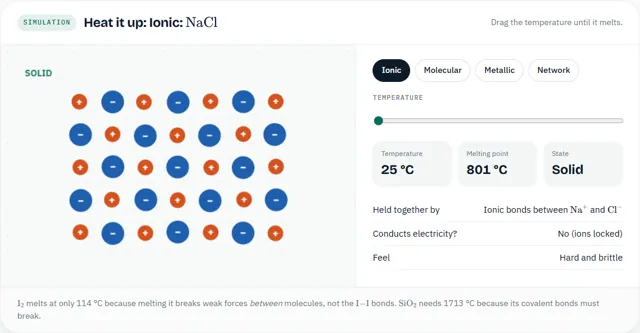
Heat it up:
Crystalline or amorphous.
Crystalline solids have a regular, repeating 3D arrangement (salt, snowflakes). Amorphous solids are jumbled, with no long-range order (rubber, glass, cotton candy).
?One allotrope of phosphorus is made of separate molecules; the other is a network of P atoms all bonded together. Which melts higher?Think, then tap to check
The network. Melting it means breaking covalent bonds, which are much stronger than the dispersion forces between molecules. (P is a nonmetal, so no metallic bonding.)
?Why is diamond so much harder than graphite?Think, then tap to check
In diamond every C has four covalent bonds in 3D. Graphite is layers held together only by weak dispersion forces, so the layers slide. Both contain only covalent bonds, not ionic.
Study notes
Key concepts
IMFs set the properties (SAP-5.B.1). Many properties of liquids and solids depend on the type and strength of the forces between particles.
-
When a substance vaporizes, the attractions between particles are (almost completely) broken. So boiling point, enthalpy of vaporization and vapor pressure correlate directly with interaction strength: stronger forces → higher boiling point, lower vapor pressure.
-
When a substance melts, the attractions are only rearranged, not broken. Melting points also tend to rise with interaction strength, but the relationship is subtler because how well particles pack in the solid also matters. (For example, symmetric molecules that pack well can have unusually high melting points.) If a question asks you to rank IMF strength, use boiling points or vapor pressures, not melting points, whenever you have the choice.
Particulate drawings (SAP-5.B.2) that show several interacting particles are the standard way to explain properties: show the particles, their spacing, and the interactions (dashed lines for hydrogen bonds, + and − charges for ions, δ+ and δ− for dipoles).
The four types of crystalline solids
| Type | Particles at lattice points | Forces holding the solid together | Melting point | Electrical conductivity | Other properties | Examples |
|---|---|---|---|---|---|---|
| Ionic | cations and anions | ionic (Coulombic) attractions | high | none as a solid; conducts when molten or dissolved | hard, brittle; low vapor pressure | NaCl, MgO, CaF₂ |
| Covalent network | atoms of nonmetals | covalent bonds in a 3-D (or 2-D layered) network | very high | none (graphite is the exception: conducts along its layers) | very hard and rigid (diamond); graphite soft and slippery | C (diamond, graphite), SiO₂, SiC |
| Molecular | discrete molecules | IMFs (LDF, dipole–dipole, H-bond) | low | none | soft; often volatile | I₂, H₂O(s), CO₂(s), sucrose, polymers |
| Metallic | metal cations in a "sea" of delocalized electrons | metallic bonding | variable, usually high | good conductor as solid and liquid | malleable, ductile, lustrous, conduct heat | Cu, Fe, brass, steel |
Ionic solids (SAP-5.B.3). Strong Coulombic attractions between ions give low vapor pressures and high melting and boiling points. Melting point rises with ion charge and falls with ion size (Coulomb's law: force ∝ q₁q₂/r²). So MgO (2+ and 2−, mp 2852 °C) melts far higher than NaCl (1+ and 1−, mp 801 °C), and NaF melts higher than NaCl (smaller anion). Ionic solids are brittle: if a force shifts one layer of ions past the next by half a step, ions of the same charge line up next to each other, they repel, and the crystal cracks. Ionic solids do not conduct as solids because the ions are locked in place; they conduct only when the ions are mobile (molten, or dissolved in water). Electrons do not carry the current in molten salts; ions do.
Covalent network solids (SAP-5.B.4). Atoms are covalently bonded into a giant network, either 3-D (diamond, SiO₂ quartz, SiC) or 2-D layers (graphite). They form only from nonmetals: elements (C, Si, B) or binary compounds of two nonmetals (SiO₂, SiC). To melt them, covalent bonds must break, so melting points are very high. 3-D networks are rigid and hard because the bond angles are fixed. Graphite is soft because the layers are held to each other only by LDFs and slide easily; within a layer each C is sp² hybridized and the delocalized pi electrons let graphite conduct electricity along the layers.
Molecular solids (SAP-5.B.5). Distinct molecules held together by relatively weak IMFs. Low melting points; they do not conduct because the electrons are held tightly in covalent bonds and lone pairs. Some molecular solids are made of very large molecules or polymers (e.g., polyethylene, sucrose); they still melt or soften at relatively low temperatures because only IMFs, not covalent bonds, are overcome.
Metallic solids and alloys (SAP-5.B.6). Metal cations sit in a sea of delocalized valence electrons. The mobile electrons make metals good conductors of electricity and heat. Metals are malleable and ductile because the cores can slide to new positions while the electron sea keeps holding them together (no like-charge repulsion as in ionic solids).
-
Interstitial alloys (e.g., steel, C in Fe): small atoms fill the holes between larger atoms. The small atoms make the lattice more rigid, so the alloy is harder, stronger and less malleable and ductile than the pure metal.
-
Substitutional alloys (e.g., brass, Zn replacing Cu): atoms of similar radius replace each other in the lattice. Properties such as density change gradually with composition.
-
Alloys keep a sea of mobile electrons, so they still conduct.
Polymers and biomolecules (SAP-5.B.7). Noncovalent interactions between parts of long molecules decide their shape (folding of proteins, the double helix of DNA), and their shape decides how they function.
Amorphous solids. Glass, many plastics and rubber have no long-range order. Because the forces vary from place to place, they soften over a range of temperatures instead of melting sharply.
How to identify a solid from data
| Observation | Most likely type |
|---|---|
| High mp, conducts only when molten or dissolved, brittle | ionic |
| Very high mp, never conducts (except graphite), insoluble in everything, very hard | covalent network |
| Low mp (below about 300 °C), does not conduct in any state | molecular |
| Conducts as solid, malleable, shiny | metallic |
Worked examples
Worked example 1 (modelled on 2021 AP FRQ Q2(b)). At −78 °C, CO₂(s) sublimes, but SiO₂(s) remains a solid until about 1700 °C. Using principles of interparticle forces, explain the difference.
Solution. CO₂ is a molecular solid made of discrete, nonpolar O=C=O molecules held together only by weak London dispersion forces; little energy is needed to separate the molecules. SiO₂ is a covalent network solid: every Si atom is covalently bonded to four O atoms in a continuous 3-D network, so changing its state requires breaking strong Si–O covalent bonds, which takes much more energy.
Worked example 2. Explain why MgO has a higher melting point than NaF, even though the ions are similar in size (Mg²⁺ 72 pm, Na⁺ 102 pm, O²⁻ 140 pm, F⁻ 133 pm).
Solution. By Coulomb's law the attraction is proportional to the product of the charges divided by the distance. The charge product for Mg²⁺/O²⁻ is 4 times that for Na⁺/F⁻, and the ion separations are similar (MgO is even slightly smaller). The much stronger attraction in MgO requires much more energy to disrupt, so MgO melts at 2852 °C versus 993 °C for NaF.
Unit 3 study guide: exam-style free-response set, worksheet and answers.
Worked example
- Very high melting point and hardness rule out a molecular solid.
- No conduction even when melted rules out ionic and metallic solids.
- Atoms held in a continuous network of covalent bonds fit all the data.
- Answer: A covalent network solid (such as quartz, ).
Free-response practice
Write your answer first, then open the solution and mark yourself against it.
Free-response 1. A student tests three white solids, X, Y and Z. The results are shown.
| Solid | Melting point (°C) | Conducts as solid? | Conducts when melted? | Soluble in water? |
|---|---|---|---|---|
| X | 801 | no | yes | yes |
| Y | 186 | no | no | yes |
| Z | about 1700 | no | no | no |
(a) Identify the type of solid for each of X, Y and Z.
(b) Explain, at the particulate level, why X conducts electricity when melted but not as a solid.
(c) Explain why solid X is brittle and shatters when struck with a hammer.
(d) Solid Y dissolves in water. Its aqueous solution does not conduct electricity. Identify a likely type of substance for Y and the main solute–solvent interaction.
Show the solution
(a) X: ionic solid (high mp, conducts only when molten). Y: molecular solid (low mp, never conducts). Z: covalent network solid (very high mp, insoluble, nonconducting) — for example SiO₂. (1 point for all three correct)
(b) X is made of cations and anions held in fixed positions in a lattice. In the solid the ions cannot move, so no charge flows. When the solid melts, the ions are free to move past each other and can carry charge to the electrodes. (1 point)
(c) In an ionic lattice each ion is surrounded by ions of opposite charge. A blow shifts one layer of ions relative to the next, which brings ions of the same charge next to each other. The strong repulsion between like charges pushes the layers apart and the crystal cracks. (1 point)
(d) Y is a polar molecular compound that does not ionize in water, such as a sugar like sucrose. The O–H groups of Y form hydrogen bonds with water molecules. Because Y dissolves as neutral molecules, no ions are present and the solution does not conduct. (1 point)
Common mistake
Students think molecular solids melt by breaking covalent bonds. Melting a molecular solid such as ice or only overcomes intermolecular forces, which is why molecular solids melt at low temperatures.
Frequently asked questions
?Why does graphite conduct electricity but diamond does not?
Each carbon in graphite bonds to three others, leaving delocalized electrons that move within the layers; in diamond all four valence electrons are locked in localized covalent bonds.
?What is the difference between crystalline and amorphous solids?
Crystalline solids have particles in a repeating, ordered arrangement; amorphous solids such as glass lack long-range order.
Practice questions on 3.2
- Q1A solid melts at about 1700 °C, is very hard, and does not conduct electricity as a solid or when molten. What type of solid is it?
- Q2Solid NaBr does not conduct electricity, but molten NaBr does. Why?
- Q3Which statement best explains why diamond is much harder than graphite?
- Q4Which property is shared by ionic solids and pure metals?
- Q5A compound with formula XCl₃ melts at −94 °C and does not conduct electricity as a liquid. Which compound is it?
- Q6Graphite is soft enough to use in pencils, but diamond is the hardest natural substance. Which statement best accounts for this difference?
- Q7Steel is an interstitial alloy of iron with a small amount of carbon. Compared with pure iron, steel is
- Q8Solid KBr does not conduct electricity, but molten KBr does. Which is the best explanation?
- Q9Which of the following substances has the highest melting point?
- Q10Which property of alloys is best explained by metallic bonding?
- Q11Which property do ionic solids and most metals share?
- Q12Graphite conducts electricity, but diamond does not. Why?
- Q13A compound melts at 1418 °C. Which is it?
- Q14At room temperature, is a gas and is a liquid. Why?
- Q15Which element forms a covalent network solid?
- Q16Which type of solid generally has the highest melting point?
- Q17Solid KCl does not conduct electricity, but molten KCl does. Why?
- Q18Which has the highest boiling point?
Terms used in this topic
Stuck on a unit? Let us fix it this week.
Book a 30-minute one-to-one session for $20. Bring a test, a homework set or the topic that is not clicking.
Book a session