 AP Chemistry Tutoring
3.10 Solubility
AP Chemistry Unit 3: Properties of Substances and Mixtures · 2 simulations · 14 practice questions
Updated · Aligned to the AP Chemistry Course and Exam Description
Solubility depends on the relative strength of intermolecular interactions between solute and solvent compared with those within the pure solute and pure solvent. Substances dissolve well when solute-solvent attractions are similar to or stronger than the attractions that must be overcome, summarized as "like dissolves like": polar and ionic solutes dissolve in polar solvents such as water, and nonpolar solutes dissolve in nonpolar solvents such as hexane, .
Solutions
A solution is a homogeneous mixture.
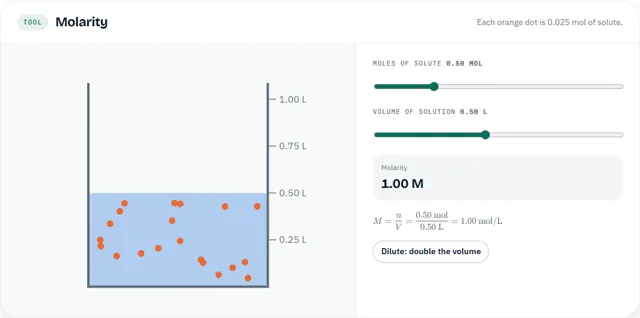
The solute is spread evenly through the solvent. Concentration in AP Chemistry is usually molarity: moles of solute per liter of solution.
Like dissolves like.
Substances mix when their IMFs are similar. Oil (LDFs) won't mix with water (hydrogen bonds). dissolves because ion–dipole forces with water beat the lattice.
Counting ions: 1 M gives 1 M and 2 M .
Molarity
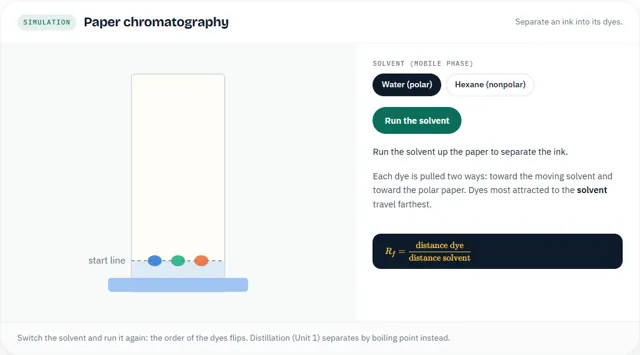
Paper chromatography
Study notes
Key concepts
"Like dissolves like" (SPQ-3.C.2). Substances with similar intermolecular interactions tend to be soluble in (or miscible with) one another. Polar and ionic solutes dissolve in polar solvents such as water; nonpolar solutes dissolve in nonpolar solvents such as hexane. Liquids that mix in all proportions are miscible (water + ethanol); liquids that form separate layers are immiscible (water + hexane).
Why "like dissolves like" works: three sets of interactions. Dissolving requires:
-
separating solute particles from each other (overcoming solute–solute attractions; for an ionic solid, the attractions in the lattice);
-
making space in the solvent (overcoming some solvent–solvent attractions);
-
forming new solute–solvent attractions.
A solute dissolves well when the new solute–solvent attractions are comparable to (or stronger than) the attractions that must be overcome.
-
Hexane in water. Water molecules are held together by strong hydrogen bonds. Hexane could interact with water only through weak LDFs and dipole–induced dipole forces. Pushing hexane between water molecules would break hydrogen bonds without replacing them with comparable attractions, so the water molecules stay together and the hexane is excluded. (It is wrong to say hexane and water "repel" each other; the attractions between them are simply much weaker than those between water molecules.)
-
Ethanol in water. Ethanol forms hydrogen bonds with water that are similar in strength to the ones broken, so they mix in all proportions.
-
I₂ in hexane vs. water. I₂ and hexane are both nonpolar with LDFs only, so I₂ dissolves in hexane (purple solution) but only slightly in water.
-
Ionic solids in water. Ion–dipole attractions between ions and water molecules (hydration) must compensate for the strong ionic attractions in the lattice. If the ionic attractions are very strong (high charges, small ions), the compound may be insoluble (e.g., CaCO₃, BaSO₄, AgCl). Ionic solids are generally insoluble in nonpolar solvents, which cannot form ion–dipole interactions.
Polar "head", nonpolar "tail". In a family of molecules with one polar group (e.g., alcohols, CₙH₂ₙ₊₁OH), solubility in water decreases as the nonpolar hydrocarbon part grows, because the O–H group's hydrogen bonds with water are outweighed by the large nonpolar chain, which interacts only through LDFs.
| Alcohol | Solubility in water at 20 °C |
|---|---|
| methanol, CH₃OH | miscible |
| ethanol, C₂H₅OH | miscible |
| 1-propanol, C₃H₇OH | miscible |
| 1-butanol, C₄H₉OH | about 7.7 g per 100 mL |
| 1-pentanol, C₅H₁₁OH | about 2.2 g per 100 mL |
| 1-hexanol, C₆H₁₃OH | about 0.6 g per 100 mL |
Saturated, unsaturated, supersaturated.
-
Saturated: holds the maximum amount of solute at that temperature; dissolved solute is in dynamic equilibrium with undissolved solid (rate of dissolving = rate of crystallization).
-
Unsaturated: less than the maximum; more solute can dissolve.
-
Supersaturated: more dissolved solute than a saturated solution at that temperature; unstable. Adding a seed crystal or disturbing it makes the excess crystallize.
Solubility is the amount of solute in a saturated solution at a given temperature (e.g., g solute per 100 g water). On a solubility curve (solubility vs. temperature), points on the curve are saturated, points below are unsaturated, and points above are supersaturated (or excess solid is present).
Factors affecting solubility and rate of dissolving.
-
Rate only (not the final amount): stirring (agitation), crushing the solid (more surface area), warming.
-
Temperature: the solubility of most solids in water increases with temperature. The solubility of gases in water decreases as temperature rises, because gas molecules with higher kinetic energy escape the liquid more easily (warm lakes hold less O₂; warm soda goes flat faster).
-
Pressure: the solubility of a gas in a liquid is directly proportional to the partial pressure of that gas above the liquid (opening a soda lowers the CO₂ pressure and CO₂ bubbles out). Pressure has little effect on solids and liquids.
-
Gas solubility and IMFs: among nonpolar gases, solubility in water increases with the number of electrons (stronger LDFs and dipole–induced dipole forces): He < N₂ < O₂ < Ar < Kr in water.
| KNO₃ solubility (g per 100 g H₂O) | 20 °C: 31.6 | 40 °C: 63.9 | 60 °C: 110 | 80 °C: 169 |
|---|---|---|---|---|
| NaCl solubility (g per 100 g H₂O) | 20 °C: 35.9 | 40 °C: 36.4 | 60 °C: 37.1 | 80 °C: 38.0 |
Worked examples
Worked example 1 (modelled on 2015 AP FRQ Q2(f)). A gas mixture of C₂H₆(g) and CH₃OH(g) is bubbled through water. Almost all of the ethane passes through and can be collected, but the methanol does not. Explain in terms of IMFs between water and each gas.
Solution. Ethane is nonpolar; it can interact with water only through weak LDFs and dipole–induced dipole forces, which cannot compensate for disrupting the hydrogen bonds between water molecules, so ethane is barely soluble and is collected as a gas. Methanol has an O–H group and forms hydrogen bonds with water molecules (it acts as both donor and acceptor), so it dissolves in the water and is not collected.
Worked example 2 (solubility curve). 100 g of water is saturated with KNO₃ at 60 °C and then cooled to 20 °C. What mass of KNO₃ crystallizes (assume no supersaturation)?
Solution. At 60 °C the solution holds 110 g; at 20 °C it can hold 31.6 g. Mass crystallizing = 110 − 31.6 = 78 g (about 78.4 g). Doing the same with NaCl would give only about 1.2 g, which is why recrystallization by cooling works well for KNO₃ but not NaCl.
Unit 3 study guide: exam-style free-response set, worksheet and answers.
Worked example
- is nonpolar, with only dispersion forces.
- Hexane is nonpolar, so -hexane dispersion forces are similar to those in the pure substances.
- Dissolving in water would break hydrogen bonds between water molecules without forming comparably strong attractions.
- Answer: In the hexane layer.
Free-response practice
Write your answer first, then open the solution and mark yourself against it.
Free-response 1 (modelled on 2016 AP FRQ Q1(f) and 2021 FRQ Q6). LiCl(s) dissolves readily in water, and the process is exothermic. LiCl is almost insoluble in hexane.
(a) Identify the particle–particle interaction that must be overcome in solid LiCl, and the interaction that forms when LiCl dissolves in water. Name the type of force for each.
(b) Explain why the dissolution of LiCl in water releases energy even though separating the ions requires energy.
(c) Explain why LiCl does not dissolve in hexane.
(d) Describe the orientation of water molecules around a Li⁺ ion and around a Cl⁻ ion.
Show the solution
(a) Overcome: the ionic (Coulombic) attractions between Li⁺ and Cl⁻ ions in the lattice (also some hydrogen bonds between water molecules). Formed: ion–dipole attractions between Li⁺ and the δ− O of water, and between Cl⁻ and the δ+ H of water. (1 point)
(b) The energy released when strong ion–dipole attractions form (especially around the very small Li⁺ ion, which attracts water strongly) is greater than the energy needed to separate the ions from the lattice and to separate some water molecules. Net energy is released. (1 point)
(c) Hexane is nonpolar and has no dipole, so it cannot form ion–dipole attractions with Li⁺ and Cl⁻. The weak interactions it could form cannot compensate for the strong ionic attractions in the solid, so the lattice stays intact. (1 point)
(d) Around Li⁺, water molecules point their O atoms (partial negative) toward the ion. Around Cl⁻, water molecules point an H atom (partial positive) toward the ion. (1 point)
Common mistake
Students say a nonpolar solute does not dissolve in water because it repels water. Nonpolar molecules attract water weakly; they do not dissolve because separating water molecules would break strong hydrogen bonds that are not replaced by comparable solute-water attractions.
Frequently asked questions
?What does like dissolves like mean?
Solutes dissolve best in solvents with similar intermolecular forces: polar with polar and nonpolar with nonpolar.
?Why is methanol miscible with water but octanol is not?
Both have an O-H group that hydrogen bonds with water, but octanol's long nonpolar chain dominates its interactions, so its solubility in water is low.
Practice questions on 3.10
- Q1Which substance is most soluble in water?
- Q2Equal volumes of methanol, hexane and water are shaken together in a tube. Two layers form: one contains methanol and water, and the other is hexane. Which statement best explains this?
- Q3Which compound is most soluble in water?
- Q4Which substance is most soluble in hexane, C₆H₁₄?
- Q5Chloroform, CHCl₃, is more soluble in water than carbon tetrachloride, CCl₄. Which statement best explains this?
- Q6The solubility of O₂ in a lake is lower in summer than in winter because at higher temperature
- Q7A substance A is insoluble in hexane and in pentane, but is miscible with water and with methanol. Which is most likely A?
- Q8Ethanol, water and octane are shaken together. Which forms a separate layer?
- Q9Why does a solution of NaCl in water conduct electricity?
- Q10Methanol dissolves in water mainly because of:
- Q11An unknown liquid is miscible with water and methanol but immiscible with hexane. What could it be?
- Q12A solid made of neutral atoms of two different metals with different sizes is placed in water. What is expected?
- Q13Why is only slightly soluble in water?
- Q14Hexane contains small amounts of polar, hydrogen-bonding impurities. Which liquid would best extract them?
Terms used in this topic
Stuck on a unit? Let us fix it this week.
Book a 30-minute one-to-one session for $20. Bring a test, a homework set or the topic that is not clicking.
Book a session