 AP Chemistry Tutoring
3.11 Spectroscopy and the electromagnetic spectrum
AP Chemistry Unit 3: Properties of Substances and Mixtures · 2 simulations · 13 practice questions
Updated · Aligned to the AP Chemistry Course and Exam Description
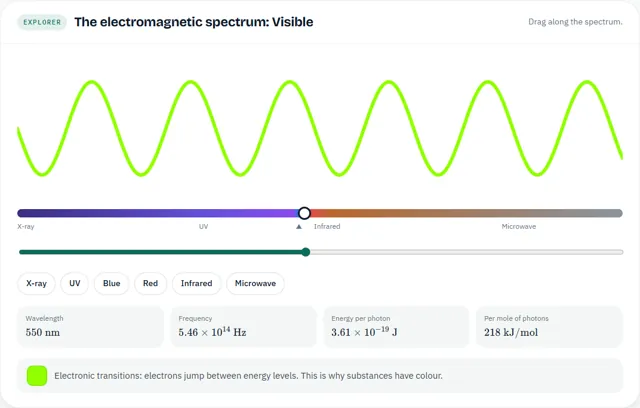
Different regions of the electromagnetic spectrum cause different molecular transitions: microwave radiation changes rotational energy, infrared radiation changes vibrational energy, and ultraviolet and visible radiation cause electronic transitions. Wavelength and frequency are related by , with , so shorter wavelengths have higher frequencies and higher photon energies.
Light & spectroscopy
Shorter wavelength, more energy.
Light is a wave and a stream of photons. Each photon's energy depends on its frequency.
·
The photoelectric effect.
Light knocks electrons out of a metal only if each photon has enough energy. Brighter light of too low a frequency does nothing; above the threshold, extra energy becomes the electron's kinetic energy. (PES in Unit 1 uses exactly this.)
The electromagnetic spectrum:
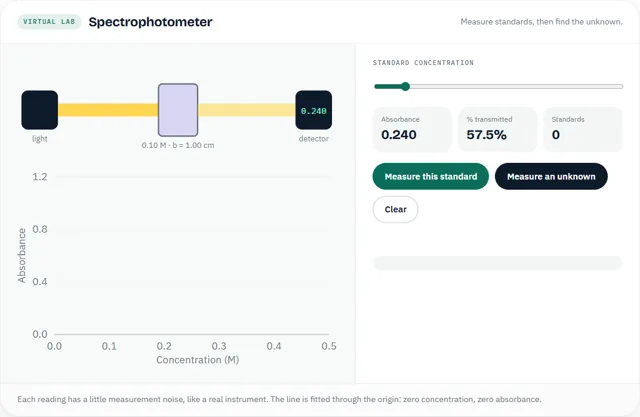
Beer–Lambert: more absorber, more absorbance.
Shine light through a solution. Absorbance rises in a straight line with concentration. Measure standards, draw the line, read off the unknown.
: how strongly the substance absorbs (molar absorptivity) · : path length (cm) · : concentration (M)
- , so .
Spectrophotometer
Study notes
Quick check before you start
Which carries more energy per photon: red light or violet light?
- A. red light
- B. violet light
- C. they carry the same energy
- D. it depends on how bright the light is
Show the answer
(B) violet light. Violet has a shorter wavelength and a higher frequency than red, and photon energy rises with frequency (). Brightness changes the number of photons, not the energy of each one. The notes below explain why.
1. Anatomy of a wave
Light is an electromagnetic wave and also a stream of particles called photons.
| Symbol | Name | Meaning | Units |
|---|---|---|---|
| wavelength | distance from crest to crest | m (often given in nm) | |
| frequency | waves passing a point each second | Hz | |
| speed of light | the same for all light in a vacuum |
Because every kind of light has the same speed, wavelength and frequency are locked together: long wavelength means low frequency; short wavelength means high frequency. Amplitude tells you how bright the light is, not how much energy one photon carries.
2. The electromagnetic spectrum
Order to memorise, from longest wavelength to shortest: radio, microwave, infrared, visible, ultraviolet, X-ray, gamma. Say it forwards and backwards. Moving along that list, gets shorter, gets higher and the energy of each photon gets bigger. The trap: gamma rays have the highest energy and the shortest wavelength.
Visible light is a thin slice, from about 400 nm (violet) to 700 nm (red). Its seven colours, VIBGYOR, run from the shortest wavelength and most energy to the longest wavelength and least energy:
| Colour | Approx. (nm) |
|---|---|
| Violet | 400–425 |
| Indigo | 425–450 |
| Blue | 450–495 |
| Green | 495–570 |
| Yellow | 570–590 |
| Orange | 590–620 |
| Red | 620–700 |
ROYGBIV is the same list backwards, from low energy (red) to high energy (violet). The simulation above has a VIBGYOR strip: tap a colour to see its wavelength, frequency and photon energy.
| Region | Approximate wavelength | Approximate frequency (Hz) | Effect on molecules and atoms (SAP-8.A.1) | Spectroscopy use |
|---|---|---|---|---|
| Radio | longer than 1 m | below | nuclear spin flips in a magnet (NMR; beyond AP) | MRI, NMR |
| Microwave | 1 mm to 1 m | to | changes in rotational energy levels of molecules | microwave spectroscopy; microwave ovens rotate water molecules |
| Infrared (IR) | 700 nm to 1 mm | to | changes in vibrational energy levels (bond stretching and bending) | IR spectroscopy identifies functional groups (O–H, C=O, N–H) |
| Visible | 400 nm (violet) to 700 nm (red) | to | electronic transitions (valence electrons to higher levels) | UV–visible spectrophotometry, colour, Beer's law |
| Ultraviolet (UV) | 10 to 400 nm | to | electronic transitions; high-energy UV can break bonds or ionize | UV–vis spectroscopy; UV photoelectron spectroscopy of valence electrons |
| X-ray | 0.01 to 10 nm | to | removes core (inner-shell) electrons | X-ray PES (core binding energies), X-ray diffraction |
| Gamma | shorter than 0.01 nm | above | nuclear energy changes | — |
The three statements the course framework requires (SAP-8.A.1): microwave → rotational transitions; infrared → vibrational transitions; ultraviolet and visible → electronic transitions. The energy gaps go rotational < vibrational < electronic, matching microwave < infrared < UV/visible.
3. Speed of light:
in metres, in hertz (), . (The AP equation sheet gives ; is fine to three significant figures.)
Worked example: green light, 530 nm. Find its frequency.
- Write what you know: , .
- Convert to metres: .
- Rearrange: .
- . Sense check: visible light is always around .
4. Units: convert before you calculate
Forgetting to change nm into m is the most common lost mark on this topic. and are in SI units, so everything else must be too.
| Change | How | Example |
|---|---|---|
| nm → m | multiply by | |
| m → nm | divide by (multiply by ) | |
| J → kJ | divide by 1000 | |
| Hz | the same as |
Scientific notation check. Moving the decimal point to the left makes the exponent bigger: becomes , not . Visible light is about to .
5. Photon energy: and
- is the energy of one photon, in joules.
- (Planck's constant).
- Shortcut: .
is just with put in. Given a frequency, use ; given a wavelength, convert it to metres and use .
Worked example: a photon.
- Pick the equation: is given, so use .
- Substitute: .
- Units: leaves J.
- . One photon of visible light is always around .
6. Ratios without a calculator
and are constants, so whatever happens to happens in reverse to and . Decide first whether the relationship is direct or inverse.
| Relationship | Type | Example |
|---|---|---|
| direct | frequency triples, so energy triples | |
| inverse | wavelength halves, so energy doubles | |
| inverse | wavelength triples, so frequency drops to one third |
7. From one photon to a mole of photons
Divide by 1000 to report kJ/mol.
Worked example: 400 nm photons.
- Convert: .
- One photon: .
- One mole: .
- .
Visible light comes out at roughly 150 to 300 kJ/mol, about the size of a bond energy. That is why light can drive chemical reactions.
8. Electrons, energy levels and emitted light
- Absorb to go up. An electron absorbs a photon to jump to a higher level.
- Emit to come down. Dropping to a lower level releases a photon.
- . The photon's energy equals the gap between the two levels. A species absorbs a photon only if its energy exactly matches a gap between two allowed levels (SAP-8.B.1).
- Bigger drop, shorter wavelength. More energy released means a shorter , toward the violet end.
This is where line spectra come from: each line is one particular drop. Hydrogen's red line at 656 nm is the drop from to . An absorption spectrum shows which wavelengths are taken in; an emission spectrum shows the wavelengths given out when excited species drop back down. Atoms give sharp lines (each element has its own pattern, like a fingerprint); molecules in solution give broad absorption bands.
9. Colour and Beer's law
A solution looks coloured because it absorbs some visible wavelengths and lets the rest through. We see the complementary colour of the light absorbed. Blue solution absorbs orange-red light (about 600 to 800 nm) and transmits blue. For a Beer's law experiment, set the spectrophotometer to the wavelength the solution absorbs most strongly (): the complementary colour, not the colour you see.
| Colour absorbed | Approx. (nm) | Colour seen |
|---|---|---|
| violet | 400–430 | yellow-green |
| blue | 430–490 | orange |
| green | 490–560 | red / purple |
| yellow | 560–590 | violet-blue |
| orange | 590–630 | blue |
| red | 630–700 | blue-green |
Real-world links. Greenhouse gases (, , ) absorb infrared radiation given off by Earth, which makes their bonds vibrate; they then re-emit infrared in all directions, warming the atmosphere. Ozone absorbs ultraviolet, whose photons have enough energy to promote electrons and break bonds. A microwave oven's 2.45 GHz radiation makes water molecules rotate faster.
Photoelectron spectroscopy (PES) (link to Unit 1) uses high-energy ultraviolet or X-ray photons to knock electrons out; it shows electron binding energies and the electron configuration of an atom. Infrared and microwave photons do not carry enough energy to remove electrons.
10. Problem-solving roadmap
Every calculation on this topic sits somewhere on this chain. Before you start, ask: what am I given, what do I want, and which arrows do I cross?
what you're given
× 10⁻⁹
ν = c / λ
E = hν
× NA, ÷ 1000
- Shortcut. Given and want ? Skip and use in one step.
- Going backwards. Given and want ? Rearrange to , then convert metres back to nm.
More worked examples
Worked example 1. A photon of green light has . Calculate its frequency, its energy, and the energy of one mole of such photons.
per photon. Per mole: .
Worked example 2. absorbs strongly at . Which region is this, and what kind of transition does it cause?
: longer than visible light (700 nm) but much shorter than 1 mm, so it is infrared. Infrared absorption excites a molecular vibration (here, an asymmetric stretch of the C=O bonds). Photon energy: , about 9 times less than a 500 nm photon.
Practice: nine test-style questions
Try each one before you open the answer. Give units and three significant figures.
Question 1. Which type of electromagnetic radiation has the longest wavelength?
- A. radio waves
- B. visible light
- C. X-rays
- D. gamma rays
Show the answer
(A) radio waves. From longest to shortest wavelength: radio, microwave, infrared, visible, UV, X-ray, gamma. Gamma is the trap: it has the highest energy, not the longest wavelength.
Question 2. Light has a wavelength of 500 nm. What is its frequency?
- A.
- B.
- C.
- D.
Show the answer
(C) . . (A) forgot to convert nm to m, (B) divided by , (D) multiplied by .
Question 3. A photon has a frequency of . What is its energy?
- A.
- B.
- C.
- D.
Show the answer
(B) . . (A) divided by , (C) used by mistake, (D) divided by .
Question 4. Hydrogen gives out a red line at 656 nm. What is the energy of one of these photons?
- A.
- B.
- C.
- D.
Show the answer
(D) . . (A) left in nm, (B) forgot (), (C) multiplied by instead of dividing.
Question 5 (trap check). Express 450 nm in metres ().
- A.
- B.
- C.
- D.
Show the answer
(B) . : moving the decimal point two places left adds 2 to the exponent. (C) just attached to 4.50, (A) multiplied by , (D) is off by one power of ten.
Question 6. A photon has an energy of . What is its wavelength in nm?
- A. 497 nm
- B.
- C.
- D.
Show the answer
(A) 497 nm. . (B) forgot to convert m to nm, (C) flipped the fraction (), (D) used without .
Question 7. If the wavelength of light doubles, what happens to the energy of each photon?
- A. it doubles
- B. it stays the same
- C. it is halved
- D. it quadruples
Show the answer
(C) it is halved. , so is inversely proportional to : doubling divides by 2. (A) treats the relationship as direct, (B) ignores the equation, (D) squares it.
Question 8 (challenge). What is the energy of one mole of photons with a wavelength of 500 nm?
- A.
- B.
- C.
- D. 239 kJ
Show the answer
(D) 239 kJ. One photon: ; times photons per mole . (A) forgot to convert J to kJ, (B) stopped at one photon, (C) left in nm.
Question 9. An electron in an atom drops from a higher energy level to a lower one. What happens?
- A. a photon is absorbed; a bigger drop gives a longer
- B. a photon is emitted; a bigger drop gives a shorter
- C. a photon is emitted; a bigger drop gives a longer
- D. a photon is absorbed; a bigger drop gives a shorter
Show the answer
(B). Dropping to a lower level releases energy as an emitted photon. A bigger drop releases more energy, so by the wavelength is shorter. Absorption is what moves an electron up.
Cheat sheet
| Constants | Equations | Conversions |
|---|---|---|
Remember: shorter means higher and more energy; convert nm to m before you put numbers in; an electron dropping down gives out a photon. Check the size of every answer: visible light is 400 to 700 nm and about per photon.
Unit 3 study guide: exam-style free-response set, worksheet and answers.
Worked example
- Convert: .
- .
- 500 nm is visible light, which causes electronic transitions.
- Answer: ; an electronic transition.
Free-response practice
Write your answer first, then open the solution and mark yourself against it.
Free-response 1. A student studies three types of radiation: microwaves with ν = 2.45 × 10⁹ Hz, infrared with λ = 3.0 × 10⁻⁶ m, and ultraviolet with λ = 254 nm.
(a) Calculate the wavelength of the microwave radiation.
(b) For each type of radiation, identify the type of molecular or electronic transition it causes.
(c) Calculate the energy of one photon of the 254 nm radiation, and the energy of one mole of these photons in kJ/mol.
(d) The average C–C bond energy is about 348 kJ/mol. Can 254 nm photons break C–C bonds? Justify with your answer to (c).
Show the solution
(a) λ = c/ν = 2.998 × 10⁸ ÷ 2.45 × 10⁹ = 0.122 m. (1 point)
(b) Microwave: rotational transitions. Infrared: vibrational transitions. Ultraviolet: electronic transitions. (1 point)
(c) E = hc/λ = (6.626 × 10⁻³⁴)(2.998 × 10⁸) ÷ (254 × 10⁻⁹) = 7.82 × 10⁻¹⁹ J per photon. Per mole: 7.82 × 10⁻¹⁹ × 6.022 × 10²³ = 4.71 × 10⁵ J = 471 kJ/mol. (1 point)
(d) Yes. Each photon carries 471 kJ/mol worth of energy, which is greater than the 348 kJ/mol needed to break a C–C bond, so absorption of a 254 nm photon can supply enough energy to break one bond. (This is why short-wavelength UV damages organic molecules such as DNA.) (1 point)
Common mistake
Students think longer wavelength means higher energy. Energy is proportional to frequency and inversely proportional to wavelength, so radio and microwave photons carry less energy than visible or UV photons.
Frequently asked questions
?What does infrared spectroscopy measure?
IR radiation is absorbed when it matches the energy of bond vibrations, so an IR spectrum shows which types of bonds are present.
?Which has more energy, UV or infrared light?
Ultraviolet light: it has a shorter wavelength and higher frequency, so each photon carries more energy.
Practice questions on 3.11
- Q1Photons from which region of the spectrum can promote valence electrons to higher energy levels?
- Q2An IR spectrum is produced by which type of transition?
- Q3Which type of spectroscopy is used to identify functional groups such as O–H and C=O in an organic molecule?
- Q4Which radiation could cause a molecule of H₂O to bend (change its vibrational state)?
- Q5Greenhouse gases absorb and re-emit infrared radiation. What happens to a CO₂ molecule when it absorbs an IR photon?
- Q6Arrange microwave, infrared and ultraviolet photons in order of increasing energy.
- Q7Which region of the spectrum causes changes in molecular rotation?
- Q8UV–visible absorption is caused by:
- Q9Which technique identifies functional groups from bond vibrations?
- Q10How does act as a greenhouse gas?
- Q11Which technique measures the binding energies of core electrons?
- Q12A sodium atom changes from to . What caused this?
- Q13Which radiation frequency is most likely to change the rotation of an HCl molecule?
Stuck on a unit? Let us fix it this week.
Book a 30-minute one-to-one session for $20. Bring a test, a homework set or the topic that is not clicking.
Book a session