 AP Chemistry Tutoring
3.9 Separation of solutions and mixtures (chromatography)
AP Chemistry Unit 3: Properties of Substances and Mixtures · 2 simulations · 11 practice questions
Updated · Aligned to the AP Chemistry Course and Exam Description
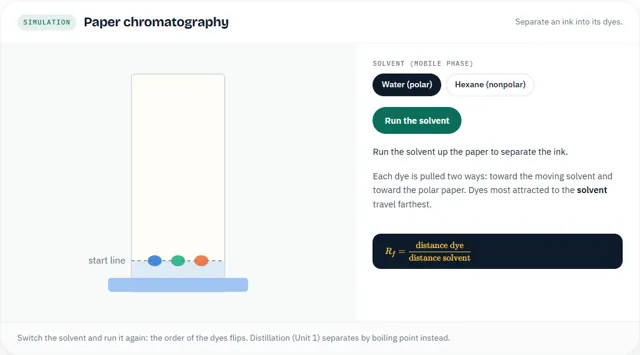
Components of a mixture can be separated using differences in their intermolecular interactions. In paper or thin-layer chromatography, components that interact more strongly with the mobile phase travel farther, and each is described by its retention factor, . Distillation separates liquids by differences in volatility, which also depend on intermolecular forces.
Solutions
A solution is a homogeneous mixture.
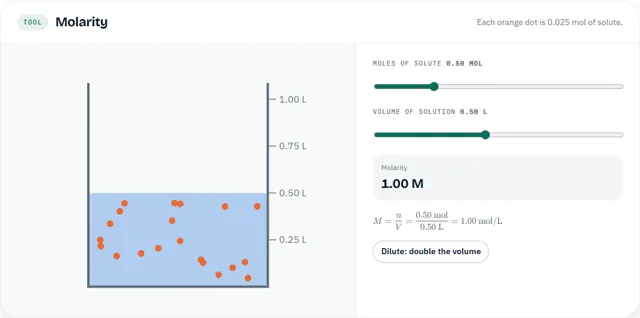
The solute is spread evenly through the solvent. Concentration in AP Chemistry is usually molarity: moles of solute per liter of solution.
Like dissolves like.
Substances mix when their IMFs are similar. Oil (LDFs) won't mix with water (hydrogen bonds). dissolves because ion–dipole forces with water beat the lattice.
Counting ions: 1 M gives 1 M and 2 M .
Molarity
Paper chromatography
Study notes
Key concepts
Why filtration does not work for solutions (SPQ-3.C.1). In a solution the solute is dispersed as individual ions or molecules, which pass straight through the pores of filter paper. Filtration only separates an undissolved solid from a liquid (a heterogeneous mixture). Components of a solution are separated by methods that exploit differences in intermolecular interactions.
Chromatography (SPQ-3.C.1a). All types of chromatography have two phases:
-
the stationary phase: a solid (or liquid coated on a solid) that does not move: paper (cellulose, very polar, with many O–H groups), a silica or alumina plate (thin-layer chromatography, TLC; polar), or a column packing (polar silica, or nonpolar C₁₈ hydrocarbon chains in "reverse-phase" columns);
-
the mobile phase: the solvent that moves through or along the stationary phase and carries the mixture.
Each component is constantly partitioned between sticking to the stationary phase and dissolving in the mobile phase. A component that interacts more strongly with the mobile phase (more similar IMFs to the solvent) spends more time moving and travels farther (or elutes from a column sooner). A component that interacts more strongly with the stationary phase travels a shorter distance (or elutes later).
The polarity reasoning chain (practise this sentence). "Paper is polar. The solvent is nonpolar. Dye A travelled the shortest distance, so it has the strongest attractions to the polar paper (stronger dipole–dipole / hydrogen-bonding interactions) relative to the nonpolar solvent; therefore A is the most polar dye."
| Stationary phase | Mobile phase | Travels farthest / elutes first | Travels least / elutes last |
|---|---|---|---|
| polar (paper, silica) | nonpolar (hexane) | least polar component | most polar component |
| polar (paper) | polar (water, ethanol) | most polar / most water-soluble component | least polar component |
| nonpolar (C₁₈ column) | polar (water, acetonitrile) | most polar component | least polar component |
Retention factor (Rf).
Rf is always between 0 and 1 and has no units. Under the same conditions (same paper, same solvent, same temperature) a given substance always has the same Rf, so comparing Rf values identifies the components of an unknown. A pure substance gives a single spot; a mixture gives several spots.
Paper chromatography procedure. (1) Draw a start line in pencil (ink would itself separate) about 1–2 cm from the bottom. (2) Spot a small, concentrated drop of the sample on the line. (3) Stand the paper in a covered beaker with solvent below the start line (if the spot is under the solvent, it dissolves into the pool instead of moving up the paper). (4) Let the solvent rise by capillary action. (5) Remove the paper before the solvent reaches the top; mark the solvent front immediately. (6) Measure distances and calculate Rf.
Column chromatography. The mixture is added to the top of a column packed with stationary phase, and solvent is passed through. Components exit (elute) at different times and are collected in separate fractions. The component with the strongest attraction to the stationary phase elutes last.
Distillation (SPQ-3.C.1b). Distillation separates liquids by exploiting differences in their vapor pressures, which are caused by differences in IMF strength.
-
When a mixture is heated, the component with the weaker IMFs (higher vapor pressure, lower boiling point) is enriched in the vapor. The vapor is condensed in a water-cooled condenser and collected as the distillate.
-
Simple distillation separates a volatile liquid from a nonvolatile solute (water from salt water) or liquids with very different boiling points.
-
Fractional distillation, with a packed column, separates liquids with closer boiling points (ethanol bp 78 °C from water bp 100 °C; fractions of crude oil). The column allows many evaporation–condensation cycles, each enriching the vapor in the more volatile component.
-
The thermometer bulb should be at the side arm (it measures the temperature of the vapor going to the condenser). Boiling chips prevent bumping.
Other separation methods (prior knowledge)
| Method | Separates | Based on |
|---|---|---|
| Filtration | undissolved solid from liquid | particle size |
| Evaporation / crystallization | dissolved nonvolatile solid from solvent | volatility |
| Separatory funnel (decanting) | two immiscible liquids | different densities; immiscibility from different IMFs |
| Distillation | liquids, or solvent from a solution | vapor pressure / boiling point (IMFs) |
| Chromatography | dissolved components | relative attraction to mobile vs. stationary phase (IMFs) |
Worked examples
Worked example. A green ink is separated on paper with water as the solvent. The solvent front moves 8.0 cm. A yellow spot is at 2.4 cm and a blue spot at 5.6 cm. Calculate Rf values and decide which dye is more soluble in water.
Solution. Rf(yellow) = 2.4/8.0 = 0.30; Rf(blue) = 5.6/8.0 = 0.70. The blue dye travelled farther with the water (the mobile phase), so it has stronger attractions to water relative to the paper: it is more soluble in water (and more polar or more able to hydrogen-bond with water) than the yellow dye. (Blue did not travel farther because it is lighter or denser; mass is not the reason.)
Unit 3 study guide: exam-style free-response set, worksheet and answers.
Worked example
- .
- The first dye travels a shorter fraction of the distance, so it is held more strongly by the polar paper.
- Answer: ; the first dye is more polar.
Free-response practice
Write your answer first, then open the solution and mark yourself against it.
Free-response 1. A student has a mixture of two dyes, X and Y. Dye X is nonpolar. Dye Y has several O–H groups.
(a) The student runs thin-layer chromatography using a silica plate (polar, with surface Si–O–H groups) and hexane as the solvent. Predict which dye has the larger Rf. Justify in terms of intermolecular interactions.
(b) The solvent front travels 6.4 cm. One spot is 1.6 cm from the start line and the other is 5.2 cm. Calculate both Rf values and assign them to X and Y.
(c) The student repeats the experiment but draws the start line in ballpoint pen instead of pencil. Explain why this is a problem.
(d) The student wants to separate the solvent hexane (bp 69 °C) from a solution of dye X in hexane, and recover both. Name a suitable method and explain how it works in terms of IMFs.
Show the solution
(a) Dye X has the larger Rf. X is nonpolar, so it has weak interactions (only LDFs) with the polar silica and similar LDFs with the nonpolar hexane; it stays in the mobile phase and moves far. Y can hydrogen-bond to the Si–O–H groups on the silica, so it is held strongly by the stationary phase and moves only a short distance. (1 point)
(b) Rf = 1.6/6.4 = 0.25 (dye Y) and 5.2/6.4 = 0.81 (dye X). (1 point)
(c) Ink is itself a mixture of dyes and would dissolve in the solvent and separate, producing extra spots that would be confused with the sample. Pencil (graphite) does not dissolve or move. (1 point)
(d) Simple distillation. Hexane molecules are held only by weak LDFs, so hexane has a high vapor pressure and boils at 69 °C, while the larger dye molecules have much stronger total IMFs and a negligible vapor pressure at that temperature. Hexane vaporizes, is condensed and collected; the dye remains in the flask. (1 point)
Common mistake
Students assume the most polar component always travels farthest. It depends on the phases: with a polar stationary phase such as paper and a less polar solvent, polar components are held back and have smaller values.
Frequently asked questions
?What does a high Rf value mean?
A high means the component spends more time in the mobile phase, so it is more attracted to the solvent than to the stationary phase.
?Can an Rf value be greater than 1?
No. A component cannot travel farther than the solvent front, so is always between 0 and 1.
Practice questions on 3.9
- Q1In a paper chromatography experiment, a dye spot moves only a short distance from the start line, while the solvent front moves almost to the top of the paper. What can be concluded about the dye?
- Q2A reverse-phase column has a nonpolar stationary phase (long hydrocarbon chains), and the mobile phase is polar (acetonitrile/water). Which substance is expected to elute first?
- Q3Two liquids are both highly polar and fully miscible, but their boiling points are 65 °C and 118 °C. Which method is best for separating them?
- Q4A mixture of pentane (bp 36 °C), ethanol (bp 78 °C), water (bp 100 °C) and 1-butanol (bp 118 °C) is distilled. Which liquid is collected first?
- Q5A student spots a dye on polar paper and develops it in a nonpolar solvent. The R_f values are: dye P 0.15, dye Q 0.45, dye R 0.80. Which dye is the most polar?
- Q6Which technique is most appropriate for recovering solid KNO₃ from an aqueous solution of KNO₃?
- Q7A column has a nonpolar stationary phase and a polar mobile phase. Which compound elutes first?
- Q8Two miscible nonpolar liquids have very different boiling points. What is the best way to separate them?
- Q9In paper chromatography with a nonpolar solvent, which dye travels the shortest distance?
- Q10Diethyl ether, ethanol, water and 1-butanol are distilled. Which distils first?
- Q11In paper chromatography using water, red dye travels farther than blue dye. Why?
Terms used in this topic
Stuck on a unit? Let us fix it this week.
Book a 30-minute one-to-one session for $20. Bring a test, a homework set or the topic that is not clicking.
Book a session