 AP Chemistry Tutoring
3.12 Photoelectric effect
AP Chemistry Unit 3: Properties of Substances and Mixtures · 2 simulations · 15 practice questions
Updated · Aligned to the AP Chemistry Course and Exam Description
The photoelectric effect is the ejection of electrons from a surface by light, and it shows that light comes in packets (photons) with energy , where . Electrons are ejected only if each photon has at least the minimum energy needed, no matter how intense the light; the same photon-energy reasoning tells whether light can break a chemical bond.
Light & spectroscopy
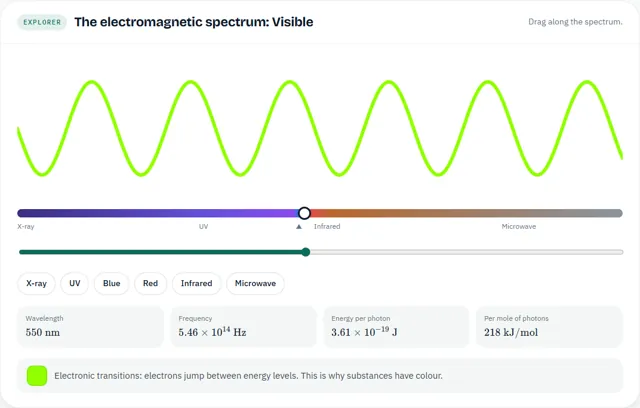
Shorter wavelength, more energy.
Light is a wave and a stream of photons. Each photon's energy depends on its frequency.
·
The photoelectric effect.
Light knocks electrons out of a metal only if each photon has enough energy. Brighter light of too low a frequency does nothing; above the threshold, extra energy becomes the electron's kinetic energy. (PES in Unit 1 uses exactly this.)
The electromagnetic spectrum:
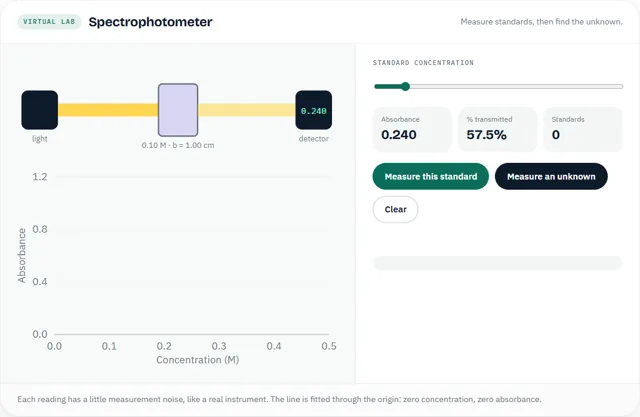
Beer–Lambert: more absorber, more absorbance.
Shine light through a solution. Absorbance rises in a straight line with concentration. Measure standards, draw the line, read off the unknown.
: how strongly the substance absorbs (molar absorptivity) · : path length (cm) · : concentration (M)
- , so .
Spectrophotometer
Study notes
Key concepts
Photons carry fixed packets of energy (SAP-8.B.2). Light behaves as a stream of photons. The energy of one photon depends only on its frequency (Planck's equation), and frequency and wavelength are related by the speed of light:
h = 6.626 × 10⁻³⁴ J·s (Planck's constant); c = 2.998 × 10⁸ m/s. These values are on the AP equation sheet. Wavelength must be in meters: 1 nm = 10⁻⁹ m, 1 μm = 10⁻⁶ m.
Absorption and emission change the energy of the species by exactly the photon energy (SAP-8.B.1). When an atom or molecule absorbs a photon, its energy increases by hν; when it emits a photon, its energy decreases by hν. Therefore a transition between two levels separated by ΔE absorbs or emits light of exactly:
Example: a hydrogen atom dropping from n = 2 to n = 1 releases ΔE = 1.634 × 10⁻¹⁸ J, so it emits UV light of λ = hc/ΔE = 1.216 × 10⁻⁷ m = 121.6 nm.
The photoelectric effect. When light shines on a clean metal surface, electrons (photoelectrons) can be ejected. Experiments show:
-
No electrons are ejected unless the frequency of the light is at least a minimum value, the threshold frequency ν₀, which depends on the metal. Below ν₀, no electrons come off no matter how bright the light or how long it shines.
-
Above ν₀, electrons are ejected immediately, even with very dim light.
-
Increasing the intensity (brightness) above ν₀ increases the number of electrons ejected per second, but not their kinetic energy.
-
Increasing the frequency above ν₀ increases the kinetic energy of the ejected electrons.
A wave model of light cannot explain these results (a bright wave should eventually deliver enough energy). Einstein explained them with photons: one photon gives all its energy to one electron. The minimum energy needed to remove an electron from the metal is the work function, Φ = hν₀. Any extra photon energy becomes kinetic energy of the electron:
| Change | Electrons ejected? | Number of electrons | KE of each electron |
|---|---|---|---|
| ν below ν₀, any intensity | no | 0 | — |
| ν above ν₀, increase intensity | yes | increases | unchanged |
| ν above ν₀, increase frequency | yes | unchanged (same photon flux) | increases |
Link to photoelectron spectroscopy (Unit 1). PES is the photoelectric effect applied to gas-phase atoms. A photon of known energy hν ejects an electron; the instrument measures the electron's kinetic energy, and the binding (ionization) energy is found from BE = hν − KE. Core electrons need X-ray photons; valence electrons can be removed with UV photons.
Per photon vs. per mole. AP questions often give binding energies in MJ/mol or kJ/mol. To use E = hν for one photon, divide the molar energy by Avogadro's number (6.022 × 10²³ mol⁻¹); to go from one photon to a mole, multiply.
Calculator checklist. (1) nm → m. (2) kJ/mol → J per particle (×1000 ÷ 6.022 × 10²³). (3) Use E = hc/λ for energy from wavelength, λ = hc/E for wavelength from energy. (4) Sense check: visible photons are about 3–5 × 10⁻¹⁹ J each (about 170–300 kJ/mol).
Worked examples
Worked example 1 (threshold). The work function of potassium is 3.67 × 10⁻¹⁹ J. (a) Find the threshold frequency and threshold wavelength. (b) Will 600. nm light eject electrons? (c) Find the maximum KE of electrons ejected by 400. nm light.
Solution. (a) ν₀ = Φ/h = 3.67 × 10⁻¹⁹ ÷ 6.626 × 10⁻³⁴ = 5.54 × 10¹⁴ s⁻¹. λ₀ = c/ν₀ = hc/Φ = 5.41 × 10⁻⁷ m = 541 nm. (b) E(600 nm) = hc/λ = 3.31 × 10⁻¹⁹ J, less than Φ, so no electrons are ejected (600 nm is longer than the 541 nm threshold wavelength), however intense the light. (c) E(400 nm) = 4.97 × 10⁻¹⁹ J. KE = 4.97 × 10⁻¹⁹ − 3.67 × 10⁻¹⁹ = 1.30 × 10⁻¹⁹ J.
Worked example 2 (modelled on 2019 AP FRQ Q5(b)). The PES of magnesium shows the 3s peak at a binding energy of 0.74 MJ/mol. Calculate the wavelength of radiation needed to remove one 3s electron from one Mg atom.
Solution. E per atom = 0.74 × 10⁶ J/mol ÷ 6.022 × 10²³ mol⁻¹ = 1.23 × 10⁻¹⁸ J. λ = hc/E = (6.626 × 10⁻³⁴)(2.998 × 10⁸) ÷ 1.23 × 10⁻¹⁸ = 1.6 × 10⁻⁷ m (162 nm, ultraviolet). Any shorter wavelength also works; the extra energy becomes kinetic energy of the electron.
Worked example 3 (PES energy balance). A photon with energy 3.40 × 10⁻¹⁸ J ejects the electron from a hydrogen atom. The electron's kinetic energy is 1.22 × 10⁻¹⁸ J. What is the binding energy of the electron per atom and per mole?
Solution. BE = hν − KE = 3.40 × 10⁻¹⁸ − 1.22 × 10⁻¹⁸ = 2.18 × 10⁻¹⁸ J per atom; × 6.022 × 10²³ = 1.31 × 10⁶ J/mol = 1312 kJ/mol (the first ionization energy of H).
Unit 3 study guide: exam-style free-response set, worksheet and answers.
Worked example
- per photon.
- Per mole: .
- Compare: 479 kJ/mol is greater than 432 kJ/mol.
- Answer: Yes; each photon carries (479 kJ/mol), enough to break the bond.
Free-response practice
Write your answer first, then open the solution and mark yourself against it.
Free-response 1 (modelled on 2021 AP FRQ Q2(i) and 2019 FRQ Q5(b)). The first ionization energy of sodium is 496 kJ/mol. The work function of solid sodium metal is 3.65 × 10⁻¹⁹ J.
(a) Calculate the minimum energy, in joules, needed to remove the valence electron from one gaseous Na atom.
(b) Calculate the longest wavelength of light that can ionize a gaseous Na atom. In which region of the spectrum is it?
(c) Light with λ = 350. nm shines on solid sodium metal. Calculate the energy of one photon and the maximum kinetic energy of the ejected electrons.
(d) The student doubles the intensity of the 350. nm light, and then, separately, switches to 600. nm light of very high intensity. Describe the effect of each change on the ejection of electrons. Justify.
Show the solution
(a) E = 496 × 10³ J/mol ÷ 6.022 × 10²³ mol⁻¹ = 8.24 × 10⁻¹⁹ J. (1 point)
(b) λ = hc/E = (6.626 × 10⁻³⁴)(2.998 × 10⁸) ÷ 8.24 × 10⁻¹⁹ = 2.41 × 10⁻⁷ m = 241 nm, ultraviolet. (1 point)
(c) E = hc/λ = (6.626 × 10⁻³⁴)(2.998 × 10⁸) ÷ (350. × 10⁻⁹) = 5.68 × 10⁻¹⁹ J. KE = 5.68 × 10⁻¹⁹ − 3.65 × 10⁻¹⁹ = 2.03 × 10⁻¹⁹ J. (1 point)
(d) Doubling the intensity at 350. nm doubles the number of photons per second, so about twice as many electrons are ejected per second, but each still has a maximum KE of 2.03 × 10⁻¹⁹ J because each photon's energy is unchanged. At 600. nm, each photon has E = hc/λ = 3.31 × 10⁻¹⁹ J, which is less than the work function (3.65 × 10⁻¹⁹ J), so no electrons are ejected however intense the light is; one photon must supply all the energy to one electron. (1 point)
Common mistake
Students think brighter light of any color will eventually eject electrons. If each photon's energy is below the threshold, no electrons are ejected regardless of intensity, because one photon interacts with one electron.
Frequently asked questions
?What does the photoelectric effect prove?
It shows that light energy is quantized in photons, each with energy , rather than spread continuously as a wave.
?Is Planck's constant given on the AP Chemistry exam?
Yes. Planck's constant and the speed of light are on the equations and constants sheet.
Practice questions on 3.12
- Q1What is the energy of one photon of light with a frequency of ? ()
- Q2A diagram shows light striking the surface of a metal and electrons leaving the surface. What does it represent?
- Q3Which pair of wavelength and frequency values is consistent for EM radiation?
- Q4A photon has energy 1.2 × 10⁻¹⁹ J. What is its frequency?
- Q5What is the energy of a photon with frequency 1.0 × 10¹⁴ Hz?
- Q6A metal needs at least 3.6 × 10⁻¹⁹ J to eject an electron. Which wavelength of light will eject electrons?
- Q7Light above the threshold frequency shines on a metal. The intensity is doubled while the frequency is kept constant. Which statement is correct?
- Q8An atom absorbs a photon of wavelength 486 nm. By how much does the energy of the atom increase?
- Q9Which statement describes the photoelectric effect?
- Q10What is the frequency of light with a wavelength of 500 nm?
- Q11A photon has an energy of J. What is its frequency?
- Q12What is the energy of a photon with a frequency of Hz?
- Q13What does a photoelectron spectrum show?
- Q14According to the Bohr model, what allows an electron to be ejected?
- Q15A metal requires at least J to eject an electron. Which wavelength of light will eject electrons?
Terms used in this topic
Stuck on a unit? Let us fix it this week.
Book a 30-minute one-to-one session for $20. Bring a test, a homework set or the topic that is not clicking.
Book a session