 AP Chemistry Tutoring
3.13 Beer-Lambert law
AP Chemistry Unit 3: Properties of Substances and Mixtures · 2 simulations · 16 practice questions
Updated · Aligned to the AP Chemistry Course and Exam Description
The Beer-Lambert law states that the absorbance of a solution is directly proportional to the concentration of the absorbing species: , where is the molar absorptivity, is the path length and is the molar concentration. In the lab a calibration curve of absorbance versus concentration, measured at the wavelength of maximum absorbance, is used to find an unknown concentration.
Light & spectroscopy
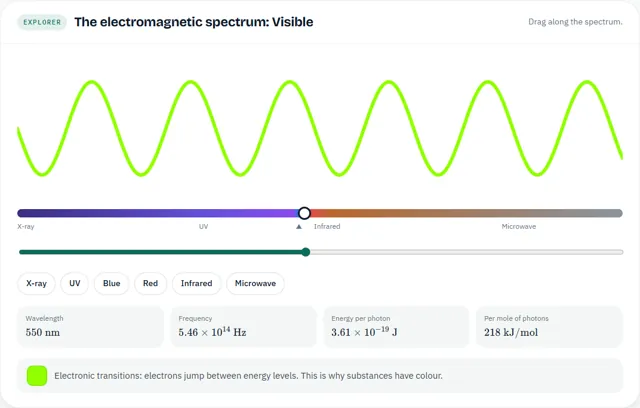
Shorter wavelength, more energy.
Light is a wave and a stream of photons. Each photon's energy depends on its frequency.
·
The photoelectric effect.
Light knocks electrons out of a metal only if each photon has enough energy. Brighter light of too low a frequency does nothing; above the threshold, extra energy becomes the electron's kinetic energy. (PES in Unit 1 uses exactly this.)
The electromagnetic spectrum:
Beer–Lambert: more absorber, more absorbance.
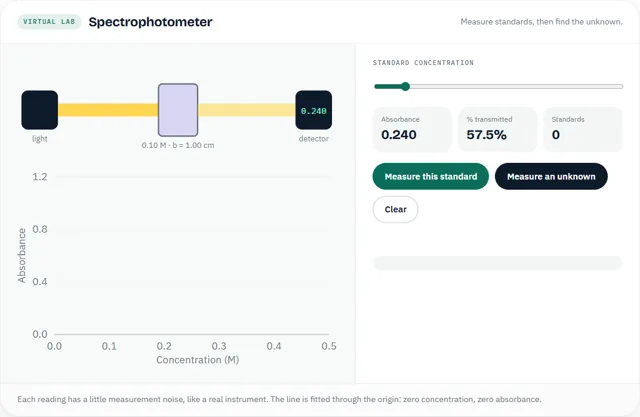
Shine light through a solution. Absorbance rises in a straight line with concentration. Measure standards, draw the line, read off the unknown.
: how strongly the substance absorbs (molar absorptivity) · : path length (cm) · : concentration (M)
- , so .
Spectrophotometer
Study notes
Key concepts
The law (SAP-8.C.1). When light of a single wavelength passes through a solution, the amount absorbed depends on three things:
-
A, absorbance: no units. It is measured by the spectrophotometer.
-
ε (epsilon), molar absorptivity: how strongly that particular species absorbs light of that particular wavelength. Units: M⁻¹ cm⁻¹ (L mol⁻¹ cm⁻¹). It is a property of the substance and the wavelength; it is large at λ_max and small at wavelengths the species barely absorbs. (Some older sheets write the same law as A = abc, with a for absorptivity.)
-
b, path length: the distance the light travels through the solution, in cm (the width of the cuvette, usually 1.00 cm).
-
c, concentration of the absorbing species, in mol/L.
Both b and c are proportional to the number of absorbing particles in the light beam: a longer path or a more concentrated solution puts more absorbing ions or molecules in the way of the light.
Absorbance is proportional to concentration (SAP-8.C.2). In most experiments the same cuvette (same b) and the same wavelength (same ε) are used for every measurement. Then A is directly proportional to c alone: doubling the concentration doubles the absorbance. This is the basis for measuring concentrations with a spectrophotometer.
Transmittance (useful extension). The spectrophotometer actually compares the intensity of light leaving the sample, I, with the intensity entering it, I₀. Transmittance T = I/I₀ (often given as %T). Absorbance is defined as A = −log T. So 100 %T → A = 0; 10 %T → A = 1.0; 1 %T → A = 2.0. Absorbance (not %T) is the quantity that is linear in concentration. The CED lab activity (separating Kool-Aid dyes and measuring %T from 400 to 750 nm) uses this relationship.
How a spectrophotometer works. Light source (white light) → wavelength selector (diffraction grating or prism; picks one narrow band of wavelengths) → sample in a cuvette → detector that measures the transmitted intensity → reading of A or %T.
Standard procedure for a Beer's law determination
-
Choose the wavelength. Measure the absorbance of one standard across the visible range (an absorption spectrum). Choose λ_max, the wavelength of maximum absorbance. Reasons: ε is largest there, so the method is most sensitive (largest change in A per change in c), and the curve is flat at the peak, so small errors in the wavelength setting barely change A. The colour at λ_max is complementary to the colour of the solution (3.11).
-
Calibrate (blank) the instrument. Fill a cuvette with the solvent only (usually distilled water, or all reagents except the coloured species) and set A = 0 (100 %T). This subtracts any absorbance due to the cuvette and solvent.
-
Prepare standards. Make several solutions of accurately known concentration, normally by dilution of a stock solution using volumetric pipets and volumetric flasks (3.7). They should bracket the expected unknown concentration.
-
Measure the standards at λ_max in the same cuvette (or matched cuvettes), wiping the outside with a lint-free tissue and holding the cuvette by its frosted or ridged sides.
-
Make a calibration curve (Beer's law plot). Plot A (y-axis) against c (x-axis). The best-fit straight line should pass through or very near the origin. Its slope equals εb (so ε = slope ÷ b).
-
Measure the unknown under identical conditions and read its concentration from the line (or calculate c = A ÷ slope).
-
Keep A in the linear range. Beer's law is most reliable at absorbances below about 1 (some instruments to about 1.5). If the unknown's absorbance is above the highest standard, dilute it by a known factor, measure again, and multiply the result by the dilution factor.
Interpreting a Beer's law graph
| Feature | Meaning |
|---|---|
| straight line through origin | Beer's law obeyed; A ∝ c |
| slope | εb (M⁻¹); if b = 1.00 cm, slope = ε |
| steeper line for substance X than Y at the same b | X has a larger ε at that wavelength |
| same substance measured in a 2.00 cm cuvette instead of 1.00 cm | slope doubles |
| line bends toward the x-axis at high c | deviation from Beer's law at high absorbance; dilute samples |
| intercept clearly above zero | blank not set correctly, or an absorbing impurity in all samples |
Sources of experimental error (CED skill 2.E: identify and describe errors). For each error, think: does it make the measured A of the unknown too high or too low, and therefore the calculated c too high or too low (c = A/εb)?
| Error | Effect on measured A | Effect on calculated concentration | Why |
|---|---|---|---|
| fingerprints, smudges or scratches on the cuvette (unknown only) | too high | too high | less light reaches the detector; instrument counts it as absorbed |
| air bubbles in the light path | too high | too high | bubbles scatter light |
| water droplets left in the cuvette before adding the unknown | too low | too low | the sample is diluted, so fewer absorbing particles are in the beam |
| cuvette rinsed with distilled water but not with the solution | too low | too low | same dilution effect |
| cuvette rinsed with a more concentrated standard and not dried | too high | too high | extra absorbing species |
| cuvette not filled high enough, so the beam passes above the liquid | too low | too low | light reaches detector without passing through the sample |
| unknown measured at a wavelength different from λ_max used for the standards | usually too low | too low | ε is smaller away from λ_max |
| instrument not blanked, or blanked with the wrong solvent | depends on blank | systematic error | absorbance of cuvette/solvent not subtracted correctly |
| cuvette with a longer path length than the standards' cuvette | too high | too high | b larger, more absorbing particles in the beam |
| solution left in a warm room and solvent evaporates | too high | too high | concentration actually increased |
| a different coloured impurity that absorbs at λ_max | too high | too high | extra absorbing species |
Important limits. A colourless species (e.g., Na⁺, Cl⁻, most organic molecules) does not absorb visible light, so a visible spectrophotometer cannot measure it unless it is first converted into a coloured species (e.g., Fe²⁺ + 1,10-phenanthroline → red-orange complex). Spectrophotometry can follow a reaction in real time, because absorbance tracks the concentration of a coloured reactant or product (used in Unit 5 kinetics, e.g., 2015 FRQ Q5 on bleaching a blue dye).
Key equations
Worked examples
Worked example 1 (direct calculation). A KMnO₄ solution in a 1.00 cm cuvette has an absorbance of 0.491 at 525 nm. ε = 2455 M⁻¹ cm⁻¹ at this wavelength. Find [MnO₄⁻].
Solution. c = A/(εb) = 0.491 ÷ (2455 × 1.00) = 2.00 × 10⁻⁴ M.
Worked example 2 (calibration curve). Standards of CoCl₂(aq) were measured at 510 nm in a 1.00 cm cuvette.
| [CoCl₂] (M) | 0.0200 | 0.0400 | 0.0600 | 0.0800 | 0.1000 |
|---|---|---|---|---|---|
| Absorbance | 0.096 | 0.193 | 0.287 | 0.385 | 0.478 |
An unknown CoCl₂ solution has A = 0.250. Find its concentration and the molar absorptivity.
Solution. The best-fit line is A = 4.78c + 0.001, essentially through the origin. Slope = εb = 4.78 M⁻¹, so ε = 4.78 M⁻¹ cm⁻¹. Unknown: c = (0.250 − 0.001) ÷ 4.78 = 0.0521 M (0.0523 M if the line is forced through the origin). Note that Co²⁺(aq) absorbs weakly (small ε), so fairly concentrated solutions are needed.
Worked example 3 (dilution before measuring). A sample was too concentrated, so 10.00 mL of it was diluted to 50.00 mL. The diluted solution has A = 0.320 in a cuvette for which εb = 4.80 M⁻¹. Find the concentration of the original sample.
Solution. c(diluted) = 0.320 ÷ 4.80 = 0.0667 M. Dilution factor = 50.00/10.00 = 5.000. c(original) = 0.0667 × 5.000 = 0.333 M.
Worked example 4 (transmittance). A solution transmits 40.0% of the incident light. What is its absorbance? If the concentration is doubled, what percentage is transmitted?
Solution. A = −log(0.400) = 0.398. Doubling c doubles A to 0.796; T = 10⁻⁰·⁷⁹⁶ = 0.160, so 16.0% is transmitted (not 20%: transmittance is not proportional to concentration).
Unit 3 study guide: exam-style free-response set, worksheet and answers.
Worked example
- Rearrange: .
- .
- Answer:
Free-response practice
Write your answer first, then open the solution and mark yourself against it.
Free-response 1 (modelled on 2021 AP FRQ Q3(f)–(g)). A student determines the concentration of a NiSO₄(aq) solution by spectrophotometry at 395 nm in a 1.00 cm cuvette. The calibration data are given.
| [NiSO₄] (M) | 0.0500 | 0.100 | 0.150 | 0.200 |
|---|---|---|---|---|
| Absorbance | 0.258 | 0.512 | 0.771 | 1.025 |
(a) Explain why the student first measures the absorbance of distilled water in the cuvette and sets the reading to zero.
(b) Using the data, determine the molar absorptivity of Ni²⁺(aq) at 395 nm.
(c) The unknown has A = 0.640. Calculate [NiSO₄] in the unknown.
(d) The student's cuvette had a small scratch on one face when the unknown was measured, but not when the standards were measured. Would the calculated concentration be greater than, less than, or equal to the true value? Justify.
(e) A second student uses a wavelength of 550 nm, where Ni²⁺ absorbs only weakly, for both standards and unknown. Explain why the results would be less precise, even though Beer's law still applies.
Show the solution
(a) Blanking with solvent sets A = 0 for the cuvette plus water, so the measured absorbance of each sample is due only to the absorbing Ni²⁺ ions (it corrects for light absorbed or reflected by the cuvette and water). (1 point)
(b) Slope of A vs. c: (1.025 − 0.258)/(0.200 − 0.0500) = 0.767/0.150 = 5.11 M⁻¹ (a least-squares fit gives 5.12 M⁻¹ with intercept 0.002, essentially zero). ε = slope ÷ b = 5.12 M⁻¹ ÷ 1.00 cm = 5.12 M⁻¹ cm⁻¹. (1 point)
(c) c = A/(εb) = 0.640 ÷ (5.12 × 1.00) = 0.125 M (the same to three significant figures using 5.11). (1 point)
(d) Greater than. The scratch scatters light, so less light reaches the detector and the measured absorbance is higher than it should be. Since c is proportional to A, the calculated concentration is too high. (1 point)
(e) At 550 nm, ε is small, so the absorbances of all solutions are small and the calibration line is shallow. A small error in the absorbance reading then corresponds to a large error in concentration, and the differences between standards are hard to distinguish. Also, away from the peak the absorbance changes rapidly with wavelength, so small instrument wavelength drift causes larger errors. (1 point)
Free-response 2 (determination of iron; modelled on 2014 AP FRQ Q1 and the AP Lab Manual Investigation 1). A student finds the mass of iron in one iron-supplement tablet. The tablet is dissolved in acid and all the iron is converted to Fe²⁺. The solution is diluted to 250.0 mL in a volumetric flask (solution A). Then 2.00 mL of solution A is mixed with excess 1,10-phenanthroline, which forms a red-orange complex with Fe²⁺ (one Fe per complex), and diluted to 100.00 mL (solution B). Solution B has an absorbance of 0.444 at 510 nm in a 1.00 cm cuvette. The molar absorptivity of the complex at 510 nm is 1.11 × 10⁴ M⁻¹ cm⁻¹.
(a) Explain why the Fe²⁺ must be converted to the coloured complex before measurement.
(b) Calculate the concentration of the iron complex in solution B.
(c) Calculate the concentration of Fe²⁺ in solution A.
(d) Calculate the mass of iron, in mg, in the tablet.
(e) The student forgets to add enough 1,10-phenanthroline, so some Fe²⁺ is not converted into the complex. Will the calculated mass of iron be too high, too low or unaffected? Justify.
Show the solution
(a) Fe²⁺(aq) is nearly colourless and absorbs visible light only very weakly. The complex absorbs strongly at 510 nm (large ε), so its absorbance is large enough to measure accurately at low concentrations. (1 point)
(b) c = A/(εb) = 0.444 ÷ (1.11 × 10⁴ × 1.00) = 4.00 × 10⁻⁵ M. (1 point)
(c) Dilution: c(A) = 4.00 × 10⁻⁵ M × (100.00 mL ÷ 2.00 mL) = 2.00 × 10⁻³ M. (1 point)
(d) Moles Fe = 2.00 × 10⁻³ mol/L × 0.2500 L = 5.00 × 10⁻⁴ mol. Mass = 5.00 × 10⁻⁴ × 55.85 g/mol = 0.0279 g = 27.9 mg. (1 point)
(e) Too low. Unconverted Fe²⁺ does not absorb at 510 nm, so the absorbance (and the calculated concentration of complex) represents only part of the iron, giving a calculated mass that is less than the true mass. (1 point)
Common mistake
Students think absorbance and transmittance increase together. A more concentrated solution absorbs more light and transmits less, so as absorbance rises the light passing through falls.
Frequently asked questions
?Why do you choose the wavelength of maximum absorbance?
Absorbance changes most with concentration at that wavelength, which gives the most sensitive and accurate measurements.
?How does a fingerprint on the cuvette affect the result?
It scatters or absorbs extra light, so the measured absorbance is too high and the calculated concentration is too high.
Practice questions on 3.13
- Q1A 0.10 M solution has an absorbance of 0.40. In the same cell at the same wavelength, another solution of the same substance has an absorbance of 0.10. What is its concentration?
- Q2Besides concentration, which factor directly changes the absorbance reading of a coloured solution at a fixed wavelength?
- Q3A graph of absorbance (y) vs. concentration (x) for a series of standards is a straight line. What is the slope?
- Q4An absorption spectrum of 0.10 M CoCl₂(aq) shows absorbances of 0.05 at 400 nm, 0.48 at 510 nm, 0.30 at 550 nm and 0.02 at 650 nm. Which wavelength should be used for a Beer's law study?
- Q5A substance has A = 0.65 in a 1.2 cm cuvette. Its molar absorptivity at that wavelength is 1.3 M⁻¹ cm⁻¹. What is its concentration?
- Q6After measuring the standards, a student notices fingerprints on the cuvette used for the unknown only. How will this affect the calculated concentration of the unknown?
- Q7A student leaves a few drops of distilled water in the cuvette before adding the unknown solution. Compared with the true value, the calculated concentration will be
- Q8Which is an appropriate use of a visible-light spectrophotometer?
- Q9Two solutions of the same dye are measured at λ_max. Solution 1 is 0.020 M in a 1.00 cm cuvette; solution 2 is 0.010 M in a 2.00 cm cuvette. How do their absorbances compare?
- Q10A Beer's law plot of standards is linear up to A = 1.2. An unknown gives A = 2.4. What should the student do?
- Q11Besides concentration, which factor directly affects absorbance?
- Q12On a graph of absorbance against concentration, what is the slope?
- Q13Absorbance readings for a dye: 400 nm, 0.12; 480 nm, 0.45; 520 nm, 0.71; 600 nm, 0.30. Which wavelength should be used?
- Q14A solution has in a 1.00 cm cuvette with . What is its concentration?
- Q15The outside of a cuvette is scratched and smudged. How does this affect the calculated concentration?
- Q16A cuvette is rinsed with distilled water and not dried before the sample is added. How does this affect the absorbance?
Stuck on a unit? Let us fix it this week.
Book a 30-minute one-to-one session for $20. Bring a test, a homework set or the topic that is not clicking.
Book a session