 AP Chemistry Tutoring
3.3 Solids, liquids and gases
AP Chemistry Unit 3: Properties of Substances and Mixtures · 1 simulation · 14 practice questions
Updated · Aligned to the AP Chemistry Course and Exam Description
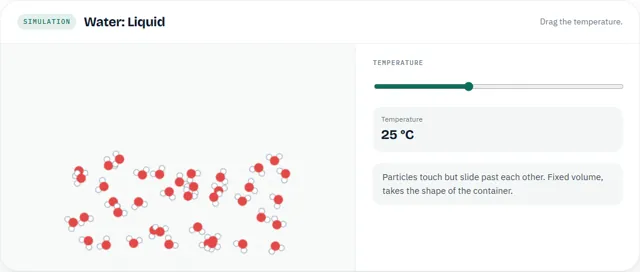
The state of a substance depends on the balance between the kinetic energy of its particles and the intermolecular forces holding them together. In solids particles vibrate in fixed positions, in liquids they are close together but move past each other, and in gases they are far apart and move freely. Stronger IMFs give lower vapor pressure and higher boiling point; a liquid boils when its vapor pressure equals the external pressure.
Solids, liquids, gases
Water:
Stronger IMFs: higher boiling point, lower vapor pressure.
To boil, molecules must escape their neighbours. Strong IMFs hold them back: few escape at any temperature, so the vapor pressure is low and the boiling point is high.
Boiling breaks IMFs, never the covalent bonds inside the molecules.
| Solid | fixed shape · fixed volume · vibrate in place |
| Liquid | takes container's shape · fixed volume · slide past |
| Gas | no fixed shape or volume · far apart, fast |
Study notes
Key concepts
The state of a substance depends on a competition between two things: the kinetic energy of the particles (which tends to spread them apart) and the strength of the attractions between particles (which holds them together). Low temperature or strong IMFs favour condensed phases; high temperature or weak IMFs favour the gas.
Solids (SAP-6.A.1).
-
Crystalline solids: particles in a regular, repeating 3-D arrangement (NaCl, ice, diamond, metals). They melt sharply at one temperature.
-
Amorphous solids: no regular long-range order (glass, plastics, rubber). They soften over a range of temperatures.
-
In both, particles vibrate about fixed positions; they do not move past one another (no overall translation). The structure depends on the interparticle interactions and on how well the particles can pack together.
Liquids (SAP-6.A.2). Particles are in close contact but continually move, slide past each other and collide. Their arrangement and motion are influenced by the type and strength of the forces (polarity, hydrogen bonding) and by temperature. A liquid has a definite volume but takes the shape of its container.
Similar molar volume of solid and liquid (SAP-6.A.3). In both condensed phases the particles touch, so a mole of solid and a mole of liquid occupy similar volumes (usually within about 10%). Water is an unusual exception in direction: ice is about 9% less dense than liquid water because its hydrogen-bonded open hexagonal lattice holds molecules farther apart than in the liquid.
Gases (SAP-6.A.4). Particles are in constant, random, straight-line motion between collisions. The average spacing between particles is very large compared with their size (roughly 10 molecular diameters or more at 1 atm). Collision frequency and spacing depend on temperature, pressure and volume. Because the particles move freely and feel minimal forces, a gas has neither a definite volume nor a definite shape, is easily compressed, and has a low density (about 1/1000 of the liquid).
Particulate drawings of the three states (H₂O as the example, about 10 molecules each)
| State | What the drawing should show |
|---|---|
| Solid (ice) | molecules in an ordered pattern, touching or nearly touching, each H₂O oriented so that H atoms point toward O atoms of neighbours (hydrogen bonds drawn as dashed lines); no motion lines or only small vibration marks |
| Liquid | molecules still close together and touching, filling the bottom of the container, but randomly arranged and oriented; some hydrogen bonds shown; same number of molecules as the solid in roughly the same volume |
| Gas | a few molecules spread far apart throughout the whole container, randomly placed, with motion arrows; no hydrogen bonds; molecules themselves are unchanged (still H₂O, not separate H and O atoms) |
A frequent error is drawing a gas as separate H and O atoms. Phase changes are physical changes: the molecules stay intact.
Phase changes.
| Change | From → to | Energy | What happens to IMFs |
|---|---|---|---|
| Melting (fusion) | solid → liquid | absorbed (endothermic) | weakened / rearranged |
| Freezing | liquid → solid | released (exothermic) | strengthened / formed |
| Vaporization (boiling, evaporation) | liquid → gas | absorbed | broken |
| Condensation | gas → liquid | released | re-formed |
| Sublimation | solid → gas | absorbed | broken |
| Deposition | gas → solid | released | formed |
Heating curves. On a graph of temperature vs. heat added:
-
Sloped segments: one phase is being heated. Added energy raises the average kinetic energy, so temperature rises.
-
Flat (plateau) segments: a phase change. Added energy goes into overcoming IMFs (increasing potential energy) while the temperature and average kinetic energy stay constant. The melting plateau is shorter than the boiling plateau because vaporization breaks essentially all attractions while melting only loosens them (ΔHvap is larger than ΔHfus).
-
Liquid water at 0 °C has more energy than ice at 0 °C; steam at 100 °C has more energy than liquid water at 100 °C.
Vapor pressure. In a closed container, molecules at the surface of a liquid with enough kinetic energy escape into the gas phase. Gas molecules also return to the liquid. When the rates of evaporation and condensation become equal, a dynamic equilibrium is reached, and the pressure of the vapor is the equilibrium vapor pressure.
-
Vapor pressure depends only on the identity of the liquid and the temperature, NOT on the amount of liquid or the volume of the container (as long as some liquid remains).
-
Weaker IMFs → higher vapor pressure (the liquid is more volatile).
-
Higher temperature → higher vapor pressure, because a larger fraction of molecules has enough kinetic energy to escape (see the Maxwell–Boltzmann distribution in 3.5).
-
A liquid boils when its vapor pressure equals the external pressure. The normal boiling point is the temperature at which vapor pressure equals 1 atm (760 torr). On a mountain, the air pressure is lower, so water reaches that lower vapor pressure at a lower temperature and boils below 100 °C.
| Liquid (20 °C) | Vapor pressure (torr) | Normal bp (°C) | Main IMFs |
|---|---|---|---|
| diethyl ether, (C₂H₅)₂O | 440 | 35 | LDF, dipole–dipole |
| ethanol, C₂H₅OH | 44 | 78 | LDF, dipole–dipole, H-bond |
| water, H₂O | 17.5 | 100 | LDF, dipole–dipole, extensive H-bond |
Phase diagrams. Many textbooks show phase diagrams (triple point, critical point, supercritical fluid, the negative solid–liquid slope of water, CO₂ subliming at 1 atm). The CED states that interpreting phase diagrams will NOT be assessed on the AP exam; it is treated as prior knowledge. Know the vocabulary, but you do not need to practise reading phase diagrams for the exam.
Worked examples
Worked example (modelled on 2011 AP FRQ Q6(a)). All air is pumped out of a rigid 2.0 L flask. Some liquid hexane is injected and the flask is held at 25 °C. The amount of liquid decreases at first and then stays constant. The equilibrium vapor pressure of hexane at 25 °C is 151 torr. What is the pressure in the flask once the amount of liquid is constant? Justify.
Solution. The pressure equals 151 torr. The only gas in the flask is hexane vapor. When the amount of liquid stops changing, the rate of evaporation equals the rate of condensation, so the vapor is at its equilibrium vapor pressure at 25 °C. Adding more liquid or using a bigger flask would not change this pressure, as long as liquid remains.
Unit 3 study guide: exam-style free-response set, worksheet and answers.
Worked example
- Water molecules hydrogen bond to each other; diethyl ether has no O-H group and has dipole-dipole and dispersion forces only.
- Weaker IMFs let more molecules escape into the vapor at the same temperature.
- Answer: Diethyl ether has the higher vapor pressure.
Free-response practice
Write your answer first, then open the solution and mark yourself against it.
Free-response 1. A 50.0 g sample of ice at −20 °C is heated at a constant rate until it becomes steam at 120 °C.
(a) Describe the shape of the heating curve (temperature vs. time), naming each segment.
(b) During the segment at 100 °C, the temperature does not change even though heat is being added. Explain where the energy goes, in terms of kinetic energy, potential energy and IMFs.
(c) Explain why the plateau at 100 °C lasts much longer than the plateau at 0 °C.
(d) Describe how a particulate drawing of the sample just below 100 °C differs from one just above 100 °C, keeping the number of molecules the same.
Show the solution
(a) Five segments: (1) sloped rise from −20 °C to 0 °C (ice warming); (2) flat at 0 °C (melting, ice + water); (3) sloped rise from 0 °C to 100 °C (liquid warming); (4) flat at 100 °C (boiling, liquid + vapor); (5) sloped rise from 100 °C to 120 °C (steam warming). (1 point)
(b) The average kinetic energy (temperature) stays constant. The added energy increases the potential energy of the molecules by overcoming the hydrogen bonds and other IMFs that hold the molecules together in the liquid, allowing them to separate into the gas. (1 point)
(c) Melting only loosens and rearranges the hydrogen bonds (molecules stay in contact), while boiling separates the molecules essentially completely, so much more energy per mole is needed for vaporization (ΔHvap of water = 40.7 kJ/mol) than for fusion (ΔHfus = 6.01 kJ/mol). At a constant heating rate, the larger energy requirement takes longer. (1 point)
(d) Below 100 °C (liquid): molecules close together, touching, randomly arranged, filling the lower part of the container, with some hydrogen bonds shown. Above 100 °C (gas): the same number of intact H₂O molecules spread far apart throughout the entire container, randomly placed, no hydrogen bonds. (1 point)
Common mistake
Students think particles stop moving in a solid. Particles in a solid still vibrate about fixed positions; they simply do not have enough kinetic energy to overcome the attractions holding them in place.
Frequently asked questions
?Why does water boil at a lower temperature on a mountain?
Atmospheric pressure is lower at high altitude, so water's vapor pressure reaches the external pressure at a lower temperature.
?Does adding heat during boiling raise the temperature?
No. While a pure liquid boils, added energy goes into overcoming intermolecular forces, so the temperature stays constant until all the liquid has vaporized.
Practice questions on 3.3
- Q1Which phase has neither a definite shape nor a definite volume?
- Q2Which property is most similar for the solid and liquid phases of the same substance?
- Q3A particulate diagram shows ten identical molecules: all are touching their neighbours and are clustered at the bottom of the container, but they are randomly arranged with no repeating pattern. Which phase is shown?
- Q4A sample of liquid ether is in a closed container at constant temperature with liquid present at equilibrium. More liquid ether is added at the same temperature. After equilibrium is re-established, the vapor pressure of ether is
- Q5Water boils at about 90 °C on a high mountain. The best explanation is that, on the mountain,
- Q6Which change occurs when H₂O(l) changes to H₂O(g)?
- Q7Why do the physical properties of different gases vary relatively little?
- Q8Which phase has a definite volume but no definite shape?
- Q9In which phase are the particles close together but able to move past one another?
- Q10Which describes an amorphous solid?
- Q11Which property is usually similar for a substance's solid and liquid phases?
- Q12Which phase is significantly compressible?
- Q13At constant temperature, why does a gas behave more ideally as its volume increases?
- Q14Glass softens over a range of temperatures instead of melting at one sharp point. This is typical of:
Terms used in this topic
Stuck on a unit? Let us fix it this week.
Book a 30-minute one-to-one session for $20. Bring a test, a homework set or the topic that is not clicking.
Book a session