 AP Chemistry Tutoring
3.4 Ideal gas law
AP Chemistry Unit 3: Properties of Substances and Mixtures · 2 simulations · 13 practice questions
Updated · Aligned to the AP Chemistry Course and Exam Description
The ideal gas law, , relates the pressure, volume, amount and absolute temperature of a gas, with . In a gas mixture each gas contributes a partial pressure, and Dalton's law gives with , where is the mole fraction.
Gases
The ideal gas.
Imagine gas particles that take up no space and never attract or repel each other. Real gases come close at ordinary conditions, and all of them obey one equation.
. .
What is pressure?
Particles colliding with the walls. More particles in the same space means more collisions per second, so more pressure. Heating does two things: particles hit more often and harder.
Gas in a cylinder
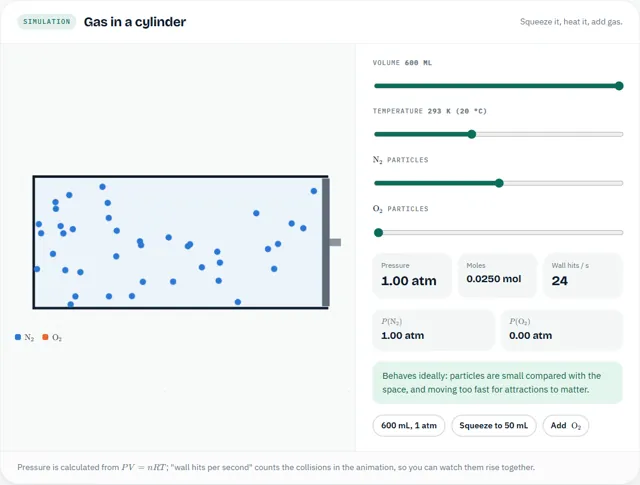
A car engine squeezes 600 mL of air at 1.0 atm down to 50 mL, at constant temperature. New pressure?
- Same gas (), same , so is constant: .
- : one-twelfth the volume, twelve times the pressure. Try it above.
in a rigid 7.0 L cylinder is at 2.1 atm and 10 °C. It is heated to 40 °C. New pressure?
- Rigid: is fixed, and is fixed. So : .
- Convert to kelvin: , .
- . (Using °C would wrongly give 8.4 atm.)
Mixtures: add the partial pressures.
Each gas in a mixture pushes as if it were alone. Its share is set by its mole fraction.
?Two rigid 5 L containers at the same temperature: at 0.8 atm and at 1.0 atm. All the is moved into the container. Total pressure?Think, then tap to check
Real gases misbehave when squeezed or cold.
High pressure: particles are crowded, so their own volume matters. Low temperature: they move slowly, so attractions pull on them. Big particles deviate more.
Kinetic molecular theory.
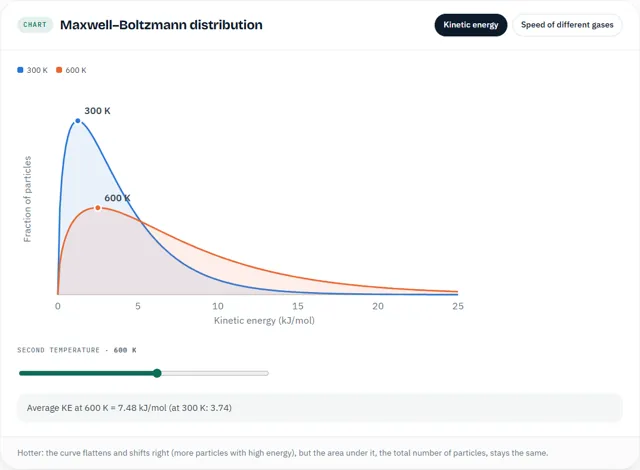
Gas particles are in continuous, random motion: different speeds, different directions. Temperature measures their average kinetic energy, .
Maxwell–Boltzmann distribution
Study notes
Key concepts
Gas variables. A gas sample is described by four quantities: pressure P, volume V, temperature T, and amount n (moles).
-
Pressure is force per unit area. Gas pressure comes from gas particles colliding with the container walls: more frequent or more forceful collisions → higher pressure. Units: 1 atm = 760 mm Hg = 760 torr = 101.3 kPa. Pressure is measured with a barometer (atmosphere) or a manometer or pressure gauge (a gas sample).
-
Temperature must always be in kelvin in gas calculations: K = °C + 273 (273.15 for more precision).
-
Volume in liters (L) when R = 0.08206 L·atm/(mol·K).
The ideal gas law (SAP-7.A.1). For an ideal gas:
R = 0.08206 L·atm/(mol·K) = 62.36 L·torr/(mol·K) = 8.314 J/(mol·K). Choose the value of R whose units match your data.
The simple gas laws are special cases.
| Law | Held constant | Relationship | Graph |
|---|---|---|---|
| Boyle's law | n, T | P₁V₁ = P₂V₂ (P and V inversely proportional) | P vs. V is a curve (hyperbola); P vs. 1/V is a straight line through the origin |
| Charles's law | n, P | V₁/T₁ = V₂/T₂ (V directly proportional to T in K) | V vs. T(K) is a straight line through the origin; V vs. T(°C) is a straight line that extrapolates to zero volume at −273 °C |
| Gay-Lussac's law | n, V | P₁/T₁ = P₂/T₂ | P vs. T(K) straight line through the origin |
| Avogadro's law | P, T | V₁/n₁ = V₂/n₂ | V vs. n straight line through the origin |
| Combined gas law | n | P₁V₁/T₁ = P₂V₂/T₂ | — |
Graphs (SAP-7.A.3) are tested: be able to sketch each one and to say which variables were held constant. For an ideal gas at constant n and T, a graph of PV vs. P is a horizontal line; for a fixed sample, PV vs. T is a straight line through the origin with slope nR.
Avogadro's hypothesis and molar volume. Equal volumes of any gases at the same T and P contain equal numbers of molecules. At STP (273.15 K and 1.00 atm) one mole of an ideal gas occupies 22.4 L. Only use 22.4 L/mol at exactly STP; otherwise use PV = nRT.
Dalton's law of partial pressures (SAP-7.A.2). In a mixture of ideal gases, each gas behaves as if it were alone. The pressure each one exerts (its partial pressure) is independent of the others, and the total pressure is the sum:
The mole fraction X has no units and the mole fractions of all components add to 1.
Gases collected over water. When a gas is collected by water displacement, the collected gas is "wet": it is mixed with water vapor. After the water levels inside and outside the collection tube are equalized, Patm = Pgas + Pwater, so Pgas = Patm − Pwater, where Pwater is the vapor pressure of water at that temperature (from a table; e.g., 17.5 torr at 20 °C, 23.8 torr at 25 °C, 31.8 torr at 30 °C).
Density and molar mass of a gas. Substituting n = m/M into PV = nRT:
Gas density is directly proportional to molar mass and to pressure, and inversely proportional to temperature. At the same T and P, a heavier gas is denser (that is why CO₂ sinks and He balloons rise). Gases are about 1000 times less dense than liquids.
Gas stoichiometry. Use PV = nRT to convert between the measurable P, V, T of a gas and moles; then use the mole ratio from the balanced equation as in Unit 4.
Problem-solving routine. (1) List knowns with units; convert °C to K and torr or kPa to atm if using 0.08206. (2) Decide: if one sample changes conditions → combined gas law (cancel what stays constant); if you need n, mass or molar mass → PV = nRT. (3) Solve symbolically, then substitute. (4) Check that the answer makes physical sense (e.g., heating at constant volume should increase pressure).
Key equations
Worked examples
Worked example 1 (pressure). What is the pressure of 2.50 g of CO₂ in a 1.50 L flask at 35.0 °C?
Solution. n = 2.50 g ÷ 44.01 g/mol = 0.05681 mol. T = 35.0 + 273.15 = 308.15 K.
Worked example 2 (density). Calculate the density of Cl₂(g) at 1.20 atm and 40.0 °C.
Solution. D = PM/RT = (1.20 atm)(70.90 g/mol) ÷ [(0.08206 L·atm/(mol·K))(313.15 K)] = 3.31 g/L.
Worked example 3 (molar mass). A 0.582 g sample of a gaseous hydrocarbon occupies 250.0 mL at 0.985 atm and 25.0 °C. Find the molar mass and suggest an identity.
Solution. M = mRT/PV = (0.582)(0.08206)(298.15) ÷ [(0.985)(0.2500)] = 57.8 g/mol. Butane, C₄H₁₀ (58.1 g/mol), fits.
Worked example 4 (partial pressures). A cylinder contains 0.20 mol N₂, 0.30 mol O₂ and 0.50 mol Ar at a total pressure of 2.00 atm. Find each partial pressure.
Solution. Total moles = 1.00 mol. X(N₂) = 0.20, X(O₂) = 0.30, X(Ar) = 0.50. P(N₂) = 0.20 × 2.00 = 0.40 atm; P(O₂) = 0.60 atm; P(Ar) = 1.00 atm. Check: 0.40 + 0.60 + 1.00 = 2.00 atm.
Worked example 5 (gas collected over water). Hydrogen gas is collected over water at 25.0 °C. The volume is 245 mL and the barometric pressure is 752 torr. The vapor pressure of water at 25.0 °C is 23.8 torr. How many moles of H₂ were collected?
Solution. P(H₂) = 752 − 23.8 = 728.2 torr = 728.2 ÷ 760 = 0.9582 atm.
Worked example 6. A 600. mL helium balloon at 0.97 atm and 24 °C rises to where the pressure is 0.54 atm and the temperature is 5 °C. Find the new volume.
Solution. V₂ = V₁ × (P₁/P₂) × (T₂/T₁) = 600. mL × (0.97/0.54) × (278 K/297 K) = 1.0 × 10³ mL (1.0 L). The pressure drop expands the balloon more than the cooling shrinks it.
Worked example 7 (gas stoichiometry). What volume of CO₂(g), measured at 1.00 atm and 25 °C, is produced when 10.0 g CaCO₃ reacts completely with excess HCl? CaCO₃(s) + 2 HCl(aq) → CaCl₂(aq) + H₂O(l) + CO₂(g)
Solution. n(CaCO₃) = 10.0 ÷ 100.09 = 0.0999 mol = n(CO₂) (1: 1). V = nRT/P = (0.0999)(0.08206)(298.15) ÷ 1.00 = 2.44 L.
Unit 3 study guide: exam-style free-response set, worksheet and answers.
Worked example
- Moles: .
- Molar mass: .
- Answer:
Free-response practice
Write your answer first, then open the solution and mark yourself against it.
Free-response 1. A student reacts 0.0485 g of Mg(s) with excess HCl(aq) and collects the H₂(g) over water at 22.0 °C. The barometric pressure is 748 torr, and the vapor pressure of water at 22.0 °C is 19.8 torr.
Mg(s) + 2 HCl(aq) → MgCl₂(aq) + H₂(g)
(a) Calculate the number of moles of H₂ produced.
(b) Calculate the partial pressure of H₂, in atm, in the collection tube.
(c) Calculate the volume, in mL, of gas that the student should collect.
(d) Calculate the mole fraction of water vapor in the collected gas.
(e) The student forgets to subtract the vapor pressure of water and uses 748 torr as the pressure of H₂ to calculate the moles of H₂ from the measured volume. Will the calculated number of moles be too high, too low or correct? Justify.
Show the solution
(a) n(Mg) = 0.0485 g ÷ 24.31 g/mol = 1.995 × 10⁻³ mol; mole ratio 1: 1, so n(H₂) = 1.995 × 10⁻³ mol (2.00 × 10⁻³ mol). (1 point)
(b) P(H₂) = 748 − 19.8 = 728.2 torr = 728.2/760 = 0.958 atm. (1 point)
(c) V = nRT/P = (1.995 × 10⁻³)(0.08206)(295.15) ÷ 0.958 = 0.0504 L = 50.4 mL. (1 point)
(d) X(H₂O) = P(H₂O)/Ptotal = 19.8/748 = 0.0265. (1 point)
(e) Too high. Using 748 torr instead of 728 torr overstates the pressure of H₂, and n = PV/RT is directly proportional to P, so the calculated moles of H₂ are too large. (1 point)
Free-response 2 (modelled on 2018 AP FRQ Q4(b)). An 8.00 g sample of liquid methanol, CH₃OH (32.04 g/mol), is placed in an evacuated, rigid 4.00 L container. The container is sealed and heated to 400. K, at which temperature all of the methanol is vapor.
(a) Calculate the pressure in the container at 400. K.
(b) The container is cooled to 300. K. A student calculates the pressure at 300. K by assuming that all the methanol is still a gas. Calculate the value the student gets.
(c) The measured pressure at 300. K is only 0.180 atm, and liquid droplets are seen. Explain why the measured pressure is much lower than the value in (b), and calculate the mass of methanol that remains as vapor.
Show the solution
(a) n = 8.00 ÷ 32.04 = 0.2497 mol. P = nRT/V = (0.2497)(0.08206)(400.) ÷ 4.00 = 2.05 atm. (1 point)
(b) P = (0.2497)(0.08206)(300.) ÷ 4.00 = 1.54 atm. (1 point)
(c) 1.54 atm is far greater than the equilibrium vapor pressure of methanol at 300 K (0.180 atm), so most of the methanol condenses to liquid. Once liquid is present, the pressure of the vapor can only equal the vapor pressure. Moles of vapor: n = PV/RT = (0.180)(4.00) ÷ [(0.08206)(300.)] = 0.0292 mol; mass = 0.0292 × 32.04 = 0.937 g of methanol remains as vapor (about 7.06 g has condensed). (2 points: 1 for the explanation, 1 for the calculation)
Common mistake
Students use Celsius temperatures in gas law calculations. Gas laws require absolute temperature: .
Frequently asked questions
?Which value of R should I use?
Use when pressure is in atm and volume in liters; use for energy calculations. Both are on the AP equation sheet.
?What is Dalton's law of partial pressures?
The total pressure of a gas mixture equals the sum of the partial pressures of its components, and each partial pressure equals that gas's mole fraction times the total pressure.
Practice questions on 3.4
- Q1A 2.00 L container holds 0.500 mol of gas at 300. K. What is the pressure? ()
- Q2A mixture of 2.0 mol He and 6.0 mol Ne has a total pressure of 4.0 atm. What is the partial pressure of He?
- Q3A gas at 1.0 atm in 600 mL is compressed to 50 mL at constant temperature. What is the new pressure?
- Q4A rigid cylinder of at 2.1 atm and 10 °C is heated to 40 °C. What is the new pressure?
- Q5Two identical rigid containers at the same temperature hold at 0.8 atm and at 1.0 atm. All the is transferred into the container. What is the total pressure?
- Q6A rigid container holds a gas at 0.80 atm and 300. K. The gas is heated to 450. K. What is the new pressure?
- Q7A 2.0 L container holds about 4.0 g of a gas at 0 °C and 1.0 atm. Which gas could it be?
- Q8A flask contains 0.30 mol SO₂, 0.45 mol CH₄ and 0.75 mol O₂. The total pressure is 900. mm Hg. What is the partial pressure of SO₂?
- Q9A 2.0 L sample of He at 4.5 atm and a 3.0 L sample of Ne at 2.0 atm, both at the same temperature, are transferred into an empty 6.0 L flask at that temperature. What is the total pressure?
- Q10For a fixed amount of an ideal gas at constant pressure, which graph is a straight line passing through the origin?
- Q11What is the volume of 56 g of N₂ gas at 50 °C and 2.0 atm? Choose the closest value.
- Q12Four 1.0 L balloons at the same temperature and pressure contain H₂, CH₄, O₂ and CO₂. Which balloon contains the greatest mass of gas?
- Q13More oxygen gas is pumped into a rigid steel tank of O₂ while the temperature is kept constant. Which statement is true?
Stuck on a unit? Let us fix it this week.
Book a 30-minute one-to-one session for $20. Bring a test, a homework set or the topic that is not clicking.
Book a session