 AP Chemistry Tutoring
3.5 Kinetic molecular theory
AP Chemistry Unit 3: Properties of Substances and Mixtures · 2 simulations · 15 practice questions
Updated · Aligned to the AP Chemistry Course and Exam Description
Kinetic molecular theory models a gas as tiny particles in constant random motion that collide elastically and do not attract or repel each other. The average kinetic energy of the particles, , is directly proportional to the absolute temperature, so at the same temperature all gases have the same average kinetic energy, and lighter particles move faster. Speeds follow a Maxwell-Boltzmann distribution.
Gases
The ideal gas.
Imagine gas particles that take up no space and never attract or repel each other. Real gases come close at ordinary conditions, and all of them obey one equation.
. .
What is pressure?
Particles colliding with the walls. More particles in the same space means more collisions per second, so more pressure. Heating does two things: particles hit more often and harder.
Gas in a cylinder
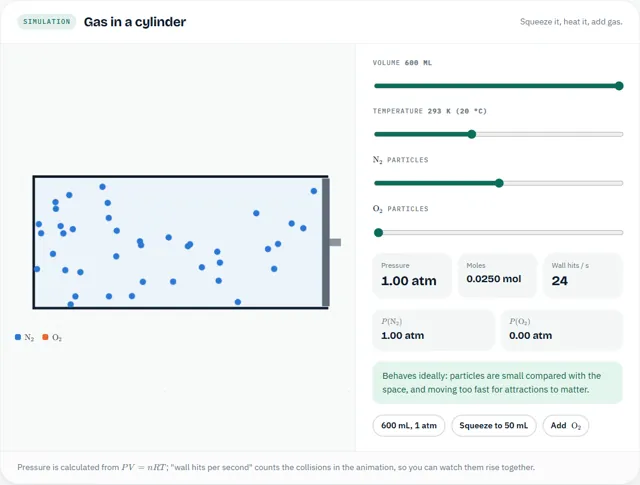
A car engine squeezes 600 mL of air at 1.0 atm down to 50 mL, at constant temperature. New pressure?
- Same gas (), same , so is constant: .
- : one-twelfth the volume, twelve times the pressure. Try it above.
in a rigid 7.0 L cylinder is at 2.1 atm and 10 °C. It is heated to 40 °C. New pressure?
- Rigid: is fixed, and is fixed. So : .
- Convert to kelvin: , .
- . (Using °C would wrongly give 8.4 atm.)
Mixtures: add the partial pressures.
Each gas in a mixture pushes as if it were alone. Its share is set by its mole fraction.
?Two rigid 5 L containers at the same temperature: at 0.8 atm and at 1.0 atm. All the is moved into the container. Total pressure?Think, then tap to check
Real gases misbehave when squeezed or cold.
High pressure: particles are crowded, so their own volume matters. Low temperature: they move slowly, so attractions pull on them. Big particles deviate more.
Kinetic molecular theory.
Gas particles are in continuous, random motion: different speeds, different directions. Temperature measures their average kinetic energy, .
Maxwell–Boltzmann distribution
Study notes
Key concepts
What KMT does (SAP-7.B.1). The kinetic molecular theory explains the macroscopic properties of gases (P, V, T) in terms of the motion of the particles. It is the particulate "why" behind the ideal gas law.
Postulates of KMT for an ideal gas:
-
Gas particles are in constant, random, straight-line motion.
-
The volume of the particles themselves is negligible compared with the volume of the container (the particles are tiny compared with the distances between them).
-
Gas particles neither attract nor repel each other (no IMFs).
-
Collisions between particles and with the walls are elastic: the total kinetic energy is conserved, although energy can be transferred between particles in a collision.
-
The average kinetic energy of the particles is directly proportional to the Kelvin temperature. All gases at the same temperature have the same average kinetic energy.
Kinetic energy and speed (SAP-7.B.2, SAP-7.B.3). All particles in a sample of matter are in continuous, random motion. For one particle:
The Kelvin temperature is proportional to the average kinetic energy of the particles. Consequences:
-
Doubling the Kelvin temperature doubles the average KE. Doubling the Celsius temperature does not.
-
At the same temperature, all gases have the same average KE. Because KE = ½mv², particles with a smaller mass must move faster on average. At 25 °C, the average speed of H₂ molecules is about 4 times that of O₂ molecules.
-
Average speed is proportional to the square root of T: doubling T (in K) multiplies the average speed by √2 ≈ 1.41.
-
At absolute zero (0 K) particle motion would be at its minimum; no substance can be cooled below 0 K.
A useful extension (not on the AP equation sheet, but consistent with it) is the root-mean-square speed:
At 25 °C: N₂ about 515 m/s, O₂ about 482 m/s, CO₂ about 411 m/s, H₂ about 1920 m/s.
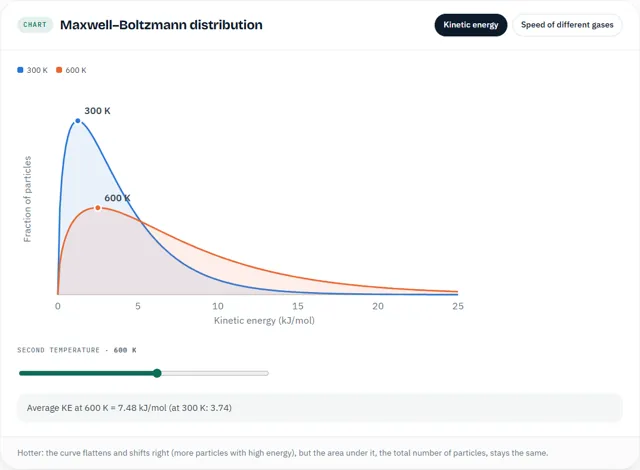
The Maxwell–Boltzmann distribution (SAP-7.B.1, SAP-7.B.4). Not all particles in a sample move at the same speed. Collisions constantly change individual speeds. The Maxwell–Boltzmann distribution is a graph of the number (or fraction) of particles (y-axis) against their speed or kinetic energy (x-axis).
-
The curve starts at zero (no particles are perfectly stationary), rises to a peak (the most probable speed), and then has a long tail to the right (a few very fast particles). It is not symmetric.
-
The area under the curve represents the total number of particles. For the same sample at two temperatures, the areas must be equal.
-
Higher temperature: the peak shifts to the right (higher speed/energy) and becomes lower, and the curve becomes broader and flatter. A larger fraction of particles has high energy.
-
Same temperature, different gases (speed axis): the lighter gas has its peak at a higher speed and a broader, flatter curve; the heavier gas has a tall, narrow peak at low speed.
-
Same temperature, different gases (kinetic energy axis): the curves are identical, because the KE distribution depends only on T.
-
The fraction of particles with energy above a threshold value (the area under the curve to the right of that value) grows sharply with temperature. This explains why evaporation and vapor pressure increase with temperature (3.3) and why reaction rates increase with temperature (Unit 5). A catalyst does not change the curve; it lowers the threshold (activation energy).
Describing Maxwell–Boltzmann curves in words
| Curve | Peak position | Peak height | Width |
|---|---|---|---|
| O₂ at 300 K | about 395 m/s | tall | narrow |
| O₂ at 600 K | about 560 m/s (×√2) | lower | broader |
| H₂ at 300 K | about 1580 m/s (×4 vs O₂) | lowest | broadest |
(Most probable speed = √(2RT/M); the numbers are for illustration.)
Explaining gas laws with KMT (the exam wants these sentences).
-
Pressure is caused by gas particles colliding with the container walls. P increases if collisions are more frequent or more forceful.
-
Heating a gas at constant volume (Gay-Lussac): the particles' average KE and speed increase, so (1) they collide with the walls more often and (2) each collision transfers more force (greater momentum change). Both raise the pressure. Two reasons are often asked for (2011 FRQ Q6(b), 2019 FRQ Q4(c)).
-
Compressing a gas at constant T (Boyle): the same particles in a smaller volume hit the walls more often; average KE is unchanged.
-
Adding gas at constant V and T: more particles → more collisions per second → higher P.
-
Cooling a gas at constant P (Charles): slower particles hit the walls less often and with less force, so to keep the pressure equal to the outside pressure the volume decreases until the collision rate per unit area balances (2021 FRQ Q7(c)).
Diffusion and effusion. Diffusion is the spreading of one gas through another. Effusion is the escape of gas particles through a tiny hole into a vacuum. At the same temperature, lighter particles move faster, so they diffuse and effuse faster. Graham's law:
Worked examples
Worked example 1. A sample of an ideal gas is cooled from 400. K to 200. K. What happens to the average kinetic energy and to the average speed of the molecules?
Solution. Average KE ∝ T, so the average KE is halved. Speed ∝ √T, so the average speed decreases by a factor of √2 (to 0.707 of its original value).
Worked example 2 (Graham's law). An unknown gas effuses through a pinhole at 0.378 times the rate of helium at the same temperature. Find its molar mass and suggest an identity.
Solution. rate(unknown)/rate(He) = √(MHe/Munknown) → 0.378 = √(4.003/M) → M = 4.003 ÷ 0.378² = 28.0 g/mol. N₂ (or CO) fits.
Worked example 3 (modelled on 1999 released MC Q64). Equal numbers of moles of He, Ne and Ar are placed in a container that has a pinhole leak. After some gas has effused, rank the partial pressures of the remaining gases.
Solution. He atoms are lightest and fastest, so He escapes fastest and Ar slowest. The remaining gas is richest in Ar: P(He) < P(Ne) < P(Ar).
Unit 3 study guide: exam-style free-response set, worksheet and answers.
Worked example
- Same temperature, so the same average kinetic energy.
- Since , the ratio is .
- Answer: Equal average kinetic energies; helium atoms move about 3.16 times faster on average.
Free-response practice
Write your answer first, then open the solution and mark yourself against it.
Free-response 1 (modelled on 2019 AP FRQ Q4(a)–(c) and 2011 FRQ Q6(b)). A sample of N₂(g) is in a rigid, sealed container at 300. K and 0.900 atm. It is heated to 600. K.
(a) Describe the effect of heating on the motion of the N₂ molecules.
(b) Calculate the pressure at 600. K.
(c) Using kinetic molecular theory, give TWO reasons why the pressure increases.
(d) Describe how the Maxwell–Boltzmann speed distribution at 600. K differs from the one at 300. K.
(e) A sample of He at 600. K is added to a separate identical container. Compare the average kinetic energy and the average speed of He atoms with those of N₂ molecules at 600. K.
Show the solution
(a) The average kinetic energy of the molecules doubles, so they move faster on average (average speed increases by a factor of √2). (1 point)
(b) P₂ = P₁ × T₂/T₁ = 0.900 × 600./300. = 1.80 atm. (1 point)
(c) (1) Faster molecules collide with the walls more frequently. (2) Each collision is more forceful (greater change in momentum), because the molecules are moving faster. (1 point for both reasons)
(d) The 600 K curve has its peak at a higher speed, is lower in height and broader, and has a larger fraction of molecules at high speeds; the area under both curves is the same. (1 point)
(e) Same average kinetic energy, because both are at 600 K. He atoms (4.0 g/mol) have a greater average speed than N₂ (28.0 g/mol), because with equal KE = ½mv², the smaller mass must have the larger speed (by a factor of √(28.0/4.0) ≈ 2.6). (1 point)
Common mistake
Students say heavier gas particles have more kinetic energy at the same temperature. Average kinetic energy is the same for all gases at a given temperature; heavier particles simply move more slowly.
Frequently asked questions
?What does a Maxwell-Boltzmann distribution show?
It shows the fraction of particles at each speed; the peak is the most probable speed, and raising the temperature flattens the curve and shifts it to higher speeds.
?Does temperature measure the speed of particles?
Temperature is proportional to the average kinetic energy of the particles, which depends on both mass and speed.
Practice questions on 3.5
- Q1Samples of He and Ar are at the same temperature. Which statement is correct?
- Q2If the average kinetic energy of the particles in a gas sample is doubled, which of the following has also doubled?
- Q3Samples of H₂, N₂ and NH₃ are all at 25 °C. Which statement is correct?
- Q4Which list ranks the gases in order of increasing average molecular speed at 25 °C?
- Q5A Maxwell–Boltzmann speed distribution is drawn for a sample of N₂ at 300 K. The same sample is then heated to 500 K. Compared with the 300 K curve, the 500 K curve
- Q6At 0 °C and 1 atm, which gas has the greatest rate of effusion through a pinhole?
- Q7O₂ effuses twice as fast as an unknown gas under the same conditions. What is the molar mass of the unknown gas?
- Q8Which statement is NOT a postulate of the kinetic molecular theory for an ideal gas?
- Q9If the Kelvin temperature of a gas triples, what happens to its average kinetic energy?
- Q10When a gas is heated, its Maxwell–Boltzmann curve shifts to the right. This shows that:
- Q11An ideal gas is heated from 150 K to 600 K. What happens to the average kinetic energy (KE) and the average speed ()?
- Q12Four speed-distribution curves for the same gas are compared. Which feature marks the highest temperature?
- Q13Warm water holds less dissolved than cold water. Why?
- Q14He, Ne and Ar are all at 300 K. Which statement is correct?
- Q15At which temperature do the particles of an ideal gas have the lowest average kinetic energy?
Terms used in this topic
Stuck on a unit? Let us fix it this week.
Book a 30-minute one-to-one session for $20. Bring a test, a homework set or the topic that is not clicking.
Book a session