 AP Chemistry Tutoring
3.6 Deviation from ideal gas law
AP Chemistry Unit 3: Properties of Substances and Mixtures · 2 simulations · 13 practice questions
Updated · Aligned to the AP Chemistry Course and Exam Description
Real gases deviate from because real particles attract one another and occupy volume. Deviations are largest at high pressure and low temperature, when particles are close together and moving slowly. Attractions make the measured pressure lower than the ideal value, while particle volume makes the real volume larger, so gases with strong intermolecular forces or large particles deviate most.
Gases
The ideal gas.
Imagine gas particles that take up no space and never attract or repel each other. Real gases come close at ordinary conditions, and all of them obey one equation.
. .
What is pressure?
Particles colliding with the walls. More particles in the same space means more collisions per second, so more pressure. Heating does two things: particles hit more often and harder.
Gas in a cylinder
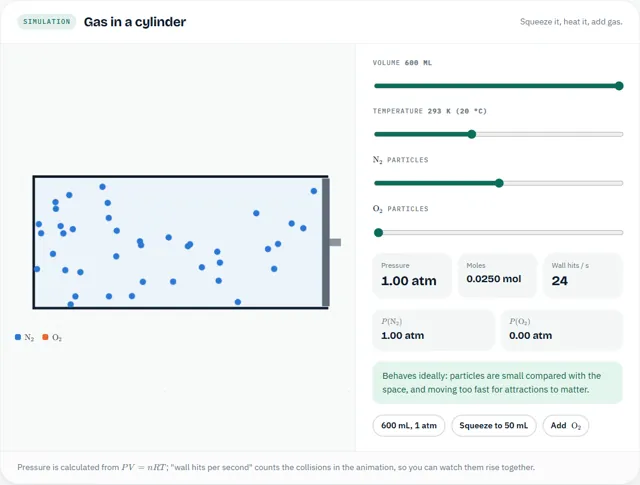
A car engine squeezes 600 mL of air at 1.0 atm down to 50 mL, at constant temperature. New pressure?
- Same gas (), same , so is constant: .
- : one-twelfth the volume, twelve times the pressure. Try it above.
in a rigid 7.0 L cylinder is at 2.1 atm and 10 °C. It is heated to 40 °C. New pressure?
- Rigid: is fixed, and is fixed. So : .
- Convert to kelvin: , .
- . (Using °C would wrongly give 8.4 atm.)
Mixtures: add the partial pressures.
Each gas in a mixture pushes as if it were alone. Its share is set by its mole fraction.
?Two rigid 5 L containers at the same temperature: at 0.8 atm and at 1.0 atm. All the is moved into the container. Total pressure?Think, then tap to check
Real gases misbehave when squeezed or cold.
High pressure: particles are crowded, so their own volume matters. Low temperature: they move slowly, so attractions pull on them. Big particles deviate more.
Kinetic molecular theory.
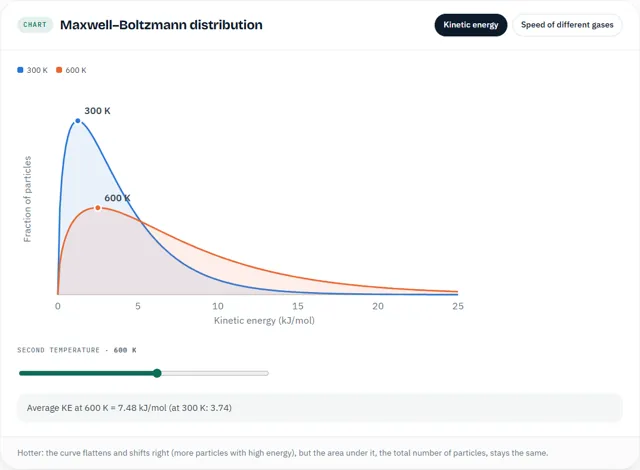
Gas particles are in continuous, random motion: different speeds, different directions. Temperature measures their average kinetic energy, .
Maxwell–Boltzmann distribution
Study notes
Key concepts
Real gases are not ideal (SAP-7.C.1). The ideal gas law assumes that gas particles have no volume and no attractions. Real particles have both. Most gases behave almost ideally at ordinary conditions (room temperature, about 1 atm), but deviations become large under two kinds of conditions.
1. Attractions between particles: important near condensation (low T, or high P).
-
When particles move slowly (low temperature) or are close together (high pressure), IMFs between them matter.
-
A particle about to hit the wall is pulled back slightly by its neighbours, so it hits the wall less often and with less force. Some particles also stick together briefly.
-
Result: the measured pressure is lower than the ideal value (and at constant pressure, the measured volume is smaller than the ideal value). PV/nRT is less than 1.
-
Gases with stronger IMFs deviate more: polar molecules (SO₂, NH₃, H₂O, HCl), and large molecules with many electrons. Gases with very weak IMFs (He, H₂, Ne) deviate least.
-
The extreme case is condensation: if a real gas is cooled to its boiling point, the attractions win and it becomes a liquid, so its volume is far smaller than PV = nRT predicts (2021 FRQ Q7(d): O₂ at −180 °C, just above its boiling point of −183 °C).
2. Volume of the particles: important at extremely high pressure.
-
At very high pressure, the particles fill a significant fraction of the container. The free space in which the particles can move is less than the container volume.
-
Result: the measured volume is larger than the ideal value (or, at fixed volume, the pressure is higher). PV/nRT is greater than 1.
-
Larger particles cause a larger effect.
Conditions for ideal behaviour. Gases behave most ideally at high temperature and low pressure: particles are fast (attractions are unimportant compared with their kinetic energy) and far apart (their volume is negligible and they rarely interact). The most ideal real gas is a small, nonpolar particle with few electrons (He).
Summary
| Cause | Conditions where it matters | Effect on measured P (fixed V) | Effect on measured V (fixed P) | PV/nRT |
|---|---|---|---|---|
| Intermolecular attractions | low T, moderately high P, strong IMFs | lower than ideal | smaller than ideal | less than 1 |
| Particle volume | very high P, large particles | higher than ideal | larger than ideal | greater than 1 |
Graph of PV/nRT vs. P (described). For an ideal gas this is a horizontal line at 1. For a real gas such as CH₄ or CO₂ at room temperature, the curve first dips below 1 as P increases (attractions dominate), reaches a minimum, and then rises above 1 at very high pressures (particle volume dominates). For H₂ and He, the dip is tiny or absent and the curve rises above 1 almost at once. At higher temperatures the dip becomes smaller.
Extension: the van der Waals equation. This is not on the AP exam, but it shows both corrections clearly. The term an²/V² corrects for attractions (a is larger for gases with stronger IMFs) and nb corrects for particle volume (b is larger for larger particles).
Example: 1.00 mol CO₂ in 0.500 L at 300. K. Ideal: P = nRT/V = 49.2 atm. Van der Waals (a = 3.59 L²·atm/mol², b = 0.0427 L/mol): P = 39.5 atm. The real pressure is about 20% lower, because attractions dominate at this temperature.
Exam-language tip. When asked "why is the measured pressure less than the ideal gas law predicts?", the answer must mention attractive forces between the gas particles (and, if possible, name them, e.g., LDFs and dipole–dipole forces between SO₂ molecules) and say that these attractions reduce the frequency and/or force of collisions with the walls. Do NOT say "the particles have volume" for a pressure that is lower than ideal; particle volume makes P higher than ideal. Do not blame "experimental error" when the question says the equipment works properly.
Worked examples
Worked example (modelled on 2021 AP FRQ Q7(d)). A cylinder with a movable piston holds 0.325 mol O₂ at 1.00 atm. At 25 °C the volume is 7.95 L. When the cylinder is cooled to −180 °C, the measured volume is much smaller than the volume calculated with the ideal gas law. The boiling point of O₂ is −183 °C. Calculate the ideal volume at −180 °C and explain why the measured volume is smaller.
Solution. V(ideal) = nRT/P = (0.325)(0.08206)(93.15) ÷ 1.00 = 2.48 L. At −180 °C, just 3 degrees above the boiling point, the O₂ molecules move slowly, and the London dispersion forces between them are no longer negligible compared with their kinetic energy. The attractions pull molecules together, reducing the number and force of collisions with the piston, so the gas occupies less volume than an ideal gas would (some O₂ may even begin to condense).
Unit 3 study guide: exam-style free-response set, worksheet and answers.
Worked example
- is small and has only weak dispersion forces.
- is polar and forms hydrogen bonds, so attractions between molecules are much stronger and pull the measured pressure further below the ideal value.
- Answer: deviates more.
Free-response practice
Write your answer first, then open the solution and mark yourself against it.
Free-response 1 (modelled on 2019 AP FRQ Q4(d)). A student fills a rigid 1.00 L container with 0.500 mol of SO₂(g) at 300. K.
(a) Calculate the pressure predicted by the ideal gas law.
(b) The measured pressure is 11.0 atm. Is this greater or less than the ideal pressure? Explain the difference at the particulate level.
(c) The student repeats the experiment with 0.500 mol of He in the same container at the same temperature. Predict whether the difference between measured and ideal pressure will be larger or smaller than for SO₂. Justify.
(d) Suggest one change in conditions that would make the SO₂ behave more ideally. Explain.
Show the solution
(a) P = nRT/V = (0.500)(0.08206)(300.) ÷ 1.00 = 12.3 atm. (1 point)
(b) Less than ideal (11.0 < 12.3 atm). SO₂ molecules are polar and have many electrons, so they attract each other through dipole–dipole forces and London dispersion forces. These attractions pull molecules slightly toward each other as they approach the wall, so they strike the walls less often and with less force, lowering the pressure. (1 point)
(c) Smaller. He atoms are small, nonpolar and have only 2 electrons, so their LDFs are extremely weak, and He behaves almost ideally. (1 point)
(d) Raise the temperature (or use a larger container to lower the pressure). At higher temperature the molecules' kinetic energy is much larger than the energy of attraction, so the attractions have less effect on collisions; at lower pressure the molecules are farther apart and interact less. (1 point)
Common mistake
Students say real gases deviate most at high temperature. High temperature makes particles move fast enough that attractions matter little; deviations are greatest at low temperature and high pressure.
Frequently asked questions
?Why is the pressure of a real gas lower than predicted?
Attractions between particles pull them slightly away from the walls, so they hit the walls less often and with less force.
?When does a real gas behave most like an ideal gas?
At low pressure and high temperature, when particles are far apart and moving fast enough that attractions and particle volume are negligible.
Practice questions on 3.6
- Q1Under which conditions does a real gas deviate most from ideal behavior?
- Q2Which gas deviates most from ideal behaviour at the same temperature and pressure?
- Q3Under which conditions does a real gas behave most like an ideal gas?
- Q4The measured pressure of a sample of NH₃(g) at 250 K is lower than the value calculated from PV = nRT. Which statement best explains this?
- Q51-Hexanol (C₆H₁₃OH) and 3-hexanone (C₆H₁₂O) have similar molar masses. Which statement correctly compares their vapors at the same T and P?
- Q6At extremely high pressure (for example 500 atm), the measured volume of a sample of N₂ is greater than the ideal gas law predicts. The best explanation is that
- Q7A real gas exerts a lower pressure than the ideal gas law predicts. Why?
- Q8Which statement about real gases is true?
- Q9Which gas deviates most from ideal behavior?
- Q101-Butanol and diethyl ether have the same formula, . Which deviates more from ideal behavior as a gas, and why?
- Q11Which gas deviates most from ideal behavior?
- Q12Which gas sample behaves most ideally?
- Q13For a fixed amount of ideal gas, a graph of against is:
Terms used in this topic
Stuck on a unit? Let us fix it this week.
Book a 30-minute one-to-one session for $20. Bring a test, a homework set or the topic that is not clicking.
Book a session