 AP Chemistry Tutoring
3.7 Solutions and mixtures
AP Chemistry Unit 3: Properties of Substances and Mixtures · 2 simulations · 16 practice questions
Updated · Aligned to the AP Chemistry Course and Exam Description
A solution is a homogeneous mixture in which a solute is dispersed uniformly in a solvent at the particle level. Its concentration is most often expressed as molarity, , and diluting a solution follows because the moles of solute stay constant. Heterogeneous mixtures, by contrast, have visibly different regions.
Solutions
A solution is a homogeneous mixture.
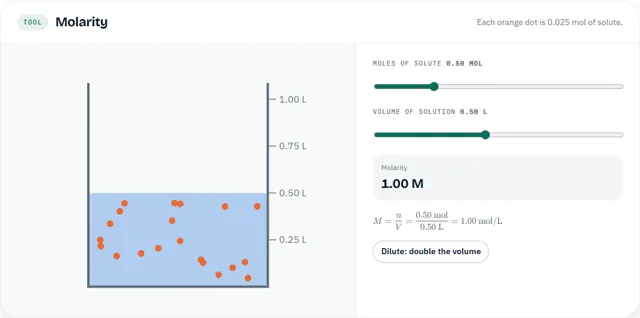
The solute is spread evenly through the solvent. Concentration in AP Chemistry is usually molarity: moles of solute per liter of solution.
Like dissolves like.
Substances mix when their IMFs are similar. Oil (LDFs) won't mix with water (hydrogen bonds). dissolves because ion–dipole forces with water beat the lattice.
Counting ions: 1 M gives 1 M and 2 M .
Molarity
Paper chromatography
Study notes
Key concepts
Solutions vs. heterogeneous mixtures (SPQ-3.A.1).
-
A solution (homogeneous mixture) has the same composition and properties throughout. Solutions can be gases (air), liquids (salt water, vodka) or solids (brass, steel).
-
In a heterogeneous mixture the macroscopic properties depend on where in the sample you look (oil and water layers, sand in water, a suspension of AgCl in water).
-
Solvent: the component present in the larger amount (usually the liquid). Solute: the component(s) dissolved in it.
-
Particles in a true solution are individual ions or molecules; they pass through filter paper and do not settle. So filtration cannot separate a solution (see 3.9).
Molarity (SPQ-3.A.2). The most common laboratory concentration unit:
-
It is moles per liter of solution, not per liter of solvent. A 1.00 M solution is made by dissolving 1.00 mol of solute and then adding water until the total volume is 1.00 L, not by adding 1.00 mol to 1.00 L of water.
-
Rearranged: n = M × V and V = n/M. Always convert mL to L.
-
Number of solute particles = moles × 6.022 × 10²³.
-
Molarity changes slightly with temperature because volume changes with temperature.
Ion concentrations. Soluble ionic compounds dissociate completely. For Al₂(SO₄)₃ at 0.150 M: [Al³⁺] = 2 × 0.150 = 0.300 M and [SO₄²⁻] = 3 × 0.150 = 0.450 M. The total concentration of ions is 0.750 M. More ions per formula unit means higher electrical conductivity at the same molarity.
Dilution. Adding solvent does not change the moles of solute:
V₂ is the final total volume, not the volume of water added.
Preparing a solution of known molarity from a solid. (1) Calculate the mass needed: mass = M × V × molar mass. (2) Weigh it on an analytical balance. (3) Transfer it to a volumetric flask of the required volume. (4) Add some distilled water and swirl to dissolve. (5) Add water up to the calibration mark (bottom of the meniscus at the line). (6) Stopper and invert to mix.
Preparing a dilution (2021 FRQ Q3(e) style). (1) Calculate V₁ = M₂V₂/M₁. (2) Measure V₁ of the stock solution with a volumetric pipet or buret (not a beaker or graduated cylinder, if accuracy matters). (3) Transfer it to a volumetric flask of volume V₂. (4) Add distilled water to the mark. (5) Stopper and invert to mix.
Mixing two solutions. Add the moles of each ion and divide by the total volume (assume volumes are additive).
Other composition units. Textbooks also cover mass percent and mole fraction. The CED states that calculations of molality, percent by mass and percent by volume will NOT be assessed on the AP exam. Mole fraction (used with gases, 3.4) is still useful.
Experimental determination of concentration. You can find the concentration of a dissolved, nonvolatile solid by evaporating a measured volume of solution to dryness and weighing the residue (moles of solid ÷ liters of solution). Other methods are titration (Unit 4), gravimetric precipitation (Unit 4) and spectrophotometry (3.13).
Worked examples
Worked example 1. 5.85 g of NaCl is dissolved in enough water to make 250.0 mL of solution. Find the molarity.
Solution. n = 5.85 ÷ 58.44 = 0.1001 mol. M = 0.1001 mol ÷ 0.2500 L = 0.400 M.
Worked example 2. What mass of K₂Cr₂O₇ (294.18 g/mol) is needed to make 500.0 mL of 0.0250 M solution?
Solution. n = 0.0250 mol/L × 0.5000 L = 0.01250 mol. Mass = 0.01250 × 294.18 = 3.68 g.
Worked example 3 (modelled on 1999 released MC Q73). What volume of distilled water must be added to 15.0 mL of 6.00 M HCl to make 0.750 M HCl?
Solution. V₂ = M₁V₁/M₂ = (6.00)(15.0)/0.750 = 120. mL total. Water added = 120. − 15.0 = 105 mL.
Worked example 4 (modelled on 1999 released MC Q59). 30.0 mL of 0.20 M NaOH is mixed with 70.0 mL of 0.10 M Ba(OH)₂. What is [OH⁻] in the mixture?
Solution. Moles OH⁻ = (0.0300)(0.20) + (0.0700)(0.10)(2) = 0.0060 + 0.0140 = 0.0200 mol. Total volume = 0.100 L. [OH⁻] = 0.0200 ÷ 0.100 = 0.20 M.
Unit 3 study guide: exam-style free-response set, worksheet and answers.
Worked example
- Moles: .
- Volume: .
- Molarity: .
- Answer:
Free-response practice
Write your answer first, then open the solution and mark yourself against it.
Free-response 1 (modelled on 2021 AP FRQ Q3(d)–(e)). A student has a stock solution of 0.250 M CoCl₂(aq) and needs 100.00 mL of 0.0400 M CoCl₂(aq) for a spectrophotometry experiment.
(a) Calculate the volume of stock solution needed.
(b) Describe the procedure, naming the glassware, for making the 0.0400 M solution.
(c) Calculate the molar concentration of Cl⁻ ions in the 0.0400 M solution.
(d) A second student checks the concentration of a different NaCl solution by evaporating 25.00 mL of it to dryness. The dry residue has a mass of 0.877 g. Calculate the molarity of the NaCl solution.
Show the solution
(a) V₁ = M₂V₂/M₁ = (0.0400)(100.00 mL)/0.250 = 16.0 mL. (1 point)
(b) Use a 10 mL plus a 5 mL volumetric pipet and a 1 mL graduated pipet, or a buret, to deliver exactly 16.0 mL of the 0.250 M stock into a 100.00 mL volumetric flask. Add distilled water until the bottom of the meniscus reaches the calibration mark. Stopper and invert several times to mix. (1 point; must include accurate volume measurement AND a volumetric flask filled to the mark)
(c) CoCl₂ → Co²⁺ + 2 Cl⁻, so [Cl⁻] = 2 × 0.0400 = 0.0800 M. (1 point)
(d) n(NaCl) = 0.877 ÷ 58.44 = 0.01501 mol. M = 0.01501 ÷ 0.02500 L = 0.600 M. (1 point)
Common mistake
Students divide by the volume of solvent instead of the volume of solution. Molarity uses the total volume of the final solution, which is why the solute is dissolved and then diluted to the mark in a volumetric flask.
Frequently asked questions
?Is a solution a homogeneous or a heterogeneous mixture?
A solution is a homogeneous mixture: its composition is uniform throughout, down to the particle level.
?How do you dilute a solution to a lower molarity?
Use to find the volume of stock solution needed, then add solvent until the final volume is reached.
Practice questions on 3.7
- Q1What volume of 6.0 M HCl is needed to prepare 250. mL of 0.30 M HCl?
- Q2Which of the following is a heterogeneous mixture?
- Q3What volume of solution contains 2.0 mol of NaCl if its concentration is 0.50 M?
- Q4How many moles of solute are present in 0.20 L of a 0.40 M solution?
- Q5150. mL of 0.80 M MgCl₂(aq) is added to 450. mL of distilled water. What is [Mg²⁺] in the resulting solution?
- Q6Which 0.10 M aqueous solution has the greatest total concentration of ions?
- Q7A student needs 250.0 mL of 0.200 M KNO₃ (101.1 g/mol). Which procedure is best?
- Q8How many ions in total are present in 50.0 mL of 0.10 M CaCl₂?
- Q9Which combination forms a heterogeneous mixture?
- Q10What volume of solution is needed to make a 0.75 M solution from 3.0 mol of KCl?
- Q11How many moles of solute are in 1.5 L of a 2.0 M solution?
- Q12What is the molarity of a solution containing 6.0 mol of solute in 1.5 L?
- Q13Which of these is a solution?
- Q14Which kind of matter has a composition that varies from one region to another?
- Q15How many moles of solute are in 0.250 L of a 0.60 M solution?
- Q16What is the simplest way to find the concentration of a dissolved ionic solid?
Stuck on a unit? Let us fix it this week.
Book a 30-minute one-to-one session for $20. Bring a test, a homework set or the topic that is not clicking.
Book a session