 AP Chemistry Tutoring
3.8 Representations of solutions
AP Chemistry Unit 3: Properties of Substances and Mixtures · 2 simulations · 10 practice questions
Updated · Aligned to the AP Chemistry Course and Exam Description
Particle diagrams represent solutions by showing solute particles evenly dispersed among solvent molecules in the correct ratio. For ionic solutes, dissolved ions are drawn separately and surrounded by water molecules oriented by ion-dipole forces: the partially negative oxygen points toward cations and the partially positive hydrogens point toward anions. For , the diagram shows two ions for every ion.
Solutions
A solution is a homogeneous mixture.
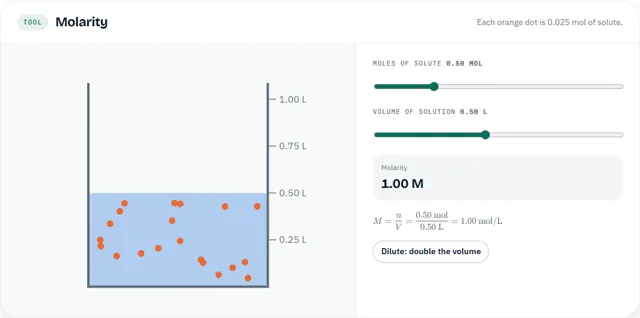
The solute is spread evenly through the solvent. Concentration in AP Chemistry is usually molarity: moles of solute per liter of solution.
Like dissolves like.
Substances mix when their IMFs are similar. Oil (LDFs) won't mix with water (hydrogen bonds). dissolves because ion–dipole forces with water beat the lattice.
Counting ions: 1 M gives 1 M and 2 M .
Molarity
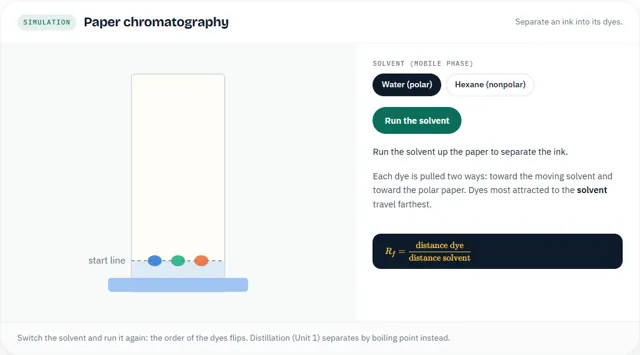
Paper chromatography
Study notes
Key concepts
What a particulate representation of a solution must show (SPQ-3.B.1). Particulate diagrams communicate two things: (1) the relative amounts (concentrations) of the components, and (2) the interactions between the components. The AP exam regularly asks you to draw, choose or criticize such diagrams.
Rules for drawing a correct solution diagram
-
Correct ratio of particles. Dissolved ionic compounds appear as separate ions in the formula ratio. CaCl₂(aq): one Ca²⁺ for every two Cl⁻. Na₂SO₄(aq): two Na⁺ for every SO₄²⁻, and the SO₄²⁻ stays together as one polyatomic ion (never draw S and O atoms separately).
-
Charges balance across the whole drawing (the solution is electrically neutral).
-
Concentration is shown by particles per volume. If beaker X is twice as concentrated as beaker Y, it should have twice as many solute particles in the same volume. Diluting a solution: the same number of solute particles drawn in a larger volume.
-
Molecular solutes stay as intact molecules (sugar, ethanol, urea, I₂). Only strong acids and soluble ionic compounds are drawn fully as ions. Weak acids such as CH₃COOH are drawn as mostly intact molecules with only a few H₃O⁺ and CH₃COO⁻ ions (Unit 8).
-
Orientation of water molecules (ion–dipole). Around a cation, water molecules point their δ− oxygen atoms toward the ion. Around an anion, water molecules point their δ+ hydrogen atoms toward the ion. Drawing H atoms pointing at a cation is a common error and loses credit.
-
Hydrogen bonds between solute and water are dashed lines from an H on N/O/F to a lone pair on N/O/F of the partner (for example, from an H of water to the O of methanal, or from an N–H of urea to the O of water).
-
Undissolved solid at the bottom of a saturated solution is drawn as a closely packed, ordered cluster of ions; the dissolved ions are spread through the liquid.
Examples described in words
| Solution | Correct representation |
|---|---|
| 0.10 M KBr | equal numbers of K⁺ and Br⁻ spread randomly; water O atoms face K⁺, water H atoms face Br⁻ |
| 0.10 M MgCl₂ vs. 0.10 M NaCl, same volume | same number of Mg²⁺ as Na⁺, but twice as many Cl⁻ in the MgCl₂ beaker |
| CH₃OH in water | intact CH₃OH molecules; dashed lines between O–H of methanol and O of water in both directions (methanol can donate and accept) |
| I₂ in hexane | intact I₂ molecules dispersed among hexane molecules; no charges, only LDFs |
| hexane added to water | two separate layers: hexane molecules (top, less dense) and water molecules (bottom); no mixing |
| saturated AgCl(aq) with excess solid | most Ag⁺ and Cl⁻ in a solid cluster at the bottom; only a few separated Ag⁺ and Cl⁻ in solution, in a 1: 1 ratio |
Conductivity link. A solution conducts electricity if it contains mobile ions. A diagram with more ions (per volume) represents a better conductor. A solution of a molecular solute (sugar, ethanol) contains no ions and does not conduct.
Not assessed. The CED states that colligative properties (boiling-point elevation, freezing-point depression, osmotic pressure, vapor-pressure lowering) will not be assessed, and neither will calculations of molality or percent by mass or volume.
Worked examples
Worked example (modelled on 2021 AP FRQ Q6(c)). Two beakers contain saturated solutions with excess solid. Beaker 1 holds CaF₂ (more soluble); a diagram shows 6 Ca²⁺ and 12 F⁻ dissolved. Beaker 2 holds a different metal fluoride, MF₂ (M²⁺ is a 2+ metal ion), whose molar solubility is one-third that of CaF₂ under these conditions. Describe a correct diagram of the dissolved ions in beaker 2 (same volume).
Solution. Draw 2 M²⁺ and 4 F⁻ ions spread through the liquid (one-third as many dissolved formula units as beaker 1, in a 1: 2 ratio of M²⁺ to F⁻), with the remaining MF₂ shown as a packed solid at the bottom. The ratio 1: 2 and the smaller number of dissolved ions are both required.
Unit 3 study guide: exam-style free-response set, worksheet and answers.
Worked example
- dissociates: , so draw twice as many as , not touching each other.
- Around , water molecules point their O atoms inward; around , they point H atoms inward.
- Answer: Separate ions in a 1 : 2 ratio, with O facing and H facing .
Free-response practice
Write your answer first, then open the solution and mark yourself against it.
Free-response 1 (modelled on 2019 AP FRQ Q1(b) and 2013 FRQ Q6(e)). Methanal, H₂CO, is a polar molecule. Its Lewis structure has a C=O double bond with two lone pairs on O, and two C–H bonds.
(a) Describe a particulate drawing that shows one hydrogen bond between a methanal molecule and a water molecule. State which atoms are joined by the dashed line.
(b) Explain why methanal molecules cannot form hydrogen bonds with each other, but can form hydrogen bonds with water.
(c) A 0.10 M aqueous solution of methanal does not conduct electricity, but a 0.10 M solution of NaCl does. Explain using particulate representations.
Show the solution
(a) Draw the water molecule with one of its H atoms pointing toward a lone pair on the O atom of methanal. The dashed line connects the H atom of water to the O atom of methanal, with O–H····O roughly linear. (1 point)
(b) A hydrogen bond needs an H atom covalently bonded to N, O or F (a donor). In methanal, the H atoms are bonded to C, so methanal has no donor and cannot hydrogen-bond to another methanal. Its O atom has lone pairs and can act as an acceptor for the O–H hydrogen of water. (1 point)
(c) Methanal dissolves as intact neutral molecules, so the diagram shows H₂CO molecules among water molecules, with no ions; there are no mobile charged particles to carry current. NaCl dissociates into Na⁺ and Cl⁻ ions, drawn as separate hydrated ions, which move toward the electrodes and carry charge. (1 point)
Common mistake
Students draw dissolved ionic compounds as intact formula units, or draw water with hydrogens pointing toward cations. Ionic solutes dissociate into separate ions, and the negative oxygen end of water faces cations.
Frequently asked questions
?Which end of a water molecule faces a positive ion?
The oxygen end, which carries a partial negative charge, faces the cation.
?Do covalent solutes like sugar break into ions in water?
No. Most molecular solutes dissolve as intact molecules; only acids and some other species ionize.
Practice questions on 3.8
- Q1Which description is a correct particulate representation of MgCl₂ completely dissolved in water?
- Q2In a correct drawing of Na⁺(aq), how should the nearest water molecules be oriented?
- Q3Acetic acid, CH₃COOH, is a weak acid. Which description best represents 0.10 M CH₃COOH(aq) at equilibrium?
- Q4Beaker X shows 8 K⁺ and 8 NO₃⁻ ions in 100 mL. Beaker Y shows 4 K⁺ and 4 NO₃⁻ ions in 25 mL. Which statement is correct?
- Q5Which solution would be the best conductor of electricity, if each beaker has the same volume?
- Q6What is the main species in a 0.1 M solution of the weak acid HF at equilibrium?
- Q7Which 0.10 M solution conducts electricity best?
- Q8In a solution of , what is the ratio of to ions?
- Q9Which condition makes a solution acidic?
- Q10Which interaction occurs between methanol and water?
Terms used in this topic
Stuck on a unit? Let us fix it this week.
Book a 30-minute one-to-one session for $20. Bring a test, a homework set or the topic that is not clicking.
Book a session