 AP Chemistry Tutoring
4.2 Net ionic equations
AP Chemistry Unit 4: Chemical Reactions · 1 simulation · 15 practice questions
Updated · Aligned to the AP Chemistry Course and Exam Description
A net ionic equation shows only the species that actually change during a reaction in aqueous solution. Strong electrolytes (soluble ionic compounds, strong acids and strong bases) are written as separate ions, and spectator ions that appear unchanged on both sides are removed. For example, mixing silver nitrate and sodium chloride gives .
Net ionic equations
Show only what actually reacts.
Soluble ionic compounds and strong acids exist as separate ions in water, so write them that way. Ions that appear unchanged on both sides are spectators: cancel them, like subtracting the same number from both sides of an equation.
Always soluble: , , and salts. Solids, liquids, gases and weak acids stay written whole.
| Molecular | + → + |
| Complete ionic | + |
| Net ionic | + → |
Cross out the spectators
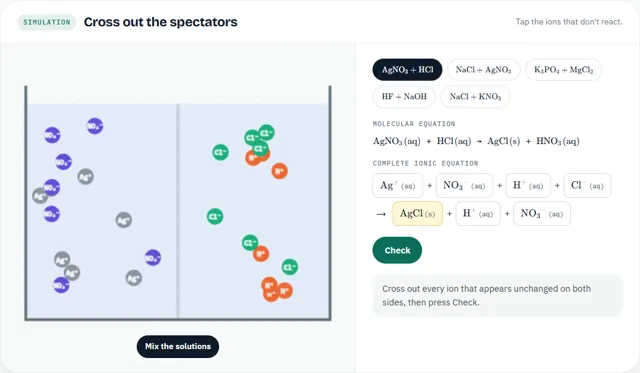
- Balance: .
- Complete ionic:
- and are on both sides: spectators. Cancel them.
Study notes
Key concepts
Every process can be written as a balanced equation (TRA-1.B.1). This includes physical changes. For example, dissolving sodium chloride is NaCl(s) → Na⁺(aq) + Cl⁻(aq), and melting ice is H₂O(s) → H₂O(l).
Conservation of atoms and mass (TRA-1.B.2). In a chemical change atoms are only rearranged. A correct equation has the same number of atoms of each element on both sides. Because each atom keeps its mass, the total mass of reactants equals the total mass of products. When ions appear, the total charge must also be the same on both sides.
Three forms of the same equation (TRA-1.B.3). The slides call these the molecular, ionic and net equations.
| Form | What is written | Example: AgNO₃(aq) + NaCl(aq) |
|---|---|---|
| Molecular (balanced chemical) equation | Every substance as its full formula, with state symbols in brackets | AgNO₃(aq) + NaCl(aq) → AgCl(s) + NaNO₃(aq) |
| Complete ionic equation | Every strong electrolyte that is dissolved is split into its ions | Ag⁺(aq) + NO₃⁻(aq) + Na⁺(aq) + Cl⁻(aq) → AgCl(s) + Na⁺(aq) + NO₃⁻(aq) |
| Net ionic equation | Spectator ions removed; only the species that actually change are shown | Ag⁺(aq) + Cl⁻(aq) → AgCl(s) |
Spectator ions are ions that appear unchanged on both sides of the complete ionic equation. They "watch" the reaction. In the example, Na⁺ and NO₃⁻ are spectators.
Which form to use? The form depends on the purpose. The molecular equation tells you what to weigh out in the lab (you buy AgNO₃, not Ag⁺). The net ionic equation shows the chemistry that really happens. On the AP exam, when a question says "write the net ionic equation", spectator ions must not appear, and the equation must be balanced for atoms and charge.
What to split into ions and what to leave together
| Write as separate ions (aq) | Keep as a whole formula |
|---|---|
| Soluble ionic compounds (salts) in solution | Solids (s), including precipitates and undissolved solids such as Mg(OH)₂(s) |
| Strong acids: HCl, HBr, HI, HNO₃, HClO₄, H₂SO₄ (first proton) | Weak acids: HF, HC₂H₃O₂, HNO₂, H₂CO₃, H₂S, H₃PO₄ and others |
| Strong bases: Group 1 hydroxides (LiOH, NaOH, KOH) and Ca(OH)₂, Sr(OH)₂, Ba(OH)₂ when dissolved | Weak bases such as NH₃ |
| Molecular substances: H₂O(l), gases such as CO₂(g), H₂(g), and molecular solutes such as sugar |
Solubility you must know (TRA-2.A.5). The AP exam only expects you to know that all sodium, potassium, ammonium and nitrate salts are soluble in water. Other solubilities will be given in the question or can be inferred (for example, "a precipitate formed"). The slides ask, "Why is PbI₂ a solid but NaNO₃ aqueous?" Answer: NaNO₃ contains Na⁺ and NO₃⁻, so it is always soluble; PbI₂ is the only other possible product, and since a precipitate is observed, PbI₂ must be the solid.
Step-by-step method for a net ionic equation
-
Write and balance the molecular equation with state symbols.
-
Split every strong electrolyte that is (aq) into its ions. Use coefficients and subscripts correctly: 3 CaCl₂(aq) gives 3Ca²⁺(aq) + 6Cl⁻(aq).
-
Cross out ions that are identical (same formula, same state, same number) on both sides.
-
Reduce coefficients to the lowest whole numbers and check atom and charge balance.
When there is no net ionic equation. If every product is a soluble strong electrolyte, every ion is a spectator, and no reaction occurs. Example: NaNO₃(aq) + KCl(aq) → no reaction. This answers the slide question "Which of the following will not have a net ionic equation?".
Common mistakes
-
Splitting a weak acid: write HC₂H₃O₂(aq), not H⁺ + C₂H₃O₂⁻.
-
Splitting a precipitate or a solid reactant: Mg(OH)₂(s) stays together.
-
Splitting polyatomic ions: NO₃⁻ stays as NO₃⁻, not N and O.
-
Forgetting charge balance: Ag⁺ + Cl⁻ → AgCl is charge-balanced (+1 − 1 = 0); Al + H⁺ → Al³⁺ + H₂ is not.
Worked examples
Worked example 4.2-A. Write the molecular, complete ionic and net ionic equations for the reaction of aqueous lead(II) nitrate with aqueous sodium iodide (slide example).
Solution
Molecular: Pb(NO₃)₂(aq) + 2NaI(aq) → PbI₂(s) + 2NaNO₃(aq). (Note that the slide's version "2PbI" is not correct: lead(II) iodide is PbI₂, and the coefficient 2 belongs on NaI and NaNO₃.)
Complete ionic: Pb²⁺(aq) + 2NO₃⁻(aq) + 2Na⁺(aq) + 2I⁻(aq) → PbI₂(s) + 2Na⁺(aq) + 2NO₃⁻(aq)
Spectators: Na⁺ and NO₃⁻.
Net ionic: Pb²⁺(aq) + 2I⁻(aq) → PbI₂(s). Check: 1 Pb and 2 I on each side; charge +2 − 2 = 0 on the left and 0 on the right.
Worked example 4.2-B. Write the net ionic equation for the reaction of sodium hydrogen carbonate solution with hydrochloric acid. The products are aqueous NaCl, water and carbon dioxide.
Solution
Molecular: NaHCO₃(aq) + HCl(aq) → NaCl(aq) + H₂O(l) + CO₂(g)
Complete ionic: Na⁺(aq) + HCO₃⁻(aq) + H⁺(aq) + Cl⁻(aq) → Na⁺(aq) + Cl⁻(aq) + H₂O(l) + CO₂(g)
Net ionic: HCO₃⁻(aq) + H⁺(aq) → H₂O(l) + CO₂(g). (HCl is a strong acid, so it is split; NaHCO₃ is a sodium salt, so it is soluble and split.)
Worked example 4.2-C. Write the net ionic equation for the reaction of solid magnesium hydroxide (an antacid) with hydrochloric acid.
Solution
Molecular: Mg(OH)₂(s) + 2HCl(aq) → MgCl₂(aq) + 2H₂O(l)
Mg(OH)₂ is a solid, so it is not split. HCl is a strong acid, so it is written as H⁺ and Cl⁻. MgCl₂(aq) is written as ions.
Net ionic: Mg(OH)₂(s) + 2H⁺(aq) → Mg²⁺(aq) + 2H₂O(l). Cl⁻ is the only spectator.
Worked example 4.2-D. Write the net ionic equation for acetic acid reacting with sodium hydroxide solution.
Solution
Acetic acid is weak, so it stays as HC₂H₃O₂(aq). NaOH is a strong base. Na⁺ is a spectator.
Net ionic: HC₂H₃O₂(aq) + OH⁻(aq) → C₂H₃O₂⁻(aq) + H₂O(l)
Unit 4 study guide: exam-style free-response set, worksheet and answers.
Worked example
- Molecular: .
- Complete ionic: .
- Remove spectators and .
- Answer:
Free-response practice
Write your answer first, then open the solution and mark yourself against it.
FRQ 4.2-1. For each of the following, write the balanced net ionic equation. If no reaction occurs, write "no reaction" and explain.
(a) Aqueous barium chloride is mixed with aqueous potassium sulfate; a white precipitate forms.
(b) Aqueous ammonia is added to hydrochloric acid.
(c) Aqueous sodium nitrate is mixed with aqueous ammonium chloride.
(d) Solid copper(II) oxide is added to nitric acid and dissolves to give a blue solution.
Show the solution
(a) Ba²⁺(aq) + SO₄²⁻(aq) → BaSO₄(s). K⁺ and Cl⁻ are spectators (potassium salts are soluble, so the precipitate must be BaSO₄).
(b) NH₃(aq) + H⁺(aq) → NH₄⁺(aq). NH₃ is a weak base and is not split; Cl⁻ is a spectator. Writing H₃O⁺(aq) + NH₃(aq) → NH₄⁺(aq) + H₂O(l) is also correct.
(c) No reaction. Both possible products, NaCl and NH₄NO₃, are soluble, so every ion is a spectator.
(d) CuO(s) + 2H⁺(aq) → Cu²⁺(aq) + H₂O(l). The solid oxide is kept together; NO₃⁻ is a spectator; the blue colour is Cu²⁺(aq).
FRQ 4.2-2. (Modelled on 2014 AP FRQ Q1(a) and (c).) A student dissolves a tablet containing KI in water and adds an excess of Pb(NO₃)₂(aq). A yellow precipitate forms.
(a) Write the net ionic equation for the reaction and explain why a net ionic equation is the best way to represent it.
(b) After the precipitate is filtered off, is [K⁺] in the filtrate greater than, less than, or equal to [NO₃⁻]? Justify your answer.
Show the solution
(a) Pb²⁺(aq) + 2I⁻(aq) → PbI₂(s) (1 point). The net ionic equation shows only the species that change. K⁺ and NO₃⁻ stay dissolved and do not take part, so they are left out (1 point).
(b) Less than (1 point). Each I⁻ came from one KI, so the moles of K⁺ equal the moles of I⁻. Just enough Pb(NO₃)₂ to react with all the I⁻ would bring 2NO₃⁻ for every 2I⁻, so the moles of NO₃⁻ would equal the moles of K⁺. But the Pb(NO₃)₂ was added in excess, so more NO₃⁻ than that was added, and nitrate stays dissolved. Both ions are in the same volume, so [K⁺] < [NO₃⁻] (1 point).
Common mistake
Students split weak acids such as or into ions. Weak acids are mostly un-ionized in solution and must be written as molecules in net ionic equations.
Frequently asked questions
?What is a spectator ion?
An ion that is present in solution but appears unchanged on both sides of the equation, so it does not take part in the reaction.
?Which solubility rules do I need for AP Chemistry?
You are expected to know that all sodium, potassium, ammonium and nitrate salts are soluble in water; other solubility information is given when needed.
Practice questions on 4.2
- Q1What is the net ionic equation when solutions of and NaCl are mixed?
- Q2What is the net ionic equation when and are mixed and precipitates?
- Q3What is the net ionic equation for the reaction between hydrofluoric acid, , and ?
- Q4What is the net ionic equation for the reaction H₂SO₄(aq) + 2NaOH(aq) → Na₂SO₄(aq) + 2H₂O(l)? (Treat H₂SO₄ as fully ionised.)
- Q5Aqueous magnesium nitrate is mixed with aqueous sodium phosphate and a white precipitate forms. Which ions are spectator ions?
- Q6A 0.50 g sample of Mg(s) reacts completely with HCl(aq). Which equation best represents the species that actually react?
- Q7Which is the net ionic equation for the reaction of aqueous H₂S, a weak acid, with solid Ca(OH)₂ to give solid CaS and water?
- Q8Which pair of solutions, when mixed, gives no net ionic equation?
- Q9In the complete ionic equation for 3CaCl₂(aq) + 2Na₃PO₄(aq) → Ca₃(PO₄)₂(s) + 6NaCl(aq), how many chloride ions appear on the left side?
- Q10What is the net ionic equation for ?
- Q11Aqueous and are mixed and a precipitate forms. What are the spectator ions?
- Q12What is the net ionic equation for ?
- Q13In , which is a spectator ion?
- Q14What is the net ionic equation for reacting with excess ?
- Q15What is the net ionic equation for the weak acid HF reacting with aqueous KOH?
Stuck on a unit? Let us fix it this week.
Book a 30-minute one-to-one session for $20. Bring a test, a homework set or the topic that is not clicking.
Book a session