 AP Chemistry Tutoring
4.3 Representations of reactions
AP Chemistry Unit 4: Chemical Reactions · 1 simulation · 13 practice questions
Updated · Aligned to the AP Chemistry Course and Exam Description
Reactions can be represented by balanced equations, particle diagrams and data, and each must show conservation of atoms. A particle diagram of a reaction shows reactant particles before and product particles after, in ratios that match the balanced equation, including any leftover excess reactant. For , every molecule consumes three molecules and forms two molecules.
Net ionic equations
Show only what actually reacts.
Soluble ionic compounds and strong acids exist as separate ions in water, so write them that way. Ions that appear unchanged on both sides are spectators: cancel them, like subtracting the same number from both sides of an equation.
Always soluble: , , and salts. Solids, liquids, gases and weak acids stay written whole.
| Molecular | + → + |
| Complete ionic | + |
| Net ionic | + → |
Cross out the spectators
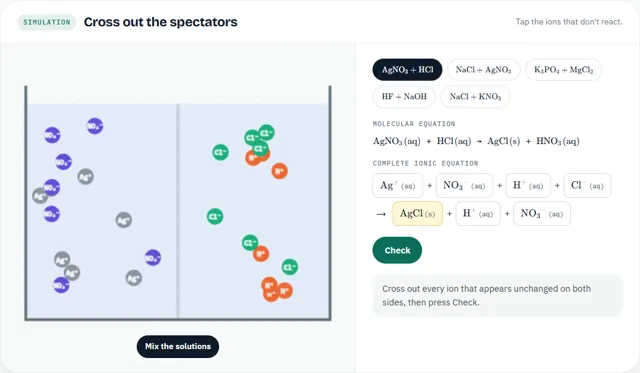
- Balance: .
- Complete ionic:
- and are on both sides: spectators. Cancel them.
Study notes
Key concepts
Equations can be turned into particle pictures (TRA-1.C.1). A particulate diagram (a "box" or "beaker" diagram) shows individual atoms, molecules and ions. A correct diagram must be consistent with the balanced equation:
-
Atoms are conserved. Count each kind of atom before and after. The counts must match.
-
The ratio of particles that react matches the coefficients. For 2H₂ + O₂ → 2H₂O, two H₂ molecules are used for every one O₂ molecule.
-
Leftover reactant must still be shown. If one reactant is in excess, the "after" box contains product particles and the unreacted excess particles. The reactant that is completely used up is the limiting reactant.
-
Show the correct form of each species. Molecular substances are drawn as molecules (bonded atoms touching). Dissolved ionic compounds are drawn as separate ions surrounded by water molecules. A solid precipitate is drawn as a clump or lattice of ions at the bottom of the container. Gases are spread out; liquids are close together but disordered.
-
Ions in solution are surrounded by water molecules that point the correct way. Around a cation (for example Na⁺), the partially negative O ends of water face the ion. Around an anion (for example Cl⁻), the partially positive H ends face the ion.
-
Charge must balance in the picture. In a beaker of CaCl₂(aq) there must be two Cl⁻ for every Ca²⁺.
Physical changes in pictures. For a phase change, the same molecules are present before and after, only their spacing and order change. For example, for Br₂(l) → Br₂(g), the "before" box shows Br₂ molecules close together at the bottom, and the "after" box shows the same number of Br₂ molecules spread throughout the box. No Br–Br bond is broken.
How to read a diagram: a checklist
-
Write a key (for example, white circle = H, black circle = C, grey circle = O).
-
Count each kind of molecule or ion in the "before" box and the "after" box.
-
Subtract to see how many of each reactant were used, and how many of each product formed. Reduce to the lowest ratio: these are the coefficients.
-
Check whether a reactant is left over. If so, it was in excess; the other reactant was limiting.
Worked examples
Worked example 4.3-A. A "before" box contains 5 separate boron atoms and 6 Cl₂ molecules. After reaction, the "after" box contains 4 BCl₃ molecules and some unreacted particles. Write the balanced equation, identify the limiting reactant, and state what else is in the "after" box.
Solution
Balanced equation: 2B + 3Cl₂ → 2BCl₃.
Each BCl₃ needs 1 B and 3 Cl atoms (1.5 Cl₂). Four BCl₃ molecules contain 4 B atoms and 12 Cl atoms (6 Cl₂). So all 6 Cl₂ are used and 4 of the 5 B atoms are used.
Limiting reactant: Cl₂ (all used up). The "after" box contains 4 BCl₃ molecules and 1 unreacted B atom. Check atoms: before, 5 B and 12 Cl; after, 4 + 1 = 5 B and 4 × 3 = 12 Cl.
Worked example 4.3-B. Describe a correct particulate drawing of the contents of a beaker after equal moles of AgNO₃(aq) and NaCl(aq) are mixed. Use 4 formula units of each.
Solution
Net ionic: Ag⁺(aq) + Cl⁻(aq) → AgCl(s). Ag⁺ and Cl⁻ react 1: 1, so all 4 Ag⁺ and all 4 Cl⁻ form 4 AgCl units. The drawing should show: a cluster of 4 Ag⁺ and 4 Cl⁻ ions packed together at the bottom (the solid, alternating positive and negative ions), and, spread through the water, 4 Na⁺ ions and 4 NO₃⁻ ions, each separate from the others. Water molecules near Na⁺ point their O atoms towards it; water molecules near NO₃⁻ point their H atoms towards it.
Unit 4 study guide: exam-style free-response set, worksheet and answers.
Worked example
- 6 can react with , so is limiting.
- Products: 2 react, forming .
- Leftover: ; check atoms: 6 N and 12 H before and after.
- Answer: 4 molecules and 1 unreacted molecule
Free-response practice
Write your answer first, then open the solution and mark yourself against it.
FRQ 4.3-1. A "before" box shows 6 H₂ molecules and 4 O₂ molecules in the gas phase. The mixture is ignited and forms water vapour.
(a) Write the balanced equation.
(b) Describe the "after" box: how many of each kind of molecule are present?
(c) Identify the limiting reactant and justify your answer using particle counts.
(d) Is mass conserved in your picture? Explain using atom counts.
Show the solution
(a) 2H₂(g) + O₂(g) → 2H₂O(g).
(b) 6 H₂O molecules and 1 O₂ molecule. 6 H₂ need 3 O₂, so 3 O₂ are used and 1 O₂ is left.
(c) H₂ is limiting. It is completely used up; 6 H₂ need only 3 of the 4 O₂ molecules.
(d) Yes. Before: 12 H atoms and 8 O atoms. After: 6 × 2 = 12 H atoms; 6 + 2 = 8 O atoms. The same atoms are present, so the mass is the same.
FRQ 4.3-2. (Modelled on 2019 AP FRQ Q3(b).) A student mixes a solution containing 4 formula units of K₂CO₃ with a solution containing 6 formula units of Ca(NO₃)₂ (an excess). A precipitate of CaCO₃ forms. List every ion and solid that should appear in a particulate drawing of the mixture after the reaction, with the number of each.
Show the solution
Before mixing: from 4 K₂CO₃, 8 K⁺ and 4 CO₃²⁻; from 6 Ca(NO₃)₂, 6 Ca²⁺ and 12 NO₃⁻.
Reaction: Ca²⁺ + CO₃²⁻ → CaCO₃(s). All 4 CO₃²⁻ react with 4 Ca²⁺.
After: 4 CaCO₃ units as a solid; dissolved ions 8 K⁺, 2 Ca²⁺ and 12 NO₃⁻. Charge check for the dissolved ions: 8(+1) + 2(+2) = +12 and 12(−1) = −12, so the solution is neutral. No CO₃²⁻ remains in solution.
Common mistake
Students draw products in the same ratio as the reactant molecules shown, ignoring the limiting reactant. Products form only until the limiting reactant runs out, and leftover excess reactant must still appear in the diagram.
Frequently asked questions
?How do you find the limiting reactant from a particle diagram?
Divide the number of each reactant particle by its coefficient; the smallest result identifies the limiting reactant.
?Must a particle diagram show the excess reactant?
Yes. Atoms are conserved, so any unreacted molecules must appear in the after picture.
Practice questions on 4.3
- Q1A vessel contains 4 molecules of CO and 3 molecules of O₂. They react according to 2CO(g) + O₂(g) → 2CO₂(g) as completely as possible. Which best describes the contents of the vessel afterwards?
- Q2A box contains 4 N₂ molecules and 9 H₂ molecules. They react: N₂ + 3H₂ → 2NH₃. What is in the box when the reaction is complete?
- Q3Which particulate description best represents the decomposition of HCl(g) into its elements in their standard states?
- Q4Which description shows the correct orientation of water molecules around a dissolved K⁺ ion?
- Q5Balance this equation with the lowest whole-number coefficients:
- Q6Balance this equation with the lowest whole-number coefficients:
- Q7Balance this equation with the lowest whole-number coefficients:
- Q8A vessel contains 6 molecules and 12 molecules, which react completely by . Which reactant is limiting, and how many molecules form?
- Q9Which equation correctly shows the decomposition of hydrogen peroxide?
- Q10Which equation represents the autoionization of water?
- Q11During the electrolysis of water, which gas forms at the anode?
- Q12When is balanced with lowest whole-number coefficients, what is the sum of the coefficients?
- Q13When is balanced with lowest whole-number coefficients, what is the sum of the coefficients?
Terms used in this topic
Stuck on a unit? Let us fix it this week.
Book a 30-minute one-to-one session for $20. Bring a test, a homework set or the topic that is not clicking.
Book a session