 AP Chemistry Tutoring
4.5 Stoichiometry
AP Chemistry Unit 4: Chemical Reactions · 1 simulation · 25 practice questions
Updated · Aligned to the AP Chemistry Course and Exam Description
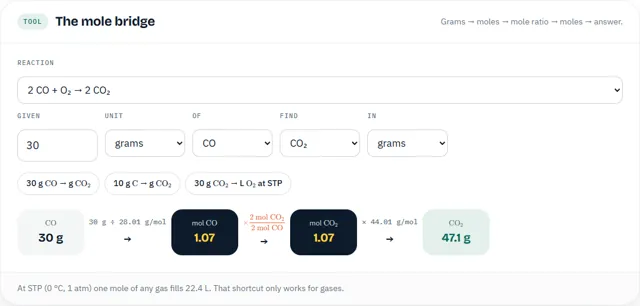
Stoichiometry uses the mole ratios from a balanced equation to relate amounts of reactants and products. The path is mass to moles (divide by molar mass), moles of one substance to moles of another (multiply by the coefficient ratio), then moles back to mass. When amounts of two reactants are given, the limiting reactant, the one that produces less product, determines the theoretical yield, and .
Stoichiometry
Coefficients are mole ratios.
means 2 mol react with 1 mol to make 2 mol (or 6 : 3 : 6, or 10 : 5 : 10).
You can never jump from grams to grams. Always go through moles.
- Carbon: 1 gives 1 .
- Oxygen: with , the left has O atoms and the right has 2. So : .
- No fractions: multiply everything by 2.
The mole bridge
The limiting reactant runs out first.
It decides how much product forms. The other reactant is in excess: some is left over. "Reacts with excess " tells you the other one is limiting.
?50 mL of 1.0 M + 50 mL of 1.0 M gives some . If the is 2.0 M instead, how much forms?Think, then tap to check
The same amount. (still 0.050 mol) is now the limiting reactant, and it limits to 0.050 mol.
? + → + + . 0.010 mol and 0.020 mol make 0.24 L . How do you double the ?Think, then tap to check
Double both reactants. 0.010 : 0.020 is exactly the 1 : 2 ratio, so neither is in excess. Doubling only one leaves the other limiting.
Study notes
Key concepts
Atoms are conserved, so amounts can be predicted (SPQ-4.A.1). Because no atoms are created or destroyed, you can calculate the amount of product from a known amount of reactant, or the amount of reactant needed to make a known amount of product.
Coefficients are mole ratios (SPQ-4.A.2). In 2H₂ + O₂ → 2H₂O, the coefficients mean 2 mol H₂ react with 1 mol O₂ to give 2 mol H₂O. They do not mean 2 g and 1 g. Always convert to moles before using the ratio.
The "mole map". Every stoichiometry problem has the same core:
-
Convert what you are given into moles of that substance (from mass, from gas data, or from solution data).
-
Use the coefficient ratio to get moles of the substance you want.
-
Convert moles into what is asked for (mass, gas volume, solution volume or concentration).
Limiting and excess reactants. When amounts of two reactants are given, the one that runs out first is the limiting reactant. It decides the amount of product. The other is in excess, and some is left over. To find the limiting reactant, either (a) calculate how much product each reactant could make (the smaller answer wins), or (b) divide the moles of each reactant by its coefficient (the smaller number is limiting). Never compare grams directly.
Theoretical, actual and percent yield. The theoretical yield is the amount of product calculated from the limiting reactant. The actual yield is what is really collected. Percent yield compares them.
Combining stoichiometry with gases and solutions (SPQ-4.A.3). Moles of a gas come from the ideal gas law; moles of a solute come from molarity and volume.
Conservation of mass in a closed container. The total mass after a reaction equals the total mass before, including any excess reactant left over.
Key equations
Here n is moles, m is mass in grams, M (first equation) is molar mass in g/mol, P is pressure in atm, V is volume in L, T is temperature in K, and M (molarity) is in mol/L.
Worked examples
Worked example 4.5-A (mass to mass; from the slides). Glucose, C₆H₁₂O₆, reacts with oxygen to give CO₂ and H₂O. What mass of O₂ is needed to react completely with 25.0 g of glucose, and what masses of CO₂ and H₂O form?
Solution
Balanced equation: C₆H₁₂O₆ + 6O₂ → 6CO₂ + 6H₂O.
Molar mass of glucose = 6(12.01) + 12(1.008) + 6(16.00) = 180.16 g/mol.
Moles of glucose = 25.0 g ÷ 180.16 g/mol = 0.1388 mol.
Moles of O₂ = moles of CO₂ = moles of H₂O = 6 × 0.1388 = 0.8326 mol.
Mass of O₂ = 0.8326 × 32.00 = 26.6 g. Mass of CO₂ = 0.8326 × 44.01 = 36.6 g. Mass of H₂O = 0.8326 × 18.02 = 15.0 g.
Check by conservation of mass: 25.0 + 26.6 = 51.6 g of reactants; 36.6 + 15.0 = 51.6 g of products.
Worked example 4.5-B. NO reacts with O₂: 2NO(g) + O₂(g) → 2NO₂(g). What mass of NO₂ forms from 40.0 g of NO and 8.0 g of O₂? What mass of the excess reactant remains?
Solution
Moles of NO = 40.0 ÷ 30.01 = 1.333 mol. Moles of O₂ = 8.0 ÷ 32.00 = 0.250 mol. (The original answer key divided by 16 instead of 32: O₂ has a molar mass of 32.00 g/mol, not 16.)
Divide by coefficients: NO, 1.333 ÷ 2 = 0.667; O₂, 0.250 ÷ 1 = 0.250. O₂ gives the smaller number, so O₂ is limiting.
Moles of NO₂ = 2 × 0.250 = 0.500 mol. Mass of NO₂ = 0.500 × 46.01 = 23.0 g.
NO used = 2 × 0.250 = 0.500 mol. NO left = 1.333 − 0.500 = 0.833 mol = 0.833 × 30.01 = 25.0 g.
Check: 40.0 + 8.0 = 48.0 g before; 23.0 + 25.0 = 48.0 g after.
Worked example 4.5-C (percent yield; from the slides). A 6.00 g sample of carbon is burned to CO₂. The yield is 60.0%. What mass of CO₂ is actually obtained?
Solution
C + O₂ → CO₂. Moles of C = 6.00 ÷ 12.01 = 0.4996 mol, so the theoretical moles of CO₂ = 0.4996 mol.
Theoretical mass = 0.4996 × 44.01 = 22.0 g. Actual mass = 0.600 × 22.0 = 13.2 g.
Worked example 4.5-D. Ca(s) + 2H₂O(l) → Ca(OH)₂(aq) + H₂(g). What volume of H₂, at 3.00 atm and 0.0 °C, forms from 20.0 g of Ca and 20.0 g of H₂O?
Solution
Moles of Ca = 20.0 ÷ 40.08 = 0.4990 mol. Moles of H₂O = 20.0 ÷ 18.02 = 1.110 mol.
Divide by coefficients: Ca, 0.4990 ÷ 1 = 0.4990; H₂O, 1.110 ÷ 2 = 0.555. Ca is limiting.
Moles of H₂ = 0.4990 mol.
(The original key used R = 0.08 and got 3.64 L; with R = 0.08206 the answer is 3.73 L.)
Worked example 4.5-E. 100.0 mL of 1.00 M HCl is mixed with 50.0 mL of 0.800 M Ba(OH)₂. How many moles of the excess reactant remain?
Solution
2HCl(aq) + Ba(OH)₂(aq) → BaCl₂(aq) + 2H₂O(l).
Moles of HCl = 1.00 × 0.1000 = 0.1000 mol. Moles of Ba(OH)₂ = 0.800 × 0.0500 = 0.0400 mol.
Ba(OH)₂ needs 2 × 0.0400 = 0.0800 mol HCl. 0.1000 mol is available, so HCl is in excess and Ba(OH)₂ is limiting.
HCl remaining = 0.1000 − 0.0800 = 0.0200 mol.
Worked example 4.5-F (moles of gas; from the slides). 3.0 mol of O₂ react with 3.0 mol of H₂ to give water vapour. How many moles of gas are present at the end?
Solution
2H₂(g) + O₂(g) → 2H₂O(g). H₂: 3.0 ÷ 2 = 1.5; O₂: 3.0 ÷ 1 = 3.0. H₂ is limiting.
O₂ used = 1.5 mol, so O₂ left = 1.5 mol. H₂O formed = 3.0 mol. Total gas at the end = 3.0 + 1.5 = 4.5 mol (down from 6.0 mol at the start).
Unit 4 study guide: exam-style free-response set, worksheet and answers.
Worked example
- Moles: : mol; : mol.
- needs mol , which is available, so is limiting.
- Water: .
- Answer: 72.1 g
Free-response practice
Write your answer first, then open the solution and mark yourself against it.
FRQ 4.5-1. (Modelled on 2016 AP FRQ Q2(a)–(b).) A student places 2.52 g of NaHCO₃ (molar mass 84.01 g/mol) in a flask and adds 40.0 mL of 0.850 M HC₂H₃O₂. The reaction is NaHCO₃(s) + HC₂H₃O₂(aq) → NaC₂H₃O₂(aq) + H₂O(l) + CO₂(g). Bubbles form and the flask gets colder.
(a) Identify the reaction as acid–base, precipitation or redox. Justify your answer.
(b) Identify the limiting reactant. Justify your answer with calculations.
(c) Calculate the mass of CO₂ that can form.
(d) Calculate the volume of this CO₂ at 1.00 atm and 298 K.
Show the solution
(a) Acid–base (1 point). A proton (H⁺) is transferred from HC₂H₃O₂ to HCO₃⁻; no oxidation numbers change and no precipitate forms (1 point).
(b) Moles NaHCO₃ = 2.52 ÷ 84.01 = 0.0300 mol. Moles HC₂H₃O₂ = 0.850 × 0.0400 = 0.0340 mol. The ratio is 1: 1, so NaHCO₃ (fewer moles) is limiting (1 point for both mole values, 1 point for the conclusion).
(c) Moles CO₂ = 0.0300 mol; mass = 0.0300 × 44.01 = 1.32 g (1 point).
(d) V = nRT/P = (0.0300)(0.08206)(298)/1.00 = 0.734 L (1 point).
FRQ 4.5-2. Ammonia reacts with oxygen: 4NH₃(g) + 5O₂(g) → 4NO(g) + 6H₂O(g). A chemist mixes 4.25 g of NH₃ with 6.40 g of O₂.
(a) Determine the limiting reactant. Show your work.
(b) Calculate the theoretical yield of NO in grams.
(c) Calculate the mass of excess reactant left over.
(d) The chemist collects 3.85 g of NO. Calculate the percent yield.
Show the solution
(a) Moles NH₃ = 4.25 ÷ 17.03 = 0.2496 mol. Moles O₂ = 6.40 ÷ 32.00 = 0.2000 mol. O₂ needed for all the NH₃ = 0.2496 × 5/4 = 0.3120 mol, but only 0.2000 mol is present. O₂ is limiting.
(b) Moles NO = 0.2000 × 4/5 = 0.1600 mol; mass = 0.1600 × 30.01 = 4.80 g.
(c) NH₃ used = 0.1600 mol; left = 0.2496 − 0.1600 = 0.0896 mol = 0.0896 × 17.03 = 1.53 g.
(d) Percent yield = 3.85 ÷ 4.80 × 100% = 80.2%.
Common mistake
Students choose the reactant with the smaller mass as the limiting reactant. The limiting reactant is found by comparing moles divided by coefficients, not grams.
Frequently asked questions
?How do you find the limiting reactant?
Convert each reactant to moles and divide by its coefficient, or calculate the product each could make; the reactant giving less product is limiting.
?Can percent yield be over 100%?
Not for a pure, dry product. A value above 100% usually means the product is wet or contains impurities.
Practice questions on 4.5
- Q1Glucose burns according to . What mass of is needed to burn 25.0 g of glucose completely? (Molar mass of glucose = 180.2 g/mol)
- Q26.0 g of carbon burns to form : . If the percent yield is 60.%, what mass of is collected?
- Q33 mol of and 3 mol of react to form water vapor: . How many moles of gas are present when the reaction is complete?
- Q450 mL of 1.0 M NaCl and 50 mL of 1.0 M are mixed and AgCl precipitates. If 50 mL of 2.0 M NaCl were used instead, with the same , the mass of precipitate would
- Q5. 100 mL of 0.10 M and 100 mL of 0.20 M produce 0.24 L of . Which change would double the volume of ?
- Q6According to 2H₂ + O₂ → 2H₂O, how many moles of reactants in total are needed to form 2 mol of water?
- Q718.0 g of carbon and 64.0 g of O₂ react to form CO₂. What mass of CO₂ forms?
- Q8What volume of 0.400 M NaOH is needed to react completely with 10.16 g of I₂ according to 3I₂ + 6NaOH → 5NaI + NaIO₃ + 3H₂O?
- Q9A solution contains 0.15 mol of KCl and 0.10 mol of MgCl₂. What is the minimum number of moles of AgNO₃ needed to precipitate all of the chloride as AgCl(s)?
- Q10Equal volumes of 1.0 M CuCl₂(aq) and 1.0 M KOH(aq) are mixed, and Cu(OH)₂(s) precipitates. Which ion has the highest concentration in the solution afterwards?
- Q11A 12.0 g sample of carbon is burned, and the yield of CO₂ is 70.0%. What mass of CO₂ is collected?
- Q12Equal masses of H₂ and O₂ are mixed and react completely to form water. Which statement is correct?
- Q1312.0 g of Zn reacts with 10.0 g of S in a sealed container. What is the total mass inside afterwards?
- Q14For , how many total moles of reactants are needed to make 4 mol of ?
- Q15For , how many total moles of reactants are needed to make 6 mol of ?
- Q1645.0 g of NO reacts with 32.0 g of by . What mass of forms?
- Q1716.0 g of S reacts with 48.0 g of by . Which reactant is limiting?
- Q1816.0 g of S reacts with 48.0 g of by . What mass of forms?
- Q1924.3 g of Mg burns by with an 85.0% yield. What mass of MgO is obtained?
- Q2013.1 g of Zn reacts with excess HCl. What volume of forms at 2.00 atm and 273 K?
- Q2160.0 mL of 2.0 M is mixed with 40.0 mL of 1.0 M . How many moles of the excess reactant remain?
- Q22For , 1.2 mol of reacts with 1.0 mol of . Which ion has the lowest concentration afterwards?
- Q23What volume of 0.250 M NaOH completely neutralizes 4.90 g of ?
- Q2425.0 mL of 0.40 M is mixed with 50.0 mL of 0.10 M . What mass of AgCl forms?
- Q25In a gravimetric analysis, NaCl solution is treated with excess . What happens to the sodium ions?
Stuck on a unit? Let us fix it this week.
Book a 30-minute one-to-one session for $20. Bring a test, a homework set or the topic that is not clicking.
Book a session