 AP Chemistry Tutoring
4.6 Introduction to titration
AP Chemistry Unit 4: Chemical Reactions · 1 simulation · 13 practice questions
Updated · Aligned to the AP Chemistry Course and Exam Description
A titration finds the unknown concentration of a solution by adding a titrant of known concentration until the reaction is exactly complete. At the equivalence point the moles of titrant added are stoichiometrically equal to the moles of analyte, so for a 1 : 1 reaction . The end point, usually shown by an indicator color change, is used to estimate the equivalence point.
Titration
Find an unknown concentration.
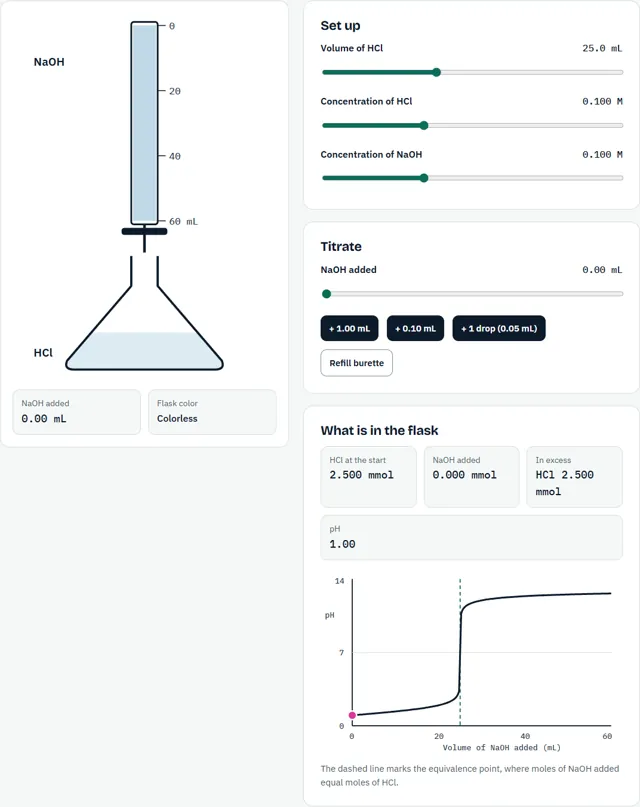
The analyte (unknown) goes in the flask. The titrant (known concentration) goes in the burette. Add titrant until all the analyte has reacted: the equivalence point.
For other ratios (like ) use the mole ratio instead.
Titration of with
? is titrated with ; equivalence is at 20 mL. Is there more acid left in the flask after 1.0 mL of NaOH or after 5.0 mL?Think, then tap to check
More after 1.0 mL. Every mL of added before equivalence consumes more acid, so after 5.0 mL there is less left.
Study notes
Key concepts
What a titration is (SPQ-4.B.1). A titration finds the unknown concentration (or amount) of a substance, the analyte, by reacting it with a solution of known concentration, the titrant. The titrant must react with the analyte specifically (only with the analyte) and quantitatively (completely, in a known mole ratio).
Equipment and vocabulary
| Term | Meaning |
|---|---|
| Buret | A long graduated tube with a tap; it delivers the titrant and is read to ±0.01 mL (two decimal places) |
| Volumetric pipet | Delivers one exact volume of the analyte solution (for example, 25.00 mL) into the flask |
| Standard solution | A solution whose concentration is accurately known |
| Equivalence point | The point at which the analyte has been completely consumed by the titrant: moles of titrant added are exactly the amount required by the balanced equation |
| Indicator | A substance that changes colour near the equivalence point (for example, phenolphthalein, colourless in acid and pink in base) |
| End point | The observed event (such as the colour change) that signals the equivalence point. A good indicator makes the end point and the equivalence point almost the same |
The key relationship. At the equivalence point, the moles of titrant and moles of analyte are in the ratio of the coefficients in the balanced equation. The slide states this for a 1: 1 acid–base reaction as "number of moles of acid = number of moles of base". For other ratios, use the coefficients:
-
HCl + NaOH: 1: 1.
-
H₂SO₄ + 2NaOH: 1 mol acid needs 2 mol base.
-
Mg(OH)₂ + 2HNO₃: 1 mol base needs 2 mol acid.
-
MnO₄⁻ + 5Fe²⁺ (redox titration in acid): 1 mol MnO₄⁻ reacts with 5 mol Fe²⁺. The purple MnO₄⁻ acts as its own indicator: the first excess drop makes the solution stay pale pink.
Reading a titration curve. A pH titration curve plots pH (y-axis) against volume of titrant added (x-axis). For a strong acid titrated with a strong base: the pH starts low (about 1), rises slowly, then rises very steeply near the equivalence point, and levels off at a high pH (about 12–13). The equivalence point is the middle of the steep rise; for a strong acid with a strong base it is at pH 7 (at 25 °C). For a weak acid with a strong base, the equivalence point is above pH 7 (Unit 8 explains why). You only need the volume at the equivalence point for Unit 4 calculations.
Typical errors and their effects
| Error | Effect on volume of titrant recorded | Effect on calculated concentration of analyte (analyte in flask) |
|---|---|---|
| Overshooting the end point (too much titrant added) | Too large | Too high |
| Air bubble in the buret tip that leaves during the titration | Too large | Too high |
| Rinsing the buret with water instead of titrant (titrant diluted) | Too large | Too high |
| Extra water added to the flask with the analyte | No change (moles of analyte unchanged) | No change |
| Stopping before the end point | Too small | Too low |
If the unknown is the titrant instead (the solution in the buret), the logic reverses: using a larger volume makes the calculated titrant concentration too low.
Key equations
For a 1: 1 reaction only, these combine to M₁V₁ = M₂V₂.
Worked examples
Worked example 4.6-A (modelled on CED sample MC question 5). An antacid tablet containing Mg(OH)₂ (molar mass 58.33 g/mol) is titrated with 0.150 M HCl. The initial buret reading is 1.45 mL and the final reading is 24.85 mL. What mass of Mg(OH)₂ was in the tablet?
Solution
Volume of HCl = 24.85 − 1.45 = 23.40 mL = 0.02340 L.
Moles HCl = 0.150 × 0.02340 = 3.51 × 10⁻³ mol.
Mg(OH)₂ + 2HCl → MgCl₂ + 2H₂O, so moles Mg(OH)₂ = 3.51 × 10⁻³ ÷ 2 = 1.755 × 10⁻³ mol.
Mass = 1.755 × 10⁻³ × 58.33 = 0.102 g.
Worked example 4.6-B (modelled on 2014 AP FRQ Q2(d)). A 20.00 mL sample of acetic acid is titrated with 0.125 M NaOH. The end point is reached after 18.36 mL. Calculate the molarity of the acid.
Solution
Moles NaOH = 0.125 × 0.01836 = 2.295 × 10⁻³ mol. The reaction is 1: 1, so moles acid = 2.295 × 10⁻³ mol.
Molarity = 2.295 × 10⁻³ ÷ 0.02000 = 0.115 M.
Worked example 4.6-C (diprotic acid). 20.00 mL of H₂SO₄ requires 32.50 mL of 0.1000 M NaOH to reach the equivalence point. Find [H₂SO₄].
Solution
H₂SO₄ + 2NaOH → Na₂SO₄ + 2H₂O. Moles NaOH = 0.1000 × 0.03250 = 3.250 × 10⁻³ mol. Moles H₂SO₄ = 3.250 × 10⁻³ ÷ 2 = 1.625 × 10⁻³ mol.
[H₂SO₄] = 1.625 × 10⁻³ ÷ 0.02000 = 0.08125 M. (Using M₁V₁ = M₂V₂ would give twice this, which is wrong because the ratio is not 1: 1.)
Worked example 4.6-D (redox titration). 25.00 mL of an Fe²⁺ solution is acidified and titrated with 0.0200 M KMnO₄. The pale pink end point appears after 18.20 mL. The net ionic equation is MnO₄⁻ + 5Fe²⁺ + 8H⁺ → Mn²⁺ + 5Fe³⁺ + 4H₂O. Find [Fe²⁺].
Solution
Moles MnO₄⁻ = 0.0200 × 0.01820 = 3.64 × 10⁻⁴ mol. Moles Fe²⁺ = 5 × 3.64 × 10⁻⁴ = 1.82 × 10⁻³ mol.
[Fe²⁺] = 1.82 × 10⁻³ ÷ 0.02500 = 0.0728 M.
Unit 4 study guide: exam-style free-response set, worksheet and answers.
Worked example
- Moles : .
- 1 : 1 ratio, so moles .
- .
- Answer:
Free-response practice
Write your answer first, then open the solution and mark yourself against it.
FRQ 4.6-1. (Modelled on 2016 AP FRQ Q7.) A student titrates 25.00 mL of an unknown monoprotic acid, HA, with 0.110 M NaOH. Three trials give these buret readings.
| Trial | Initial reading (mL) | Final reading (mL) |
|---|---|---|
| 1 | 0.50 | 23.35 |
| 2 | 23.35 | 46.10 |
| 3 | 1.20 | 24.00 |
(a) Calculate the volume of NaOH delivered in each trial and the mean.
(b) Calculate the molarity of HA.
(c) Describe what the student should see at the end point if phenolphthalein is used.
(d) In a fourth trial the student forgets to rinse the buret with NaOH solution after washing it with distilled water. Will the volume of NaOH needed be greater than, less than, or equal to the mean in (a)? Justify your answer.
Show the solution
(a) Trial 1: 22.85 mL; trial 2: 22.75 mL; trial 3: 22.80 mL. Mean = 22.80 mL. (1 point)
(b) Moles NaOH = 0.110 × 0.02280 = 2.508 × 10⁻³ mol = moles HA (1: 1). [HA] = 2.508 × 10⁻³ ÷ 0.02500 = 0.100 M. (1 point)
(c) The colourless solution turns faint pink and stays pink for about 30 s after swirling. (1 point)
(d) Greater (1 point). Water left in the buret dilutes the NaOH, so each mL contains fewer moles of OH⁻ and a larger volume is needed to deliver the same moles.
FRQ 4.6-2. An iron ore sample of mass 0.500 g is dissolved in acid and all the iron is converted to Fe²⁺. The solution is titrated with 0.0200 M KMnO₄, and 22.40 mL are needed to reach the end point. MnO₄⁻ + 5Fe²⁺ + 8H⁺ → Mn²⁺ + 5Fe³⁺ + 4H₂O.
(a) How does the student know the end point has been reached without adding an indicator?
(b) Calculate the moles of Fe²⁺ in the sample.
(c) Calculate the mass percent of iron in the ore.
Show the solution
(a) MnO₄⁻ is deep purple and Mn²⁺ is almost colourless. As long as Fe²⁺ remains, each drop of MnO₄⁻ is used up and the colour disappears. The first drop in excess gives a permanent pale pink colour.
(b) Moles MnO₄⁻ = 0.0200 × 0.02240 = 4.48 × 10⁻⁴ mol. Moles Fe²⁺ = 5 × 4.48 × 10⁻⁴ = 2.24 × 10⁻³ mol.
(c) Mass Fe = 2.24 × 10⁻³ × 55.85 = 0.125 g. Mass percent = 0.125 ÷ 0.500 × 100% = 25.0%.
Common mistake
Students use for every titration. That shortcut works only for a 1 : 1 mole ratio; for reactions like with , use the coefficients from the balanced equation.
Frequently asked questions
?What is the difference between the end point and the equivalence point?
The equivalence point is where reactants are present in exact stoichiometric amounts; the end point is where the indicator changes color, which should be very close to it.
?What happens to the result if you overshoot the end point?
Too much titrant volume is recorded, so the calculated amount of analyte is too high.
Practice questions on 4.6
- Q1A 25.0 mL sample of HCl is neutralized by 20.0 mL of 0.150 M NaOH. What is the concentration of the HCl?
- Q2What volume of 0.100 M NaOH is needed to completely neutralize 10.0 mL of 0.100 M ?
- Q3A 2.0 M HCl solution is titrated against 10.00 mL of 1.0 M NaOH. What volume of HCl is needed to reach the equivalence point?
- Q4100. mL of 2.0 M HNO₃ is titrated with 1.0 M NaOH. What volume of NaOH is needed to reach the equivalence point?
- Q5Which statement is always true at the equivalence point of any acid–base titration?
- Q6A student titrates an unknown monoprotic acid in a flask with standard NaOH from a buret. In one trial she adds NaOH past the end point and records the final volume. What is the effect on the calculated acid concentration?
- Q7Two unlabelled solutions, one HF and one HCl, of the same concentration are each titrated with 2.00 M NaOH. Which observation identifies them?
- Q8A student pipets 25.00 mL of an acid into a flask and then adds 20 mL of distilled water before titrating. How does the added water affect the volume of base needed to reach the equivalence point?
- Q9What volume of 0.50 M HCl neutralizes 20.0 mL of 0.25 M NaOH?
- Q10What volume of 0.20 M NaOH is needed to titrate 50.0 mL of 0.60 M HCl?
- Q11At the equivalence point of a titration of HCl with NaOH:
- Q12Separate samples of HCl and are titrated with NaOH. How can the curves tell them apart?
- Q13While standardizing NaOH against a known amount of acid, a student stops before reaching the true endpoint. How does the calculated NaOH molarity compare with the true value?
Stuck on a unit? Let us fix it this week.
Book a 30-minute one-to-one session for $20. Bring a test, a homework set or the topic that is not clicking.
Book a session