 AP Chemistry Tutoring
7.1 Introduction to equilibrium
AP Chemistry Unit 7: Equilibrium · 1 simulation · 5 practice questions
Updated · Aligned to the AP Chemistry Course and Exam Description
Chemical equilibrium is the state of a reversible reaction in which the forward and reverse reactions occur at equal rates, so the concentrations of reactants and products stay constant. Equilibrium is dynamic: particles keep reacting in both directions, but there is no net change. For , equilibrium is reached when , not when the concentrations are equal.
Dynamic equilibrium
Forward rate = reverse rate.
Picture LA and San Francisco. Every year 100,000 people move LA → SF and 100,000 move SF → LA. Both populations stay fixed (6 million and 4 million) even though people keep moving.
At equilibrium the amounts are constant, but not necessarily equal.
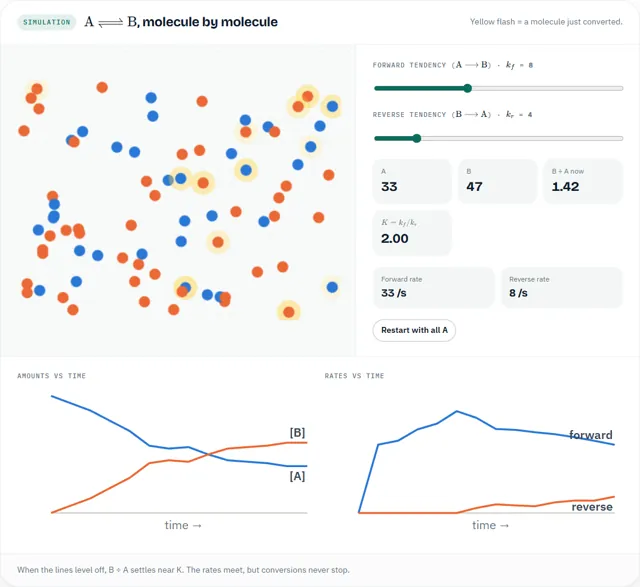
| Concentration vs time | curves level off (not at the same height) |
| Rate vs time | forward falls, reverse rises, they meet |
\(\ce{A <=> B}\), molecule by molecule
Study notes
Key concepts
Reversible processes are everywhere (TRA-6.A.1). Many processes can run forward and backward. Physical examples: water evaporates and condenses; a gas is absorbed onto a surface and desorbed from it; a salt dissolves and precipitates. Chemical examples: proton transfer in acid–base reactions (for example HF + H₂O ⇌ H₃O⁺ + F⁻) and electron transfer in redox reactions. We show a reversible process with a double arrow, ⇌.
What equilibrium looks like (TRA-6.A.2). When a closed system reaches equilibrium, you can no longer see any change. The colour stops changing, the pressure stops changing, and the mass of solid stops changing. Reactants and products are both present. Their concentrations (or partial pressures) are constant. They are usually NOT equal to each other.
Equilibrium is dynamic (TRA-6.A.3). The forward and reverse reactions do not stop. They keep running at equal rates. So every second, as many product particles are made as are used up. The slides define chemical equilibrium as "a state of dynamic balance in which the rate of formation of the products equals the rate of formation of the reactants." Evidence: if you add radioactive iodine as solid PbI₂ to a saturated PbI₂ solution, the radioactivity soon appears in the solution, even though the concentration of dissolved iodide does not change. Dissolving and precipitating are still both happening.
Graphs show equilibrium being established (TRA-6.A.4). Consider N₂O₄(g) ⇌ 2 NO₂(g), starting with only N₂O₄.
| Graph | What you see before equilibrium | What you see at equilibrium |
|---|---|---|
| Concentration vs time | [N₂O₄] falls; [NO₂] rises twice as fast (2: 1 coefficients) | Both lines become flat (horizontal) |
| Rate vs time | Forward rate starts high and falls; reverse rate starts at zero and rises | The two rate lines meet and stay together at a value above zero |
The time at which the concentration lines become flat is the same time at which the two rate curves meet.
Equilibrium can be reached from either direction. The slides show that the ratio [NO₂]²/[N₂O₄] at equilibrium is the same whether you start with N₂O₄, with NO₂, or with a mixture. The same is true for N₂ + 3 H₂ ⇌ 2 NH₃: starting from N₂ and H₂ or starting from NH₃ gives the same equilibrium ratio at the same temperature.
Common misconceptions
| Misconception | Correct idea |
|---|---|
| At equilibrium the reaction has stopped. | Both reactions continue at equal, non-zero rates. |
| At equilibrium [reactants] = [products]. | The concentrations are constant, not equal. |
| Equilibrium means half reactants and half products. | The position of equilibrium depends on K; it can be almost all products or almost all reactants. |
| Equilibrium can be reached in an open beaker of a gas reaction. | Gas-phase equilibrium needs a closed system so that nothing escapes. |
Worked examples
Example 7.1. A student seals some colourless N₂O₄(g) in a flask at constant temperature. The gas slowly turns brown (NO₂ is brown). After 3 minutes the colour stops changing. Explain, at the particle level, why the colour stops changing even though the reaction has not stopped.
Solution. At the start only N₂O₄ is present, so only the forward reaction happens and the forward rate is high. As N₂O₄ is used up, the forward rate falls. As NO₂ builds up, the reverse reaction (2 NO₂ → N₂O₄) speeds up. After about 3 minutes the two rates are equal. NO₂ is now formed and used up at the same rate, so its concentration (and the brown colour) stays constant. Both reactions are still running, so the equilibrium is dynamic.
Unit 7 study guide: exam-style free-response set, worksheet and answers.
Worked example
- At first only is present: the forward rate is at its maximum and the reverse rate is zero.
- As is consumed the forward rate decreases; as builds up the reverse rate increases.
- At equilibrium the two rates are equal and the concentrations stop changing.
- Answer: The forward rate falls and the reverse rate rises until they are equal; then concentrations remain constant.
Free-response practice
Write your answer first, then open the solution and mark yourself against it.
FRQ 7.1. A rigid flask at constant temperature contains only N₂O₄(g) at 0.100 M at time zero. The reaction N₂O₄(g) ⇌ 2 NO₂(g) takes place. The data are shown below.
| Time (s) | [N₂O₄] (M) | [NO₂] (M) |
|---|---|---|
| 0 | 0.100 | 0 |
| 10 | 0.075 | 0.050 |
| 20 | 0.060 | 0.080 |
| 30 | 0.052 | 0.096 |
| 40 | 0.050 | 0.100 |
| 50 | 0.050 | 0.100 |
| 60 | 0.050 | 0.100 |
(a) At what time is equilibrium first reached (to the nearest 10 s)? Justify your answer using the data.
(b) Show that the data for t = 20 s are consistent with the stoichiometry of the reaction.
(c) Is the rate of the forward reaction at t = 10 s greater than, less than, or equal to the rate of the forward reaction at t = 50 s? Explain.
(d) A student says, "After 40 s no N₂O₄ molecules are breaking apart." Do you agree? Explain.
Show the solution
(a) About 40 s. From 40 s onwards both concentrations stay constant (0.050 M and 0.100 M), which is the observable sign of equilibrium.
(b) [N₂O₄] fell by 0.100 − 0.060 = 0.040 M. The 1: 2 ratio means [NO₂] should rise by 2 × 0.040 = 0.080 M. The table shows 0.080 M, so the data agree.
(c) Greater. The forward rate depends on [N₂O₄]. At 10 s, [N₂O₄] = 0.075 M, which is larger than 0.050 M at 50 s, so the forward reaction is faster at 10 s.
(d) Disagree. Equilibrium is dynamic. N₂O₄ molecules are still breaking apart, but NO₂ molecules combine to form N₂O₄ at the same rate, so there is no net change.
Common mistake
Students think reactions stop at equilibrium or that reactant and product concentrations become equal. Both reactions continue at the same rate, and the constant concentrations can have any ratio set by .
Frequently asked questions
?Does a reaction stop at equilibrium?
No. Equilibrium is dynamic: both the forward and reverse reactions continue at equal rates, so there is no net change.
?Are concentrations equal at equilibrium?
Usually not. They are constant, but their values depend on the equilibrium constant and the starting amounts.
Practice questions on 7.1
- Q1Which statement is always true for a reaction at equilibrium?
- Q2Which statement correctly describes a chemical system at equilibrium?
- Q3Solid PbI₂ is stirred with water until the solution is saturated and some solid remains. A small amount of solid PbI₂ made with radioactive iodine is then added. After an hour the dissolved iodide is found to be radioactive, but the total concentration of I⁻(aq) has not changed. Which statement best explains this?
- Q4For the reaction A(g) ⇌ B(g), started with only A, the forward and reverse rates are plotted against time. The two curves meet at time t₁. Which statement is true for all times after t₁?
- Q5Some water is placed in a sealed flask at constant temperature. The liquid level falls for a while and then stays constant. Which best explains why the level stops falling?
Terms used in this topic
Stuck on a unit? Let us fix it this week.
Book a 30-minute one-to-one session for $20. Bring a test, a homework set or the topic that is not clicking.
Book a session