 AP Chemistry Tutoring
7.2 Direction of reversible reactions
AP Chemistry Unit 7: Equilibrium · 1 simulation · 4 practice questions
Updated · Aligned to the AP Chemistry Course and Exam Description
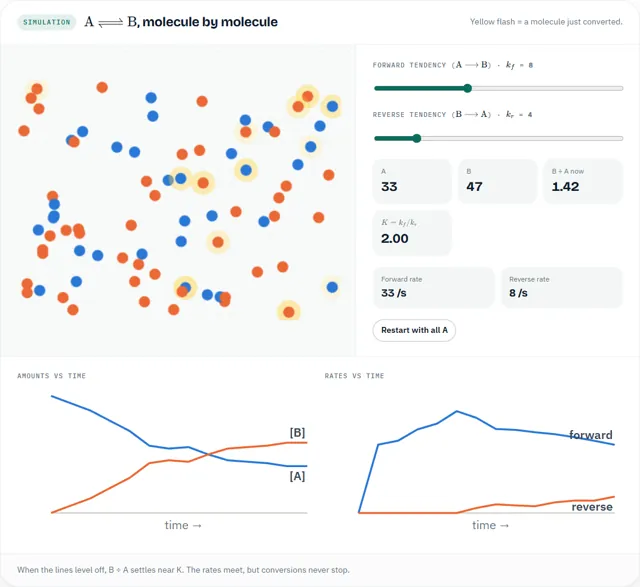
A reversible reaction can proceed in either direction, and its net direction depends on which rate is larger. If the forward rate exceeds the reverse rate, the net reaction goes toward products; if the reverse rate is larger, it goes toward reactants; when the system is at equilibrium. The same equilibrium state can be reached from pure reactants, pure products, or any mixture.
Dynamic equilibrium
Forward rate = reverse rate.
Picture LA and San Francisco. Every year 100,000 people move LA → SF and 100,000 move SF → LA. Both populations stay fixed (6 million and 4 million) even though people keep moving.
At equilibrium the amounts are constant, but not necessarily equal.
| Concentration vs time | curves level off (not at the same height) |
| Rate vs time | forward falls, reverse rises, they meet |
\(\ce{A <=> B}\), molecule by molecule
Study notes
Key concepts
Rates decide the direction (TRA-6.B.1).
| Situation | Net result |
|---|---|
| Forward rate > reverse rate | Net conversion of reactants into products; [products] rise |
| Reverse rate > forward rate | Net conversion of products into reactants; [reactants] rise |
| Forward rate = reverse rate | Equilibrium; no net change |
Why the rates become equal. Rates depend on concentrations (Unit 5). If you start with only reactants, the forward rate is high and the reverse rate is zero. As reactants are used, the forward rate falls; as products form, the reverse rate rises. The rates must meet. If you start with only products, the same thing happens in the other direction.
Link to rate constants. The slides use N₂O₄ ⇌ 2 NO₂, treating each direction as an elementary step. Forward rate = kf[N₂O₄]. Reverse rate = kr[NO₂]². At equilibrium the rates are equal, kf[N₂O₄] = kr[NO₂]², so [NO₂]²/[N₂O₄] = kf/kr. This ratio of two constants is itself a constant: the equilibrium constant. (This simple link holds for elementary reactions; you do not need it for multistep mechanisms.)
Link to Q and K (preview of 7.10). "Forward rate > reverse rate" is the same situation as Q < K. "Reverse rate > forward rate" is the same situation as Q > K.
A catalyst speeds up both directions by the same factor. It does not change the direction of net reaction or the equilibrium amounts; equilibrium is just reached sooner.
Key equations
Worked examples
Example 7.2. For the elementary reaction NO(g) + O₃(g) ⇌ NO₂(g) + O₂(g), at one instant the forward rate is 4.0 × 10⁻⁴ M s⁻¹ and the reverse rate is 1.5 × 10⁻⁴ M s⁻¹. (a) In which direction is there net reaction? (b) What happens to [NO₂] and to the forward rate over the next few seconds?
Solution. (a) Forward rate > reverse rate, so there is net conversion of NO and O₃ into NO₂ and O₂ (to the right). (b) [NO₂] increases. Because NO and O₃ are being used up, the forward rate decreases (and the reverse rate increases) until the two rates are equal.
Unit 7 study guide: exam-style free-response set, worksheet and answers.
Worked example
- There is no , so the forward rate is zero.
- The reverse reaction, , has a nonzero rate, so it is faster.
- Answer: The net reaction proceeds in reverse, forming until equilibrium.
Free-response practice
Write your answer first, then open the solution and mark yourself against it.
FRQ 7.2. A sealed flask contains a mixture of H₂(g), I₂(g) and HI(g) that is not at equilibrium. Over the next minute the purple colour of I₂ becomes paler, then stays constant.
(a) Which reaction, H₂ + I₂ → 2 HI or 2 HI → H₂ + I₂, was faster at the start? Explain how the colour change shows this.
(b) Describe how the rate of each reaction changes during the minute, and state the relationship between the two rates when the colour stops changing.
Show the solution
(a) H₂ + I₂ → 2 HI was faster. The purple colour fading means [I₂] decreased, so there was net consumption of I₂, which means the forward reaction was faster than the reverse reaction.
(b) As H₂ and I₂ are used up, the forward rate falls. As HI builds up, the reverse rate rises. When the colour stops changing, the two rates are equal (and non-zero), so the system is at equilibrium.
Common mistake
Students assume every reaction proceeds only from left to right. A reaction moves toward equilibrium in whichever direction is needed; a flask of pure products will react in the reverse direction.
Frequently asked questions
?What makes a reaction reversible?
The products can collide and react to re-form the reactants, so both directions occur in a closed system.
?Can equilibrium be reached starting from products?
Yes. The same equilibrium mixture is reached from either direction if the total amounts of each element and the conditions are the same.
Practice questions on 7.2
- Q1At a certain moment in a reaction mixture, the rate of the forward reaction is greater than the rate of the reverse reaction. Which is true at that moment?
- Q2For the elementary reaction A(g) ⇌ B(g), the forward rate constant is 0.30 s⁻¹ and the reverse rate constant is 0.10 s⁻¹ at the same temperature. What is the value of K?
- Q3A flask initially contains only HI(g), which reacts by 2 HI(g) ⇌ H₂(g) + I₂(g). Which describes the rates immediately after the flask is sealed?
- Q4Adding a catalyst to a reaction mixture that is NOT yet at equilibrium will
Stuck on a unit? Let us fix it this week.
Book a 30-minute one-to-one session for $20. Bring a test, a homework set or the topic that is not clicking.
Book a session