 AP Chemistry Tutoring
6.9 Hess's law
AP Chemistry Unit 6: Thermochemistry · 3 simulations · 8 practice questions
Updated · Aligned to the AP Chemistry Course and Exam Description
Hess's law states that because enthalpy is a state function, the enthalpy change of an overall reaction equals the sum of the enthalpy changes of any series of steps that add up to it: . When a step is reversed, the sign of its changes; when a step is multiplied by a factor, its is multiplied by the same factor.
Enthalpy of reaction
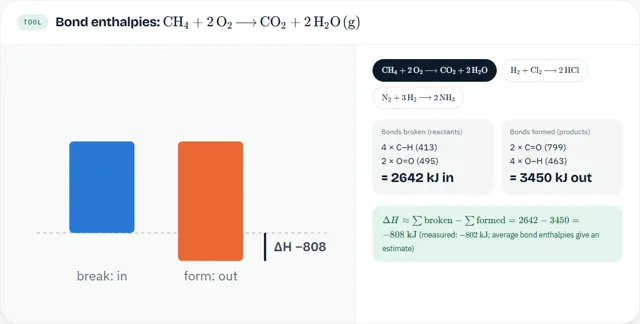
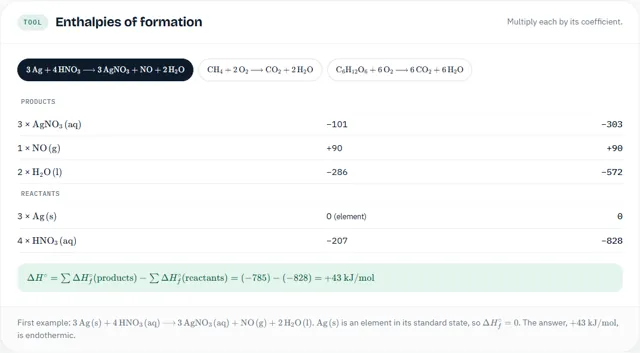
Three ways to calculate ΔH.
Reactant bonds in, product bonds out.
Elements in their standard state are 0.
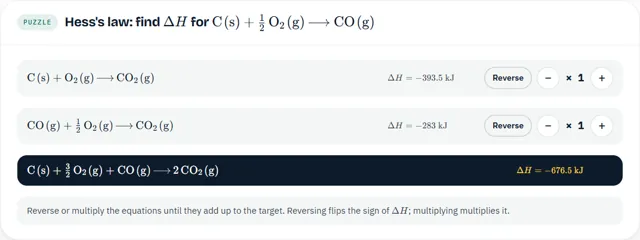
Reverse: flip the sign. Multiply: multiply .
Bond enthalpies:
Enthalpies of formation
Hess's law: find for
?A catalyst () speeds up . What happens to and to ?Think, then tap to check
is lower (a lower hump on the energy diagram). is unchanged: the reactants and products sit at the same energies.
?Why is of , or zero?Think, then tap to check
They're elements already in their standard state. Forming them from themselves involves no change.
Study notes
Key concepts
Hess's law. The enthalpy change for a reaction is the same whether it happens in one step or in several steps. ΔH depends only on the starting substances and the final substances, not on the path. (This is because enthalpy is a state function; the term itself is not required on the AP exam, but the two principles below are.) Hess's law lets us combine reactions with known ΔH, like puzzle pieces, to find ΔH for a reaction that is hard to measure directly.
The two principles you must know (ENE-3.C.1).
-
When a reaction is reversed, ΔH keeps the same size but changes sign.
-
When two or more reactions are added to give an overall reaction, their ΔH values are added to give the overall ΔH.
A third rule follows from enthalpy being extensive: if a reaction is multiplied by a factor (including a fraction), ΔH is multiplied by the same factor.
Strategy for Hess's-law problems.
-
Write the target equation.
-
For each substance in the target that appears in only one given equation, decide whether that equation must be reversed (so the substance is on the correct side) and what factor it must be multiplied by (so the coefficient matches).
-
Apply the same changes to ΔH.
-
Add the equations. Cancel anything that appears on both sides (intermediates). Check that the result is exactly the target equation.
-
Add the adjusted ΔH values.
Hess's law with phase changes. A physical process can be one of the steps. For example, ΔHsub = ΔHfus + ΔHvap. Also, a reaction that forms a liquid product releases more energy than the same reaction forming the gas, because condensation (−ΔHvap) is one extra exothermic step. For 2 SO₂(g) + O₂(g) → 2 SO₃, ΔH has a larger magnitude when the product is SO₃(l) than when it is SO₃(g).
Products, temperature and surroundings (ENE-3.D.1). ΔH for a reaction is defined for products that end at the same temperature as the reactants started. Right after an exothermic reaction, the products are hotter than the surroundings; thermal energy then flows from the products to the surroundings until thermal equilibrium is reached. Right after an endothermic reaction, the products are colder than the surroundings, and thermal energy flows from the surroundings to the products. You can think of this as a two-step path: (1) reaction, (2) heat exchange with surroundings; the overall energy change is the sum.
Link to 6.8. The ΔH°f formula is Hess's law in disguise: step 1 breaks every reactant into elements (−ΣΔH°f reactants), step 2 builds every product from elements (+ΣΔH°f products).
Key equations
Worked examples
Example 1. Find ΔH° for 2 C(s) + H₂(g) → C₂H₂(g) from:
-
(i) C₂H₂(g) + 5/2 O₂(g) → 2 CO₂(g) + H₂O(l) ΔH° = −1299.5 kJ
-
(ii) C(s) + O₂(g) → CO₂(g) ΔH° = −393.5 kJ
-
(iii) H₂(g) + ½ O₂(g) → H₂O(l) ΔH° = −285.8 kJ
Solution. C₂H₂ must be a product: reverse (i), ΔH = +1299.5 kJ. We need 2 C as reactant: multiply (ii) by 2, ΔH = −787.0 kJ. We need 1 H₂ as reactant: use (iii) as written, ΔH = −285.8 kJ.
Adding: 2 CO₂ + H₂O + 2 C + 2 O₂ + H₂ + ½ O₂ → C₂H₂ + 5/2 O₂ + 2 CO₂ + H₂O. The 2 CO₂, H₂O and 5/2 O₂ cancel, leaving 2 C(s) + H₂(g) → C₂H₂(g).
ΔH° = +1299.5 − 787.0 − 285.8 = +226.7 kJ/molᵣₓₙ.
Example 2. Find ΔH for 2 H₃BO₃(aq) → B₂O₃(s) + 3 H₂O(l) from:
-
(i) H₃BO₃(aq) → HBO₂(aq) + H₂O(l) ΔH = −0.02 kJ
-
(ii) H₂B₄O₇(aq) + H₂O(l) → 4 HBO₂(aq) ΔH = −11.3 kJ
-
(iii) H₂B₄O₇(aq) → 2 B₂O₃(s) + H₂O(l) ΔH = +17.5 kJ
Solution. It is easier to first build the doubled target, 4 H₃BO₃ → 2 B₂O₃ + 6 H₂O, then halve it. 4 × (i): ΔH = −0.08 kJ. Reverse (ii): 4 HBO₂ → H₂B₄O₇ + H₂O, ΔH = +11.3 kJ. (iii) as written: +17.5 kJ. Sum: 4 H₃BO₃ → 2 B₂O₃ + 6 H₂O (4 HBO₂ and H₂B₄O₇ cancel; water: 4 + 1 + 1 = 6), ΔH = +28.72 kJ. Halve: ΔH = +14.4 kJ/molᵣₓₙ (endothermic).
Unit 6 study guide: exam-style free-response set, worksheet and answers.
Worked example
- Keep equation (1): .
- Reverse equation (2): , .
- Add: and cancel; .
- Answer:
Free-response practice
Write your answer first, then open the solution and mark yourself against it.
FRQ 6.9-1. Use Hess's law to find ΔH for 4 HCN(l) + 9 O₂(g) → 4 CO₂(g) + 4 NO₂(g) + 2 H₂O(l), given:
-
(i) H₂(g) + 2 C(s) + N₂(g) → 2 HCN(l) ΔH = +217.8 kJ
-
(ii) C(s) + O₂(g) → CO₂(g) ΔH = −393.5 kJ
-
(iii) 2 NO₂(g) → N₂(g) + 2 O₂(g) ΔH = −66.40 kJ
-
(iv) 2 H₂(g) + O₂(g) → 2 H₂O(l) ΔH = −571.70 kJ
(a) State what must be done to each equation.
(b) Calculate ΔH for the target reaction.
Show the solution
(a) (i) Reverse and multiply by 2, so 4 HCN is a reactant: 4 HCN → 2 H₂ + 4 C + 2 N₂, ΔH = −435.6 kJ. (ii) Multiply by 4: 4 C + 4 O₂ → 4 CO₂, ΔH = −1574.0 kJ. (iii) Reverse and multiply by 2: 2 N₂ + 4 O₂ → 4 NO₂, ΔH = +132.8 kJ. (iv) Use as written: ΔH = −571.70 kJ.
Check: the 2 H₂, 4 C and 2 N₂ cancel; O₂ on the left = 4 + 4 + 1 = 9. The sum is exactly the target equation.
(b) ΔH = −435.6 − 1574.0 + 132.8 − 571.70 = −2448.5 kJ/molᵣₓₙ.
FRQ 6.9-2. Carbon tetrachloride can be made by CS₂(l) + 3 Cl₂(g) → CCl₄(l) + S₂Cl₂(l). Find ΔH using:
-
(i) CS₂(l) + 3 O₂(g) → CO₂(g) + 2 SO₂(g) ΔH = −1077 kJ
-
(ii) 2 S(s) + Cl₂(g) → S₂Cl₂(l) ΔH = −58.2 kJ
-
(iii) C(s) + 2 Cl₂(g) → CCl₄(l) ΔH = −135.4 kJ
-
(iv) S(s) + O₂(g) → SO₂(g) ΔH = −296.8 kJ
-
(v) C(s) + O₂(g) → CO₂(g) ΔH = −393.5 kJ
Show the solution
Keep (i), (ii) and (iii) as written. Reverse (iv) and multiply by 2: 2 SO₂ → 2 S + 2 O₂, ΔH = +593.6 kJ. Reverse (v): CO₂ → C + O₂, ΔH = +393.5 kJ.
Adding: CO₂, 2 SO₂, 2 S, C and 3 O₂ all cancel, and the Cl₂ adds to 1 + 2 = 3. The result is CS₂ + 3 Cl₂ → CCl₄ + S₂Cl₂.
ΔH = −1077 − 58.2 − 135.4 + 593.6 + 393.5 = −283.5 kJ/molᵣₓₙ (about −284 kJ).
Common mistake
Students reverse an equation but keep the sign of , or scale the equation without scaling . Every change to an equation must be applied to its enthalpy change too.
Frequently asked questions
?Why does Hess's law work?
Enthalpy is a state function: its change depends only on the initial and final states, not on the path taken between them.
?What do I do to delta H when I flip an equation?
Change its sign. An exothermic reaction is endothermic in reverse by the same amount.
Practice questions on 6.9
- Q1Given A → B with , and C → B with , what is for A → C?
- Q2, ; , . What is for ?
- Q3Given N₂(g) + 2 O₂(g) → 2 NO₂(g), ΔH = +66.4 kJ and 2 NO(g) + O₂(g) → 2 NO₂(g), ΔH = −114.2 kJ, what is ΔH for N₂(g) + O₂(g) → 2 NO(g)?
- Q4Given 2 S(s) + 3 O₂(g) → 2 SO₃(g), ΔH = −790 kJ and S(s) + O₂(g) → SO₂(g), ΔH = −297 kJ, what is ΔH for 2 SO₂(g) + O₂(g) → 2 SO₃(g)?
- Q5For CH₄(g) + 2 O₂(g) → CO₂(g) + 2 H₂O(g), ΔH = −802 kJ. For H₂O(g) → H₂O(l), ΔH = −44 kJ/mol. What is ΔH if the water is produced as liquid?
- Q6Using these combustion data, find ΔH for C(s, graphite) + 2 H₂(g) → CH₄(g). Equation 1: C(s) + O₂(g) → CO₂(g) ΔH = −393.5 kJ Equation 2: H₂(g) + ½ O₂(g) → H₂O(l) ΔH = −285.8 kJ Equation 3: CH₄(g) + 2 O₂(g) → CO₂(g) + 2 H₂O(l) ΔH = −890.3 kJ
- Q7For 2 H₂(g) + O₂(g) → 2 H₂O, how does the magnitude of ΔH when liquid water forms compare with the magnitude when water vapor forms?
- Q8An exothermic reaction is carried out in a sealed flask. Right after the reaction, the flask feels hot. Which statement is correct?
Terms used in this topic
Stuck on a unit? Let us fix it this week.
Book a 30-minute one-to-one session for $20. Bring a test, a homework set or the topic that is not clicking.
Book a session