 AP Chemistry Tutoring
7.11 Introduction to solubility equilibria
AP Chemistry Unit 7: Equilibrium · 1 simulation · 7 practice questions
Updated · Aligned to the AP Chemistry Course and Exam Description
A slightly soluble ionic solid in water reaches an equilibrium between the solid and its dissolved ions, described by the solubility product . For , ; if the molar solubility is , then . A smaller means lower solubility only when the salts have the same ion ratio.
Solubility equilibria
: the solid isn't in the expression.
gives . The molar solubility is how many moles dissolve per liter.
You can compare values directly only for salts with the same ion ratio (, , are all 1 : 1). Otherwise, solve for .
Common ions and pH.
Common-ion effect: dissolves less in solution than in pure water (Le Chatelier).
pH: salts with a basic anion (, , , …) dissolve more in acid, because removes the anion. dissolves more in acid, less in base.
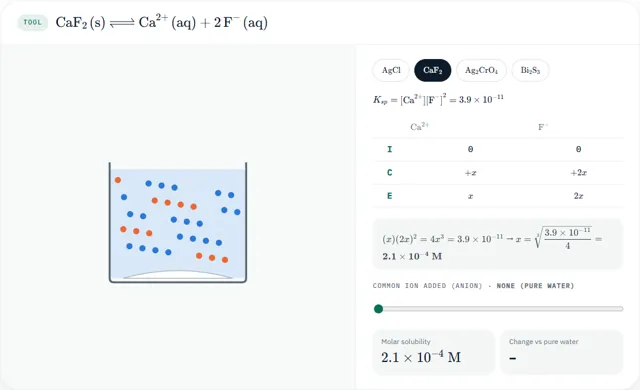
- ICE: , .
- (watch the exponent: it's cubed).
Study notes
Key concepts
Dissolving a salt is reversible (SPQ-5.A.1). In a saturated solution with some undissolved solid, the solid dissolves and the ions precipitate at equal rates. For barium sulfate (from the slides):
BaSO₄(s) ⇌ Ba²⁺(aq) + SO₄²⁻(aq), Ksp = [Ba²⁺][SO₄²⁻]
Ksp is the solubility-product constant. Like every K, it leaves out the solid, and it depends only on temperature.
Ksp is not the same as solubility. The slides stress this. Solubility is the amount that dissolves, given in g/L, g per 100 mL, or mol/L. Molar solubility (s) is the number of moles of the salt that dissolve per litre of saturated solution. You calculate s from Ksp (or Ksp from s) using the dissolution equation (SPQ-5.A.2).
Relationships between Ksp and s (in pure water)
| Salt type | Example | Ion concentrations | Ksp in terms of s |
|---|---|---|---|
| AB | AgCl | [Ag⁺] = s, [Cl⁻] = s | Ksp = s² |
| AB₂ | PbI₂, CaF₂, Mg(OH)₂ | [M²⁺] = s, [X⁻] = 2s | Ksp = s(2s)² = 4s³ |
| A₂B | Ag₂CrO₄ | [Ag⁺] = 2s, [CrO₄²⁻] = s | Ksp = (2s)²s = 4s³ |
| AB₃ | Fe(OH)₃ | [M³⁺] = s, [X⁻] = 3s | Ksp = s(3s)³ = 27s⁴ |
| A₃B₂ | Ca₃(PO₄)₂ | [Ca²⁺] = 3s, [PO₄³⁻] = 2s | Ksp = (3s)³(2s)² = 108s⁵ |
Comparing solubilities. You may compare Ksp values directly ONLY for salts with the same ion ratio (for example AgCl, AgBr and AgI, all 1: 1). For salts with different ratios, calculate s for each. Example: Ag₂CrO₄ (Ksp = 1.1 × 10⁻¹²) is MORE soluble in mol/L than AgCl (Ksp = 1.8 × 10⁻¹⁰), even though its Ksp is smaller.
Link to the solubility rules (SPQ-5.A.3). Salts that the solubility rules call "soluble" (for example all sodium, potassium, ammonium and nitrate salts) have Ksp > 1. Salts called "insoluble" have small Ksp values (often 10⁻⁵ or less), but some always dissolves.
Will a precipitate form? (from the slides) Calculate the ion product Q (same form as Ksp) using the concentrations just after mixing.
| Comparison | What happens |
|---|---|
| Q < Ksp | Unsaturated; no precipitate (more solid could dissolve) |
| Q = Ksp | Saturated; at equilibrium |
| Q > Ksp | Supersaturated; precipitate forms until Q = Ksp |
Remember to correct for dilution when two solutions are mixed.
Selective precipitation and qualitative analysis (from the slides). Differences in solubility can separate ions. Add a precipitating ion slowly; the salt whose Ksp is reached first precipitates first. Qualitative analysis asks "What is there?"; quantitative analysis asks "How much is there?"
Key equations
Worked examples
Example 7.11a (Ksp to solubility, 1: 1). Ksp for AgCl is 1.8 × 10⁻¹⁰. Find the molar solubility and the solubility in g/L (molar mass 143.32 g/mol).
Solubility = (1.3 × 10⁻⁵ mol/L)(143.32 g/mol) = 1.9 × 10⁻³ g/L.
Example 7.11b (Ksp to solubility, 1: 2). Ksp for PbI₂ is 9.8 × 10⁻⁹. Find s.
Example 7.11c (solubility to Ksp). A saturated CaF₂ solution contains 0.016 g of CaF₂ (78.07 g/mol) per litre. Find Ksp.
s = 0.016/78.07 = 2.0 × 10⁻⁴ M. [Ca²⁺] = s and [F⁻] = 2s.
Example 7.11d (Will a precipitate form? Based on the CED Unit 7 sample activity). One drop (0.050 mL) of 0.10 M KI is added to 250 mL of 0.010 M Pb(NO₃)₂. Ksp for PbI₂ = 9.8 × 10⁻⁹. (a) Should a lasting precipitate form? (b) What volume of 0.10 M KI is needed for a lasting precipitate? (Ignore the small change in total volume.)
Solution. (a) [I⁻] = (0.10 M)(0.050 × 10⁻³ L)/(0.250 L) = 2.0 × 10⁻⁵ M. Q = [Pb²⁺][I⁻]² = (0.010)(2.0 × 10⁻⁵)² = 4.0 × 10⁻¹². Q < Ksp, so no lasting precipitate. (A cloud may appear where the drop lands, because locally [I⁻] is high, but it redissolves as the drop mixes in.)
(b) Precipitation starts when Q = Ksp: [I⁻] = √(9.8 × 10⁻⁹ / 0.010) = 9.9 × 10⁻⁴ M. Moles of I⁻ = (9.9 × 10⁻⁴ M)(0.250 L) = 2.5 × 10⁻⁴ mol. Volume of KI = 2.5 × 10⁻⁴ mol / 0.10 M = 2.5 × 10⁻³ L = 2.5 mL.
Unit 7 study guide: exam-style free-response set, worksheet and answers.
Worked example
- : , .
- .
- .
- Answer:
Free-response practice
Write your answer first, then open the solution and mark yourself against it.
FRQ 7.11. Modelled on 2017 AP FRQ Q6(a) and 2014 AP FRQ Q1(g). At 25 °C, Ksp for Mn(OH)₂ is 2.0 × 10⁻¹³.
(a) Write the Ksp expression for Mn(OH)₂.
(b) Calculate the mass in grams of Mn(OH)₂ (molar mass 88.95 g/mol) dissolved in 100. mL of a saturated solution at 25 °C.
(c) Ksp for Mg(OH)₂ is 1.8 × 10⁻¹¹. Which hydroxide has the greater molar solubility? Justify your answer without a full calculation.
(d) A student wants to precipitate I⁻ ions from a solution of KI by adding AgNO₃(aq). Ksp for AgI is 8.5 × 10⁻¹⁷. Will the I⁻ be precipitated essentially completely when excess Ag⁺ is added? Justify your answer.
Show the solution
(a) Ksp = [Mn²⁺][OH⁻]².
(b) Ksp = 4s³, so s = (2.0 × 10⁻¹³/4)^(1/3) = 3.7 × 10⁻⁵ M. Moles in 0.100 L = 3.7 × 10⁻⁶ mol. Mass = (3.7 × 10⁻⁶ mol)(88.95 g/mol) = 3.3 × 10⁻⁴ g.
(c) Mg(OH)₂. Both salts have the same 1: 2 ion ratio, so Ksp values can be compared directly, and the larger Ksp (1.8 × 10⁻¹¹) means the greater molar solubility.
(d) Yes. The Ksp of AgI is extremely small, so Q = [Ag⁺][I⁻] exceeds Ksp even at very low [I⁻]. With excess Ag⁺ (for example 0.10 M), the [I⁻] left in solution would be only 8.5 × 10⁻¹⁶ M, so essentially all I⁻ precipitates.
Common mistake
Students forget the coefficient inside the concentration term, writing for . The fluoride concentration is , and it must be squared: .
Frequently asked questions
?Does a smaller Ksp always mean a less soluble salt?
Only when the salts produce the same number of ions in the same ratio. Otherwise, calculate the molar solubility of each.
?How do you predict if a precipitate will form?
Calculate the ion product with the mixed concentrations; if , a precipitate forms.
Practice questions on 7.11
- Q1 for AgCl is . What is its molar solubility in pure water?
- Q2 of is . Which expression gives its molar solubility ?
- Q3What is the molar solubility of Ag₂CrO₄ in water? (Ksp = 1.1 × 10⁻¹²)
- Q4In a saturated solution of Fe(OH)₂ at 25 °C, [OH⁻] = 4.0 × 10⁻⁶ M. What is Ksp for Fe(OH)₂?
- Q5Ksp for AgCl is 1.8 × 10⁻¹⁰ and Ksp for Ag₂CrO₄ is 1.1 × 10⁻¹². Which statement is correct?
- Q6Equal volumes of 2.0 × 10⁻⁴ M AgNO₃ and 2.0 × 10⁻⁴ M NaCl are mixed. Ksp for AgCl is 1.8 × 10⁻¹⁰. What happens?
- Q7A salt has Ksp = 25 at 25 °C. Which statement best describes it?
Stuck on a unit? Let us fix it this week.
Book a 30-minute one-to-one session for $20. Bring a test, a homework set or the topic that is not clicking.
Book a session