 AP Chemistry Tutoring
7.12 Common-ion effect
AP Chemistry Unit 7: Equilibrium · 1 simulation · 6 practice questions
Updated · Aligned to the AP Chemistry Course and Exam Description
The common-ion effect is the decrease in solubility of a slightly soluble salt when the solution already contains one of its ions. By Le Chatelier's principle, the added ion shifts toward the solid. Because is unchanged, the molar solubility in a solution with an initial is approximately , much smaller than in pure water.
Solubility equilibria
: the solid isn't in the expression.
gives . The molar solubility is how many moles dissolve per liter.
You can compare values directly only for salts with the same ion ratio (, , are all 1 : 1). Otherwise, solve for .
Common ions and pH.
Common-ion effect: dissolves less in solution than in pure water (Le Chatelier).
pH: salts with a basic anion (, , , …) dissolve more in acid, because removes the anion. dissolves more in acid, less in base.
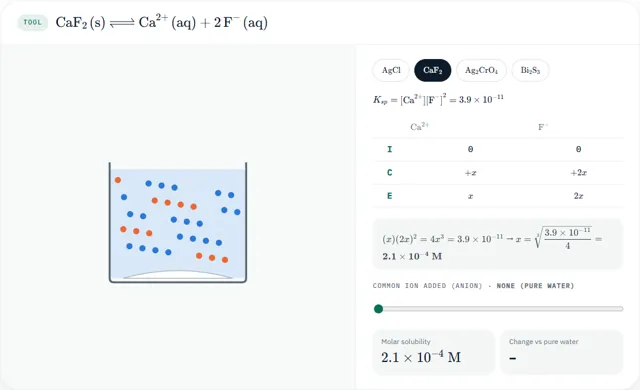
- ICE: , .
- (watch the exponent: it's cubed).
Study notes
Key concepts
What it is (SPQ-5.B.1). The solubility of a salt is lower in a solution that already contains one of its ions (a "common ion") than in pure water. The slides define the common-ion effect as "a shift of equilibrium induced by an ion common to the equilibrium."
Le Châtelier explanation. For AgCl(s) ⇌ Ag⁺(aq) + Cl⁻(aq), adding Cl⁻ (for example as NaCl) increases Q above Ksp. The equilibrium shifts left, AgCl precipitates, and less AgCl can dissolve.
Quantitative treatment. Put the common ion's initial concentration into the ICE table. Because s is usually tiny compared with the common-ion concentration, use the approximation (c + s) ≈ c.
Ksp does not change. The common ion changes how much dissolves (s), not the value of Ksp (only temperature changes Ksp).
Count the ions carefully. 0.020 M CaCl₂ gives [Cl⁻] = 0.040 M. 0.010 M Na₂SO₄ gives [SO₄²⁻] = 0.010 M.
Other examples from the slides. Na₂SO₄ decreases the solubility of BaSO₄. Adding NaF to HF(aq) decreases the percent ionization of HF (this is the basis of buffers in Unit 8).
Using the effect in the lab. Washing a precipitate with a solution containing a common ion (instead of pure water) loses less precipitate. Adding a little excess precipitating reagent makes a gravimetric analysis more complete.
Key equations
Worked examples
Example 7.12a. Find the molar solubility of PbI₂ (Ksp = 9.8 × 10⁻⁹) in 0.10 M NaI and compare it with its solubility in pure water (1.3 × 10⁻³ M, Example 7.11b).
| [Pb²⁺] | [I⁻] | |
|---|---|---|
| I | 0 | 0.10 |
| C | +s | +2s |
| E | s | 0.10 + 2s ≈ 0.10 |
The solubility drops by a factor of about 1400.
Example 7.12b. Find the molar solubility of AgCl (Ksp = 1.8 × 10⁻¹⁰) in 0.020 M CaCl₂.
[Cl⁻] = 2 × 0.020 = 0.040 M. s = 1.8 × 10⁻¹⁰ / 0.040 = 4.5 × 10⁻⁹ M.
Example 7.12c. Find the molar solubility of Mg(OH)₂ (Ksp = 1.8 × 10⁻¹¹) in 0.010 M NaOH.
s = Ksp/[OH⁻]² = 1.8 × 10⁻¹¹ / (0.010)² = 1.8 × 10⁻⁷ M (compared with 1.7 × 10⁻⁴ M in pure water).
Unit 7 study guide: exam-style free-response set, worksheet and answers.
Worked example
- Pure water: , so .
- In 0.10 M : ; since , .
- Answer: in water; in 0.10 M .
Free-response practice
Write your answer first, then open the solution and mark yourself against it.
FRQ 7.12. Ksp for AgCl is 1.8 × 10⁻¹⁰ at 25 °C.
(a) Calculate the molar solubility of AgCl in 0.050 M NaCl.
(b) By what factor is this smaller than the solubility in pure water (1.3 × 10⁻⁵ M)?
(c) Explain the difference using Le Châtelier's principle.
(d) A student measures the molar solubility of SrSO₄ in 0.020 M Na₂SO₄ as 1.7 × 10⁻⁵ M. Calculate Ksp for SrSO₄.
(e) A chemist collects AgCl precipitate on a filter. Should the precipitate be washed with pure water or with dilute NaCl to lose the least AgCl? Explain.
Show the solution
(a) s = 1.8 × 10⁻¹⁰ / 0.050 = 3.6 × 10⁻⁹ M.
(b) (1.3 × 10⁻⁵)/(3.6 × 10⁻⁹) ≈ 3.7 × 10³ times smaller.
(c) For AgCl(s) ⇌ Ag⁺ + Cl⁻, the extra Cl⁻ from NaCl makes Q larger than Ksp. The equilibrium shifts left (toward the solid), so less AgCl dissolves.
(d) [Sr²⁺] = 1.7 × 10⁻⁵ M; [SO₄²⁻] = 0.020 + 0.000017 ≈ 0.020 M. Ksp = (1.7 × 10⁻⁵)(0.020) = 3.4 × 10⁻⁷.
(e) Dilute NaCl. The common Cl⁻ ion lowers the solubility of AgCl, so less of the precipitate dissolves during washing.
Common mistake
Students think the common ion changes . depends only on temperature; the solubility decreases because a larger ion concentration leaves room for less dissolved salt.
Frequently asked questions
?Why does adding NaCl decrease the solubility of AgCl?
The extra raises above , so the equilibrium shifts toward solid and less dissolves.
?Does the common-ion effect apply to weak acids?
Yes. Adding a conjugate base, such as acetate to acetic acid, suppresses the acid's ionization; this is the basis of buffers.
Practice questions on 7.12
- Q1How does the solubility of AgCl in 0.10 M NaCl compare with its solubility in pure water?
- Q2How does the solubility of AgCl in 0.10 M compare with its solubility in pure water?
- Q3Beaker X contains 50 mL of distilled water and beaker Y contains 100 mL of 0.50 M KBr. Solid AgBr is added to each beaker and stirred; some solid remains at the bottom of each. Which is true?
- Q4Ksp for BaSO₄ is 1.1 × 10⁻¹⁰. What is its molar solubility in 0.010 M Na₂SO₄?
- Q5In which liquid is PbCl₂ (Ksp = 1.7 × 10⁻⁵) LEAST soluble?
- Q6Solid NaF is dissolved in a solution of the weak acid HF. What happens to the percent ionization of HF?
Terms used in this topic
Stuck on a unit? Let us fix it this week.
Book a 30-minute one-to-one session for $20. Bring a test, a homework set or the topic that is not clicking.
Book a session