 AP Chemistry Tutoring
7.13 pH and solubility
AP Chemistry Unit 7: Equilibrium · 1 simulation · 10 practice questions
Updated · Aligned to the AP Chemistry Course and Exam Description
The solubility of a salt whose anion is a base, such as , or , depends on pH. Lowering the pH adds , which reacts with the basic anion (e.g. ), lowering its concentration and shifting the dissolution equilibrium toward more dissolved salt. Salts with anions of strong acids, such as , are essentially unaffected by pH.
Solubility equilibria
: the solid isn't in the expression.
gives . The molar solubility is how many moles dissolve per liter.
You can compare values directly only for salts with the same ion ratio (, , are all 1 : 1). Otherwise, solve for .
Common ions and pH.
Common-ion effect: dissolves less in solution than in pure water (Le Chatelier).
pH: salts with a basic anion (, , , …) dissolve more in acid, because removes the anion. dissolves more in acid, less in base.
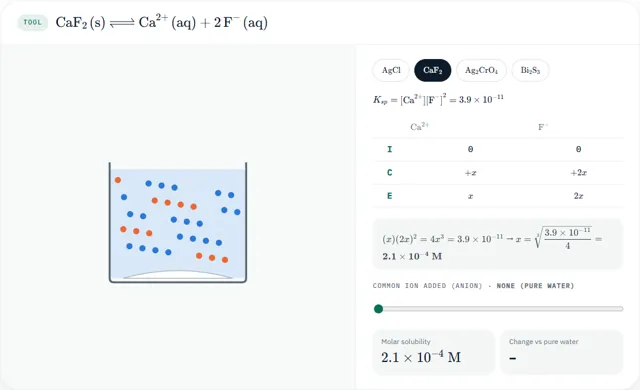
- ICE: , .
- (watch the exponent: it's cubed).
Study notes
Key concepts
When pH matters (SPQ-5.C.1). The solubility of a salt depends on pH when one of its ions is a weak base or a weak acid. On the AP exam you only need to explain this qualitatively, using Le Châtelier's principle. Calculations of solubility as a function of pH are NOT assessed.
Salts with a basic anion dissolve better in acid. Consider CaF₂(s) ⇌ Ca²⁺(aq) + 2 F⁻(aq). F⁻ is the conjugate base of the weak acid HF. Added H⁺ reacts with F⁻: H⁺ + F⁻ → HF. This removes F⁻, so Q < Ksp and more CaF₂ dissolves. The same reasoning applies to:
| Anion in the salt | Reaction with added acid | Example salts that dissolve better in acid |
|---|---|---|
| OH⁻ | H⁺ + OH⁻ → H₂O | Mg(OH)₂, Fe(OH)₃, Zn(OH)₂ |
| CO₃²⁻ | 2 H⁺ + CO₃²⁻ → H₂O + CO₂(g) | CaCO₃, BaCO₃ |
| F⁻ | H⁺ + F⁻ → HF | CaF₂, BaF₂ |
| PO₄³⁻ | H⁺ + PO₄³⁻ → HPO₄²⁻ | Ca₃(PO₄)₂, tooth enamel |
| S²⁻ | H⁺ + S²⁻ → HS⁻ | ZnS, FeS |
| CH₃COO⁻ | H⁺ + CH₃COO⁻ → CH₃COOH | silver acetate |
Salts whose anion comes from a strong acid are not affected. Cl⁻, Br⁻, I⁻ and NO₃⁻ are such weak bases that they do not react with H⁺. So the solubility of AgCl, AgBr, AgI and PbI₂ is essentially independent of pH.
Hydroxides at high pH. Adding OH⁻ (raising pH) is a common-ion effect for metal hydroxides: Mg(OH)₂ is less soluble in basic solution and more soluble in acidic solution.
Real-world examples
- Limestone and marble (CaCO₃) are eroded by acid rain.
- Ocean acidification (more dissolved CO₂, lower pH) makes it harder for shellfish to keep CaCO₃ shells.
- Tooth enamel, hydroxyapatite Ca₅(PO₄)₃OH, dissolves faster in acid produced by mouth bacteria. Fluoride replaces OH⁻ to form fluorapatite, which is less soluble.
- Old-style qualitative analysis used pH to separate sulfides: some metal sulfides precipitate only in basic solution.
Worked examples
Example 7.13. Saturated solutions of AgCl and of Ag₂CO₃, each with excess solid, are prepared. A few drops of concentrated HNO₃ are added to each. Predict and explain any change in the amount of solid.
Solution. AgCl: no noticeable change. Cl⁻ is the conjugate base of a strong acid, so it does not react with H⁺, and the AgCl equilibrium is not disturbed. Ag₂CO₃: the amount of solid decreases and bubbles of CO₂ may form. H⁺ reacts with CO₃²⁻ (to HCO₃⁻, H₂CO₃ and then CO₂ + H₂O). Removing CO₃²⁻ makes Q < Ksp, so the equilibrium Ag₂CO₃(s) ⇌ 2 Ag⁺ + CO₃²⁻ shifts right and more solid dissolves.
Unit 7 study guide: exam-style free-response set, worksheet and answers.
Worked example
- is the conjugate base of the weak acid , so removes .
- Lower makes , so more dissolves.
- is the conjugate base of a strong acid and does not react with .
- Answer: is more soluble in acid; is not significantly affected.
Free-response practice
Write your answer first, then open the solution and mark yourself against it.
FRQ 7.13. Modelled on 2013 AP FRQ Q1(c). A student has a precipitate of CaF₂(s) at the bottom of a beaker.
(a) Describe one procedure that would redissolve the precipitate. Explain why it works, with an equation.
(b) The student also has a precipitate of CaSO₄. Would the same procedure work as well for CaSO₄? Explain. (HSO₄⁻ is a fairly strong acid; Ka₂ for H₂SO₄ is about 10⁻².)
(c) Explain why toothpaste containing fluoride helps protect tooth enamel, Ca₅(PO₄)₃OH, against acids made by mouth bacteria.
Show the solution
(a) Add a strong acid such as HNO₃(aq) (or HCl) and stir. H⁺(aq) + F⁻(aq) → HF(aq). This removes F⁻ from CaF₂(s) ⇌ Ca²⁺ + 2 F⁻, making Q < Ksp, so the equilibrium shifts right and the solid dissolves. (Adding a lot of water would also work, but would need a very large volume.)
(b) Much less well. SO₄²⁻ is only a very weak base (HSO₄⁻ is a fairly strong acid), so H⁺ removes very little SO₄²⁻. The CaSO₄ equilibrium is hardly disturbed.
(c) In enamel, OH⁻ is a basic ion. Acid removes OH⁻ and dissolves the enamel. Fluoride replaces some OH⁻, forming fluorapatite, Ca₅(PO₄)₃F. F⁻ is a much weaker base than OH⁻ and fluorapatite is less soluble, so the enamel is less affected by acid.
Common mistake
Students assume all salts dissolve better in acid. Only salts with basic anions are affected; is the conjugate base of a strong acid, so is no more soluble in acid.
Frequently asked questions
?Why is Mg(OH)2 more soluble in acid?
Acid neutralizes the ions, removing them from solution, so the dissolution equilibrium shifts to dissolve more .
?Does adding base make a hydroxide less soluble?
Yes. Extra is a common ion, which shifts the equilibrium toward the solid.
Practice questions on 7.13
- Q1In which solution is most soluble?
- Q2Which compound is NOT appreciably soluble in water but IS soluble in dilute nitric acid?
- Q3A few drops of HNO₃(aq) are added to a saturated solution of CaF₂ with excess solid present. What happens?
- Q4The solubility of which salt is LEAST affected by lowering the pH?
- Q5A saturated solution of Mg(OH)₂ with excess solid is stirred. Which addition will DECREASE the amount of Mg(OH)₂ that is dissolved?
- Q6The solubility of which salt increases most when the pH is lowered from 7 to 3?
- Q7When dilute HCl is added to a saturated solution of CaF₂ in contact with solid CaF₂, which statement is correct?
- Q8Which change decreases the solubility of Fe(OH)₃(s) in water?
- Q9Tooth enamel contains Ca₅(PO₄)₃OH. Why does a diet high in acidic drinks damage enamel?
- Q10Which change increases the solubility of Zn(OH)₂(s) in water?
Terms used in this topic
Stuck on a unit? Let us fix it this week.
Book a 30-minute one-to-one session for $20. Bring a test, a homework set or the topic that is not clicking.
Book a session