 AP Chemistry Tutoring
7.14 Free energy of dissolution
AP Chemistry Unit 7: Equilibrium · 1 simulation · 4 practice questions
Updated · Aligned to the AP Chemistry Course and Exam Description
Whether a salt dissolves depends on the free energy change of dissolution, . reflects the balance between breaking ion-ion and solvent-solvent interactions and forming ion-solvent interactions, and reflects the dispersal of ions and the ordering of water around them. A negative corresponds to , a soluble salt.
Solubility equilibria
: the solid isn't in the expression.
gives . The molar solubility is how many moles dissolve per liter.
You can compare values directly only for salts with the same ion ratio (, , are all 1 : 1). Otherwise, solve for .
Common ions and pH.
Common-ion effect: dissolves less in solution than in pure water (Le Chatelier).
pH: salts with a basic anion (, , , …) dissolve more in acid, because removes the anion. dissolves more in acid, less in base.
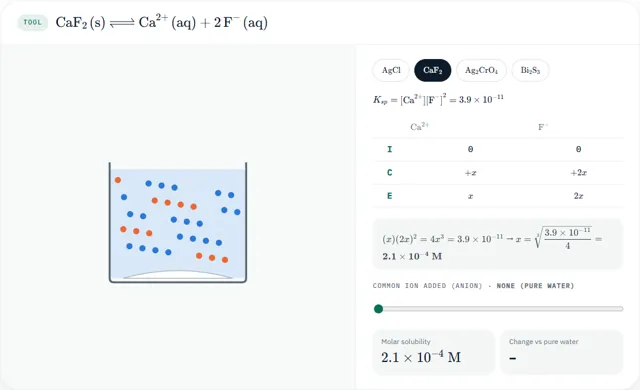
- ICE: , .
- (watch the exponent: it's cubed).
Study notes
Key concepts
ΔG° for dissolving has three parts (SPQ-5.D.1). Think of dissolving an ionic solid as three steps.
| Step | What happens | Sign of ΔH | Sign of ΔS |
|---|---|---|---|
| 1. Separate the solute particles | Break the ionic lattice (or intermolecular forces) holding the solid together | + (endothermic, needs energy) | + (ions spread out; more disorder) |
| 2. Reorganise the solvent | Some water–water hydrogen bonds break to make room; water molecules then become ordered around each ion | + for breaking H-bonds | − (water becomes more ordered, especially around small, highly charged ions) |
| 3. Solute–solvent attractions form | Ion–dipole attractions between ions and water molecules | − (exothermic, releases energy) | (included in step 2's ordering) |
Overall: ΔH°soln = sum of the three enthalpy terms. ΔS°soln = sum of the entropy terms. ΔG°soln = ΔH°soln − TΔS°soln. You can usually estimate the sign of each part, but predicting the sign of the total ΔG° is hard because large terms partly cancel. This is why the CED says you should be able to reason about the contributions, but not necessarily predict the overall outcome.
Patterns to know
- A salt can dissolve even if dissolving is endothermic (the solution gets cold), as long as the entropy increase is large enough: ΔH > 0, ΔS > 0, ΔG < 0. Examples: NH₄NO₃ and NH₄Cl in cold packs.
- A salt with small, highly charged ions (for example Ca²⁺, Mg²⁺, Al³⁺) can have a NEGATIVE ΔS°soln, because water molecules are held tightly and orderly around the ions. Its dissolving is often strongly exothermic (CaCl₂ in hot packs; ΔH < 0).
- Very strong lattices (high charges, small ions, for example MgO, CaF₂, Al₂O₃) usually give a large positive step-1 ΔH that is not repaid, so these salts are only slightly soluble.
Link to Ksp (preview of Unit 9). ΔG° = −RT ln K. For dissolution, K is Ksp. If ΔG°soln < 0, Ksp > 1 (soluble). If ΔG°soln > 0, Ksp < 1 (slightly soluble).
Link to Le Châtelier (7.9). If dissolving is endothermic, raising the temperature increases K and the solubility; if dissolving is exothermic, solubility decreases as temperature rises.
Key equations
Worked examples
Example 7.14a. For NH₄NO₃(s) → NH₄⁺(aq) + NO₃⁻(aq), ΔH°soln = +25.7 kJ/mol and ΔS°soln = +108.7 J/(mol·K). (a) Calculate ΔG°soln at 298 K. (b) Is dissolving favourable? What drives it?
Solution.
(b) Yes, ΔG° < 0. Dissolving is endothermic, so it is driven by the increase in entropy as the ordered lattice breaks up into dispersed ions. The solution feels cold because energy is absorbed from the surroundings.
Example 7.14b. Ksp for AgCl at 298 K is 1.8 × 10⁻¹⁰. Calculate ΔG° for AgCl(s) ⇌ Ag⁺(aq) + Cl⁻(aq).
ΔG° is positive, consistent with Ksp << 1 (AgCl is only slightly soluble).
Unit 7 study guide: exam-style free-response set, worksheet and answers.
Worked example
- Convert units: .
- .
- : favorable, driven by the entropy increase.
- Answer: Yes; , entropy driven.
Free-response practice
Write your answer first, then open the solution and mark yourself against it.
FRQ 7.14. When solid CaCl₂ dissolves in water, the solution becomes hot. For CaCl₂(s) → Ca²⁺(aq) + 2 Cl⁻(aq), ΔH°soln = −82.8 kJ/mol and ΔS°soln = −44.7 J/(mol·K).
(a) Calculate ΔG°soln at 298 K.
(b) Explain, in terms of the interactions between particles, why ΔH°soln is negative even though energy is needed to break apart the crystal lattice.
(c) Explain why ΔS°soln is negative, even though the ions become dispersed.
(d) A student says, "Because ΔG°soln is so negative, CaCl₂ must dissolve very quickly." Do you agree? Explain.
Show the solution
(a)
(b) Breaking the lattice is endothermic, but the ion–dipole attractions between the ions (especially the small, 2+ charged Ca²⁺) and water molecules release more energy than is needed to separate the ions and to break some water–water hydrogen bonds. So the overall enthalpy change is negative.
(c) Water molecules are strongly attracted to Ca²⁺ and become held in ordered hydration shells. This decrease in the entropy of the water is larger than the entropy gained when the ions leave the lattice.
(d) Disagree. ΔG° tells us that dissolving is thermodynamically favourable and how far it goes at equilibrium (a large K), but it says nothing about how fast it happens. The rate of dissolving depends on factors such as surface area, stirring and temperature (kinetics, not thermodynamics).
Common mistake
Students think an endothermic dissolving process cannot be favorable. If is large and positive, the term can outweigh a positive , as for ammonium nitrate in a cold pack.
Frequently asked questions
?Why does ammonium nitrate dissolve if it absorbs heat?
Dissolving greatly increases entropy as ions disperse, and at room temperature is larger than , so is negative.
?Can dissolving decrease entropy?
Yes. Small, highly charged ions order water molecules around them strongly, which can make negative.
Practice questions on 7.14
- Q1When solid KNO₃ is added to water at 25 °C, it dissolves and the temperature of the solution falls. Which gives the signs of ΔH and ΔS for the dissolving process?
- Q2Which step in the dissolving of NaCl in water is exothermic?
- Q3The entropy change for dissolving MgSO₄ in water is negative. Which is the best explanation?
- Q4A salt has ΔG°soln = +30 kJ/mol at 298 K. Which statement is correct?
Terms used in this topic
Stuck on a unit? Let us fix it this week.
Book a 30-minute one-to-one session for $20. Bring a test, a homework set or the topic that is not clicking.
Book a session