 AP Chemistry Tutoring
8.1 Introduction to acids and bases
AP Chemistry Unit 8: Acids and Bases · 2 simulations · 11 practice questions
Updated · Aligned to the AP Chemistry Course and Exam Description
The acidity of an aqueous solution is measured by , and water's autoionization, , links and through at 25 C. So at 25 C, and a solution is neutral when .
pH, strong and weak
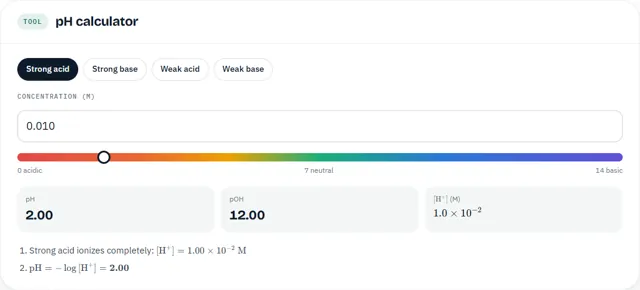
Water always holds a little and : at 25 °C. Take of both sides and you get the rule you'll use constantly:
On the AP exam you may write in place of .
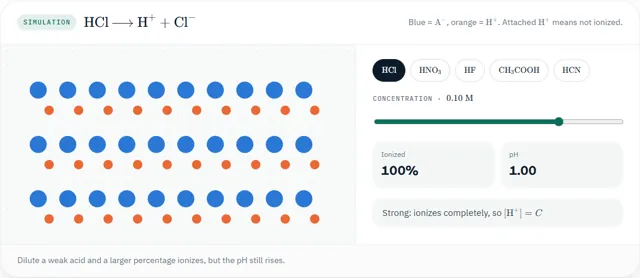
Ionize completely. Mnemonic: "SoCal HELL NO".
Dissociate completely into .
, , , , any … Small .
Take from water. Small .
pH calculator
Study notes
Key concepts
Brønsted–Lowry acids and bases. A Brønsted–Lowry acid is a proton (H⁺) donor. A Brønsted–Lowry base is a proton acceptor. Every acid–base reaction is a proton transfer. The older Arrhenius definition (acids produce H⁺ in water, bases produce OH⁻ in water) is a special case; the AP course uses the Brønsted–Lowry picture.
Conjugate acid–base pairs. When an acid loses H⁺, what is left is its conjugate base. When a base gains H⁺, it becomes its conjugate acid. The two members of a pair differ by exactly one H⁺.
| Reaction | Acid | Its conjugate base | Base | Its conjugate acid |
|---|---|---|---|---|
| HF + H₂O ⇌ F⁻ + H₃O⁺ | HF | F⁻ | H₂O | H₃O⁺ |
| NH₃ + H₂O ⇌ NH₄⁺ + OH⁻ | H₂O | OH⁻ | NH₃ | NH₄⁺ |
| CH₃COOH + NH₃ ⇌ CH₃COO⁻ + NH₄⁺ | CH₃COOH | CH₃COO⁻ | NH₃ | NH₄⁺ |
Amphiprotic species. Some species can either donate or accept a proton. Water is the most important example: it acts as a base towards HF and as an acid towards NH₃. HCO₃⁻, HSO₄⁻, H₂PO₄⁻ and HPO₄²⁻ are also amphiprotic.
Hydronium ion. A bare proton never exists on its own in water; it is bonded to a water molecule as H₃O⁺. The CED says "hydrogen ion" and "hydronium ion", H⁺(aq) and H₃O⁺(aq), may be used interchangeably. H₃O⁺ is preferred, but H⁺ is accepted on the exam.
Autoionization of water (SAP-9.A.2). Even pure water contains a tiny amount of ions, because water molecules transfer protons to each other:
2 H₂O(l) ⇌ H₃O⁺(aq) + OH⁻(aq)
The equilibrium constant is called Kw. At 25 °C, Kw = 1.0 × 10⁻¹⁴. Water is a pure liquid, so it does not appear in the expression. This relationship holds in every aqueous solution, not just in pure water: if [H₃O⁺] goes up, [OH⁻] must go down so that the product stays at Kw.
pH and pOH (SAP-9.A.1). Concentrations of H₃O⁺ and OH⁻ are usually very small, so we report them on a logarithmic scale. pH = −log[H₃O⁺] and pOH = −log[OH⁻]. The minus sign means that a higher [H₃O⁺] gives a lower pH. Because the scale is logarithmic, one pH unit is a factor of 10 in [H₃O⁺]: a solution of pH 3 has 100 times the [H₃O⁺] of a solution of pH 5.
Neutral, acidic and basic (SAP-9.A.3). A solution is neutral when [H₃O⁺] = [OH⁻], that is, when pH = pOH. At 25 °C, pKw = 14.00, so pH + pOH = 14.00, and a neutral solution has pH = pOH = 7.00. Acidic solutions have [H₃O⁺] > [OH⁻] (pH < 7 at 25 °C); basic solutions have [OH⁻] > [H₃O⁺] (pH > 7 at 25 °C).
Kw depends on temperature (SAP-9.A.4). The autoionization of water is endothermic (bonds must be broken to separate the ions). By Le Châtelier's principle, raising the temperature shifts the equilibrium to the right, so Kw increases. At 50 °C, Kw ≈ 5.5 × 10⁻¹⁴ and the pH of pure water is about 6.63. That water is still neutral, because [H₃O⁺] still equals [OH⁻]. A very common exam trap: "pH 7 means neutral" is only true at 25 °C.
| Temperature | Kw | pH of pure (neutral) water |
|---|---|---|
| 0 °C | 1.1 × 10⁻¹⁵ | 7.48 |
| 25 °C | 1.0 × 10⁻¹⁴ | 7.00 |
| 37 °C | 2.4 × 10⁻¹⁴ | 6.81 |
| 50 °C | 5.5 × 10⁻¹⁴ | 6.63 |
Significant figures in logarithms. In a pH value, only the digits after the decimal point are significant. [H₃O⁺] = 3.2 × 10⁻⁴ M (two significant figures) gives pH = 3.49 (two decimal places). The "3" before the decimal point only tells you the power of ten.
Common misconceptions.
- "A solution with pH 7 is always neutral." Only at 25 °C.
- "Basic solutions contain no H₃O⁺." Every aqueous solution contains both H₃O⁺ and OH⁻; their product is always Kw.
- "pH 2 is twice as acidic as pH 4." It is 10² = 100 times more concentrated in H₃O⁺.
Key equations
Worked examples
Worked example 8.1-A. A sample of rainwater has [H₃O⁺] = 3.2 × 10⁻⁴ M at 25 °C. Find pH, pOH and [OH⁻].
pH = −log(3.2 × 10⁻⁴) = 3.49
pOH = 14.00 − 3.49 = 10.51
[OH⁻] = Kw / [H₃O⁺] = (1.0 × 10⁻¹⁴)/(3.2 × 10⁻⁴) = 3.1 × 10⁻¹¹ M
The solution is acidic because [H₃O⁺] > [OH⁻].
Worked example 8.1-B. At 50 °C, Kw = 5.5 × 10⁻¹⁴. Calculate the pH of pure water at 50 °C and state whether it is acidic, basic or neutral.
In pure water [H₃O⁺] = [OH⁻] = x, so x² = 5.5 × 10⁻¹⁴ and x = 2.3 × 10⁻⁷ M.
pH = −log(2.35 × 10⁻⁷) = 6.63. The water is neutral, because [H₃O⁺] = [OH⁻]. The neutral point has simply moved to 6.63 at this temperature.
Worked example 8.1-C. A solution has pOH = 3.60 at 25 °C. Find [OH⁻], [H₃O⁺] and pH.
[OH⁻] = 10⁻³·⁶⁰ = 2.5 × 10⁻⁴ M; pH = 14.00 − 3.60 = 10.40; [H₃O⁺] = 10⁻¹⁰·⁴⁰ = 4.0 × 10⁻¹¹ M. The solution is basic.
Unit 8 study guide: exam-style free-response set, worksheet and answers.
Worked example
- .
- .
- .
- Answer: pH 3.60; ; pOH 10.40
Free-response practice
Write your answer first, then open the solution and mark yourself against it.
FRQ 8.1-1. Human blood is held near 37 °C, where Kw = 2.4 × 10⁻¹⁴.
(a) Calculate the pH of pure water at 37 °C.
(b) A student says "blood with pH 7.40 is basic at 37 °C." Do you agree? Justify your answer.
(c) Explain, in terms of bond breaking, why Kw is larger at 37 °C than at 25 °C.
Show the solution
(a) [H₃O⁺] = √(2.4 × 10⁻¹⁴) = 1.55 × 10⁻⁷ M, so pH = 6.81. (1 point)
(b) Agree. Neutral water at 37 °C has pH 6.81. At pH 7.40, [H₃O⁺] = 4.0 × 10⁻⁸ M, which is less than [OH⁻] = (2.4 × 10⁻¹⁴)/(4.0 × 10⁻⁸) = 6.0 × 10⁻⁷ M, so the blood is basic. (1 point)
(c) Autoionization requires breaking an O–H bond in a water molecule, so it is endothermic. Increasing temperature shifts an endothermic equilibrium toward products, so [H₃O⁺] and [OH⁻] and therefore Kw increase. (1 point)
FRQ 8.1-2. Consider the reaction HSO₄⁻(aq) + CO₃²⁻(aq) ⇌ SO₄²⁻(aq) + HCO₃⁻(aq).
(a) Identify both Brønsted–Lowry conjugate acid–base pairs, labelling the acid and the base in each pair.
(b) HSO₄⁻ and HCO₃⁻ are both amphiprotic. Write an equation showing HCO₃⁻ acting as a Brønsted–Lowry base in water.
Show the solution
(a) Pair 1: HSO₄⁻ (acid) and SO₄²⁻ (its conjugate base). Pair 2: HCO₃⁻ (acid) and CO₃²⁻ (its conjugate base). (1 point for each pair, correctly labelled)
(b) HCO₃⁻(aq) + H₂O(l) ⇌ H₂CO₃(aq) + OH⁻(aq). HCO₃⁻ accepts a proton from water. (1 point)
Common mistake
Students think neutral always means pH 7. Neutral means ; because increases with temperature, neutral water has a pH below 7 at higher temperatures.
Frequently asked questions
?Is pH 7 always neutral?
Only at 25 C. Neutral means equal and , and changes with temperature.
?How many decimal places should a pH have?
The number of decimal places in the pH equals the number of significant figures in the concentration, e.g. gives pH 3.60.
Practice questions on 8.1
- Q1A weak acid has at 25 °C. What is for its conjugate base?
- Q2At 60 °C the value of Kw is 9.6 × 10⁻¹⁴. What is the pOH of pure water at 60 °C?
- Q3Kw for water increases from 1.0 × 10⁻¹⁴ at 25 °C to 5.5 × 10⁻¹⁴ at 50 °C. What happens to the pH and the pOH of pure water when it is heated from 25 °C to 50 °C?
- Q4At 25 °C, which of the following solutions is the most basic?
- Q5At 25 °C, an aqueous solution has a pH of 9. What is [OH⁻]?
- Q6In the reaction HCO₃⁻(aq) + H₂O(l) ⇌ H₂CO₃(aq) + OH⁻(aq), which species is acting as a Brønsted–Lowry acid?
- Q7Solution X has pH 2.0 and solution Y has pH 5.0, both at 25 °C. Which statement is correct?
- Q8In liquid ammonia the reaction NH₄⁺ + NH₂⁻ → 2 NH₃ occurs. In this reaction NH₄⁺ acts as
- Q9At 10 °C, . What is the pH of pure water at this temperature?
- Q10At 60 °C, . How does pure water at 60 °C compare with pure water at 25 °C?
- Q11Which solution is the most basic?
Terms used in this topic
Stuck on a unit? Let us fix it this week.
Book a 30-minute one-to-one session for $20. Bring a test, a homework set or the topic that is not clicking.
Book a session