 AP Chemistry Tutoring
7.3 Reaction quotient and equilibrium constant
AP Chemistry Unit 7: Equilibrium · 2 simulations · 7 practice questions
Updated · Aligned to the AP Chemistry Course and Exam Description
For , the reaction quotient is at any moment, and the equilibrium constant is the value of at equilibrium. Pure solids and liquids are left out. Comparing them predicts direction: if the reaction proceeds forward, if it proceeds in reverse, and if it is at equilibrium.
Dynamic equilibrium
Forward rate = reverse rate.
Picture LA and San Francisco. Every year 100,000 people move LA → SF and 100,000 move SF → LA. Both populations stay fixed (6 million and 4 million) even though people keep moving.
At equilibrium the amounts are constant, but not necessarily equal.
| Concentration vs time | curves level off (not at the same height) |
| Rate vs time | forward falls, reverse rises, they meet |
\(\ce{A <=> B}\), molecule by molecule

The equilibrium constant
Products over reactants, raised to coefficients.
Leave out pure solids and liquids: their concentrations don't change, so they are left out of the expression. has no units, and it changes only with temperature.
e.g. at equilibrium.
e.g. . is never negative.
Same expression with partial pressures.
= moles of gas, products − reactants.
Change the equation, watch K
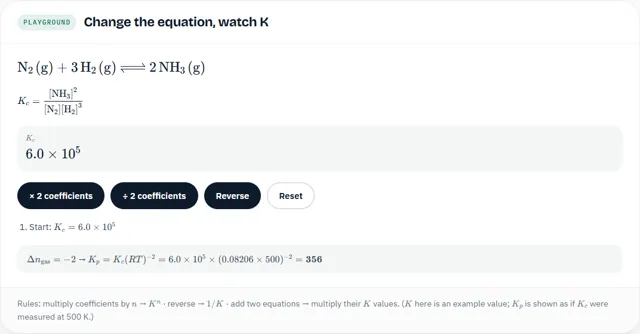
? has . What is for ?Think, then tap to check
Doubled: . Reversed: .
Study notes
Key concepts
The law of mass action. For a general reaction aA + bB ⇌ cC + dD, the equilibrium-constant expression has products on top and reactants on the bottom. Each concentration is raised to the power of its coefficient in the balanced equation (TRA-7.A.1).
Kc and Kp. Kc uses molar concentrations. For gases you may instead use partial pressures in atm and write Kp. Read every question carefully to see which one it asks for. (Converting between Kc and Kp is NOT assessed on the AP exam. For interest only: the slides show Kp = Kc(RT)^Δn, where Δn = moles of gaseous products − moles of gaseous reactants.)
The reaction quotient Q. Q has exactly the same form as K, but you put in the concentrations or pressures at any moment, not only at equilibrium. As a reaction proceeds, Q changes and moves toward K. At equilibrium Qc = Kc and Qp = Kp.
Leave out pure solids and pure liquids (TRA-7.A.2). Their "concentration" is fixed by their density and molar mass, so it does not change with the amount present. They do not appear in Q or K. Water that is the solvent is also left out. Gases and aqueous species are always included.
Homogeneous vs heterogeneous equilibria (from the slides). In a homogeneous equilibrium, all species are in the same phase (for example all gases). In a heterogeneous equilibrium, species are in two or more phases (for example CaCO₃(s) ⇌ CaO(s) + CO₂(g)). For the CaCO₃ system, Kp = P(CO₂): as long as some CaCO₃ and some CaO are present, the pressure of CO₂ at a given temperature is fixed, no matter how much solid there is.
K has no units on the AP exam. Write K as a pure number.
Not assessed: equilibria in which a dissolved species is in equilibrium with the same species in the gas phase.
Key equations
Worked examples
Example 7.3a. Write the requested expression for each reaction.
| Reaction | Expression |
|---|---|
| 2 SO₂(g) + O₂(g) ⇌ 2 SO₃(g) | Kc = [SO₃]² / ([SO₂]²[O₂]); Kp = (P_SO₃)² / ((P_SO₂)²(P_O₂)) |
| CaCO₃(s) ⇌ CaO(s) + CO₂(g) | Kp = P_CO₂ (both solids left out) |
| PbCl₂(s) ⇌ Pb²⁺(aq) + 2 Cl⁻(aq) | Kc = [Pb²⁺][Cl⁻]² (this is Ksp; see 7.11) |
| NH₃(aq) + H₂O(l) ⇌ NH₄⁺(aq) + OH⁻(aq) | Kc = [NH₄⁺][OH⁻] / [NH₃] (liquid water left out) |
| CH₄(g) + 2 H₂O(g) ⇌ CO₂(g) + 4 H₂(g) | Kp = (P_CO₂)(P_H₂)⁴ / ((P_CH₄)(P_H₂O)²) (water is a gas here, so it is included) |
Example 7.3b. For 2 NO₂(g) ⇌ N₂O₄(g), a mixture has [NO₂] = 0.20 M and [N₂O₄] = 0.10 M. Calculate Qc.
Solution.
Unit 7 study guide: exam-style free-response set, worksheet and answers.
Worked example
- .
- , so there are too few products.
- Answer: The reaction proceeds forward (toward ).
Free-response practice
Write your answer first, then open the solution and mark yourself against it.
FRQ 7.3. Answer the following.
(a) Write the Kp expression for 2 H₂S(g) + 3 O₂(g) ⇌ 2 SO₂(g) + 2 H₂O(g).
(b) Write the Kc expression for Ag₂CO₃(s) ⇌ 2 Ag⁺(aq) + CO₃²⁻(aq).
(c) For NH₄HS(s) ⇌ NH₃(g) + H₂S(g), a student writes Kp = (P_NH₃)(P_H₂S) / P_NH₄HS. Identify the error and explain why it is an error.
(d) For H₂(g) + CO₂(g) ⇌ H₂O(g) + CO(g), the partial pressures at one moment are P_H₂ = 0.50 atm, P_CO₂ = 0.40 atm, P_H₂O = 0.10 atm and PCO = 0.20 atm. Calculate Qp.
Show the solution
(a) Kp = (P_SO₂)²(P_H₂O)² / ((P_H₂S)²(P_O₂)³).
(b) Kc = [Ag⁺]²[CO₃²⁻].
(c) The solid NH₄HS should not appear. The amount of a pure solid does not change its concentration (it depends only on density and molar mass), so it is not included. The correct expression is Kp = (P_NH₃)(P_H₂S).
(d) Qp = (0.10)(0.20) / ((0.50)(0.40)) = 0.020 / 0.20 = 0.10.
Common mistake
Students include solids or liquid water in expressions. Their concentrations are effectively constant, so they do not appear in or .
Frequently asked questions
?What is the difference between Q and K?
uses the concentrations at any moment; is the special value of when the system is at equilibrium.
?If Q is greater than K, which way does the reaction go?
In reverse, toward reactants, until decreases to equal .
Practice questions on 7.3
- Q1If is less than for a reaction mixture, what happens?
- Q2For , at a certain temperature. A mixture contains , and . Which way does the reaction proceed?
- Q3 has . Which starting concentrations (, , ) make the reaction form more XY?
- Q4What is the Kc expression for 4 NH₃(g) + 5 O₂(g) ⇌ 4 NO(g) + 6 H₂O(g)?
- Q5What is the Kp expression for C(s) + CO₂(g) ⇌ 2 CO(g)?
- Q6For Fe₃O₄(s) + 4 H₂(g) ⇌ 3 Fe(s) + 4 H₂O(g), which is the correct Kc expression?
- Q7For 2 NO₂(g) ⇌ N₂O₄(g), what is Qc when [NO₂] = 0.40 M and [N₂O₄] = 0.20 M?
Stuck on a unit? Let us fix it this week.
Book a 30-minute one-to-one session for $20. Bring a test, a homework set or the topic that is not clicking.
Book a session